

Out of Round Bore Repair: Restoring Precision to Heavy Equipment

Updated: 5 days ago
You can't simply "hone" an egg-shaped bore back to life. Once a pivot point or pin hole on your heavy equipment has worn into an oval, it's lost its mechanical integrity and will continue to fail under load. You've likely dealt with the frustration of temporary fixes like shims or oversized pins that only result in more downtime and eventual component failure. Replacing the entire housing or frame is a massive expense that most budgets can't justify, especially when the rest of the machine is still productive.
We understand that precision is non-negotiable in the field. This article will teach you how to execute a professional out of round bore repair that restores your machinery to factory tolerances. You'll learn how to accurately measure the wear, build the material back up using automated welding, and machine it to a perfect finish. We'll cover the tools and techniques needed to bring these repairs in-house, saving you thousands in service fees and weeks of waiting on outside contractors. By the end, you'll have a clear roadmap for extending the service life of your fleet through permanent, metallurgical restoration.
Table of Contents
What is an Out of Round Bore and Why Does it Happen?
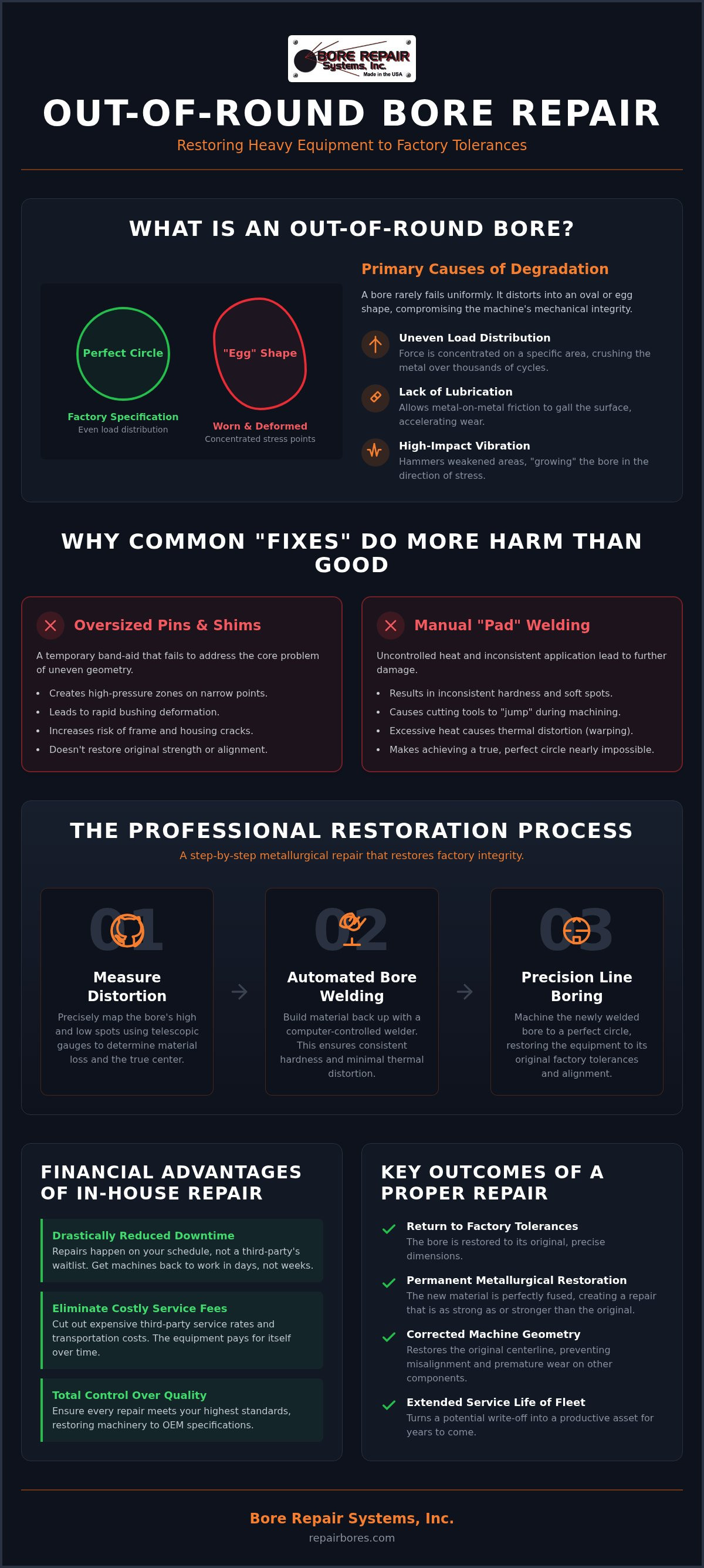
In the heavy equipment world, a bore isn't just a hole; it's a precision interface. When that interface fails, it usually doesn't do so uniformly. An out-of-round (OOR) bore occurs when a perfectly circular cavity distorts into an oval or egg shape. While automotive experts often focus on microscopic taper in engine blocks, heavy equipment operators deal with visible, structural deformation in loader arms, buckets, and articulation joints. This distortion isn't a minor flaw; it's a sign that the mechanical integrity of the machine is compromised.
Several factors drive this degradation. Uneven load distribution is the primary culprit. When an excavator bucket hits a rock or a loader lifts a heavy pile, the force isn't spread evenly across the pin. Instead, it's concentrated on a specific area, crushing the metal over thousands of cycles. Lack of lubrication accelerates the process by allowing metal-on-metal friction to gall the surface. High-impact vibration then hammers these weakened areas, effectively "growing" the bore in the direction of the most frequent stress. If you ignore these signs, you'll face accelerated pin wear and eventual structural fatigue that can lead to catastrophic component failure.
Identifying "Egg-Shaped" Wear Patterns
You don't always need a micrometer to spot a problem. In the field, look for "bleeding" or rust coming from a joint, which indicates movement where there should be none. Shiny, polished spots on one side of a bore contrasted with dark, corroded areas on the opposite side are classic signs of directional wear. Because loader arms and pivot pins typically move in a specific arc, the wear follows that path. Out-of-round wear is the result of concentrated stress on a single axis. This directional force creates the "egg" shape that makes standard bushings impossible to seat correctly.
Measuring Bore Distortion with Precision
To plan an effective out of round bore repair, you need hard data. Start by cleaning the bore to remove grease and work-hardened debris. Use telescopic gauges and outside micrometers to map the cavity. You must take measurements at multiple angles, specifically looking for the "high" and "low" spots of the oval. Calculate the difference between the minimum and maximum diameter; this delta tells you how much material you've lost. Precision Boring (manufacturing) techniques are then used to determine the new center point. When the measurements show the bore is "beyond spec"—usually meaning it's too large for the next oversized bushing—it's time for a full weld-and-machine rebuild. Understanding these dimensions ensures your out of round bore repair restores the machine to its original factory tolerances rather than just providing a temporary fix.
The Physics of Bore Wear: Why Simple Oversizing Fails
Installing oversized pins or bushings is a common field tactic, but it's fundamentally a band-aid. While it might stop the rattling for a week, it doesn't solve the underlying mechanical failure. When you have an egg-shaped bore, the contact surface between the pin and the housing is uneven. This creates high-pressure zones that exceed the material's yield strength. Instead of the load being distributed across 180 degrees of the bushing, it's concentrated on the "narrow" points of the oval. This leads to rapid bushing deformation and can eventually cause the frame itself to crack under the stress of heavy operation.
Manual "pad welding" is another traditional approach that often does more harm than good. A welder laying beads by hand cannot maintain a consistent travel speed or arc gap inside a dark cavity. This results in inconsistent hardness across the repair area. When you later attempt to machine the bore, the cutting tool will "jump" or deflect when it hits these hard spots, making it nearly impossible to achieve a true circle. Additionally, the excessive, localized heat from manual welding can cause thermal distortion, pulling the entire component out of alignment.
Centerline Deviation and Machine Geometry
Precision machinery relies on exact geometry between pivot points. If an out of round bore repair is performed by simply boring out the hole to a larger size without adding material, the centerline of that hole shifts. This deviation throws off the timing and travel of complex linkages, such as those found in excavator buckets or loader arms. Misalignment by even a few millimeters can significantly reduce hydraulic cylinder life by forcing the rod to work against side-loads it wasn't designed to handle. Understanding misaligned bore repair techniques is essential for maintaining the structural integrity of your equipment. For a deeper look at the industrial standards for these fixes, see this guide on Heavy Equipment Line Boring and Bore Repair.
Metallurgical Considerations in Bore Repair
Restoring a bore is as much about metallurgy as it is about machining. Automated bore welding minimizes the Heat-Affected Zone (HAX) by applying a consistent, controlled bead. This process ensures the repair material bonds properly with the base metal without creating brittle zones. A uniform surface is critical for the subsequent machining phase, as it allows the line boring bar to move smoothly and maintain a perfect radius. If you're looking to upgrade your shop's capabilities, exploring automated bore welders can help you achieve these professional results in-house.
Comparing Repair Methods: Manual vs. Automated Systems
Choosing the right strategy for an out of round bore repair determines whether your machine stays in the dirt or ends up back in the shop in six months. Manual "pad welding" is often the first instinct for many shops, but it's rarely the most efficient. It's labor-intensive, often requiring a technician to spend hours in a cramped, smoky environment trying to maintain a steady arc inside a dark cavity. This leads to inconsistent weld penetration and slag inclusions. When the line boring bar hits these voids later, the tool chatters, leaving a finish that's rough and potentially out of spec.
Sleeving is a faster alternative, but it carries structural risks. To install a sleeve in a severely distorted bore, you have to machine away a significant amount of the parent metal to make the hole round again. This can dangerously thin the wall of a loader arm or pivot housing, leading to cracks under heavy stress. The "weld and re-bore" method is the industry gold standard because it adds material back to the component. It allows you to return the bore to its original factory diameter while maintaining the full structural thickness of the housing.
The Case for Automated Bore Welding
Automated systems eliminate the human error inherent in manual welding. By using a motorized torch that rotates at a precise, adjustable speed, these welders lay down a perfectly concentric bead with consistent overlap. This uniform layer of new metal is much easier to machine because the cutting tool encounters a consistent hardness throughout the rotation. If you're evaluating your shop's needs, reviewing professional bore welder systems will help you understand the different levels of automation available for various bore sizes.
When to Choose Line Boring Over Replacement
The cost of replacing a major component like an excavator boom or a loader frame can be staggering. Beyond the price of the part, you have to factor in the labor to strip the machine and the weeks of lost revenue during downtime. Performing an out of round bore repair in the field allows you to fix the problem without dismantling the entire machine. However, the quality of the repair depends entirely on the person behind the machine. Investing in line boring operator training ensures your team can hit professional tolerances every time, making the repair just as durable as a new part.
Step-by-Step Guide to Fixing an Out of Round Bore
Executing a professional out of round bore repair requires a disciplined sequence of operations. If you skip the preparation or rush the setup, you'll end up with a bore that's misaligned or a surface finish that destroys bushings. This process, often called the "Weld and Re-bore" cycle, is designed to restore the component to its original factory specifications by adding material and then machining it away with high precision.
The process begins with thorough cleaning. You must remove every trace of grease, paint, and rust using degreasers and wire wheels. After cleaning, use a grinder to remove any work-hardened "skin" from the old bore surface. Welding over work-hardened steel creates brittle spots that will ruin your cutting tools during the machining phase. Once the metal is prepped, set up your automated bore welder. Apply a continuous, overlapping bead across the entire internal surface. This adds the necessary "meat" back to the component, allowing you to machine it back to the original diameter without thinning the housing walls.
After welding, mount your line boring machine. Use the original centerline of the undamaged parts of the housing as your reference point. Secure the mounting brackets and ensure the boring bar is perfectly parallel to the machine's original axis. Execute your machining passes, starting with roughing cuts and ending with a precision finishing pass. Finally, perform a physical inspection with a micrometer before installing new pins or bushings.
Preparation and Alignment
Precision starts with the setup. If the mounting brackets are off by even a fraction of a degree, the new bore won't be perpendicular to the load path. Use centering cones or a dial indicator to verify the bar's position before you take the first cut. Removing hard spots during the prep phase prevents tool chatter, which is the primary cause of a poor surface finish. If you need to upgrade your shop's capabilities, you can find professional automated bore welding equipment to streamline this entire process.
Machining to Final Tolerance
Don't try to take all the material in one go. Start with roughing passes to remove the bulk of the weld and get the hole close to round. As you approach the final dimension, switch to finishing passes with a sharper tool bit and a slower feed rate. You should measure the bore while the bar is still in place using a bore gauge or micrometer. Achieving the correct surface finish is vital for press-fit bushings; a surface that's too smooth might not hold the bushing, while one that's too rough will lead to premature wear.
Precision Equipment and Training for In-House Repair
Bringing out of round bore repair in-house is a strategic move that transforms a recurring maintenance headache into a core shop competency. Third-party field service rates for heavy equipment repair averaged between $125 and $145 per hour in 2025, not including specialized supply fees or travel costs. For major overhauls, the bill can easily climb toward $30,000. When a machine sits idle, the downtime costs account for roughly 70% of the total breakdown expense. By investing in your own equipment, most operations find they break even on their in-house machining setup within 18 to 24 months, assuming consistent utilization.
A professional repair kit is a system, not just a single tool. You need a reliable automated bore welder to restore lost material and a rigid line boring machine to finish the cavity to spec. It's vital to choose a manufacturer that offers lifetime technical support and American-made precision. You don't want your fleet grounded because of a three-week lead time for a replacement part from an overseas supplier. Reliable equipment ensures that when a bore goes egg-shaped, your team is ready to respond immediately.
Building an In-House Repair Capability
Selecting the right machine starts with an audit of your fleet's pivot points. You need a bar diameter and stroke length that can handle your largest housings while remaining portable enough for field use. Beyond the base machine, you'll need essential line boring accessories such as centering cones, various tool holders, and specialized mounting brackets. This versatility allows you to tackle diverse repair geometries without waiting on outside contractors. The ROI is calculated not just in saved labor, but in the weeks of production time you regain by avoiding equipment rentals and project schedule penalties.
The Role of Professional Training
The equipment is only as effective as the technician behind the controls. Professional training moves your team beyond the "trial and error" phase, which is where the most expensive mistakes occur. A comprehensive line boring training program teaches operators how to hit factory tolerances on the first try. This education also covers critical safety protocols, including OSHA standard 1926.600(a), which requires heavy machinery to be substantially blocked or cribbed before employees work on it. Certified training ensures every out of round bore repair is performed with the precision and safety required to maximize the service life of your most expensive assets.
Take Control of Your Equipment Maintenance
An egg-shaped bore is a symptom of mechanical failure that won't go away with a bigger pin or a temporary shim. To protect your equipment's service life, you need a permanent solution that restores the original centerline and material integrity. Moving from manual "pad welding" to automated systems eliminates the voids and hard spots that make precision machining impossible. This transition doesn't just fix a single machine; it changes how your shop operates by turning a major expense into a core capability.
Investing in an in-house out of round bore repair capability is a proven way to slash downtime and reclaim the revenue lost to third-party service fees. Our systems are Made in the USA and built for the punishing conditions of field and shop use. We include expert training with every equipment purchase because we know that the right tools are only half of the equation. Our industry-leading durability ensures your investment pays off for years to come.
View our professional Bore Repair Systems and Training Programs to start restoring precision to your fleet today. You have the power to keep your machines in the dirt and out of the repair queue.
Frequently Asked Questions
Can an out-of-round bore be fixed without welding?
No, you can't permanently fix a severely distorted bore without welding. While you could technically bore the hole larger to make it round again, you'd be forced to use oversized pins or bushings. This thins the structural wall of the housing and often leads to further mechanical failure. A proper out of round bore repair requires adding material back through welding to restore the component to its original factory dimensions.
How much wear is considered "too much" for a simple bushing replacement?
If a bore is more than 0.010 to 0.020 inches out of round, a new bushing won't seat correctly. The egg-shaped cavity prevents the bushing from making full contact with the housing, which creates localized pressure points. These high-stress zones will crush the new bushing quickly, leading to premature failure. Once you can visually detect an oval shape or measure significant directional wear, a full weld-and-bore restoration is necessary.
Is automated bore welding better than manual welding for egg-shaped holes?
Automated bore welding is far superior because it provides a uniform bead and controlled heat input. Manual welding often results in inconsistent hardness, slag inclusions, and internal voids. These defects cause the cutting tool to "jump" or deflect during the machining phase, which makes it impossible to achieve a perfect finish. Automated systems ensure a consistent metallurgical bond that's much easier to machine back to precise factory tolerances.
What tools do I need to measure an out-of-round bore accurately?
You'll need a combination of telescopic gauges and outside micrometers to map the bore's dimensions. A dial bore gauge is also an essential tool for identifying the specific "high" and "low" spots of the egg-shaped wear pattern. By taking measurements at multiple angles across the axis of wear, you can calculate the exact amount of distortion and determine the new center point for the line boring bar.
How long does a typical line boring repair take in the field?
A standard out of round bore repair for a single pivot point usually takes between 8 and 12 hours. This timeframe includes the initial cleaning, setting up the mounting brackets, the automated welding cycle, and the final machining passes. While severely damaged bores might require additional time for buildup, using portable automated equipment is significantly faster than traditional manual methods and avoids the massive downtime of transporting components to a stationary shop.
Do I need a different machine for different bore sizes?
You don't necessarily need a different machine for every pin size. Most professional line boring systems are modular. By swapping out the boring bar and using various tool holders or accessories, a single high-quality machine can often handle a wide range of diameters. It's more about selecting a versatile system that fits the general scale of your fleet, whether you're working on compact loaders or large-scale mining excavators.
Can I perform bore repair on-site without removing the component?
In industries like mining and aggregate production, keeping your screening systems from compasswire.com in peak condition is just as vital as maintaining the pivot points on your heavy machinery to ensure overall operational efficiency.
Yes, the primary advantage of portable line boring and bore welding equipment is the ability to perform repairs on-site. You can fix loader arms, buckets, and articulation joints while they're still attached to the machine's frame. This eliminates the need for extensive teardown and heavy lifting equipment. By bringing the tools to the machine, you restore factory precision right in the field, which drastically reduces your total repair costs.
What is the most common mistake made during out-of-round bore repair?
The most frequent mistake is failing to remove work-hardened material or grease before welding. If you don't grind the "skin" of the old bore down to clean metal, the new weld won't bond correctly. This creates hard spots that destroy cutting bits and cause tool chatter. Another common error is rushing the alignment phase; if the boring bar isn't perfectly parallel to the original axis, the final repair will be misaligned.


Comments