

Agricultural Equipment Bore Repair: Minimizing Farm Downtime in 2026

Updated: 1 day ago
With dealer labor rates now climbing past $200 per hour in 2026, the cost of waiting for a mobile machinist to fix a wallowed-out pin hole is no longer just an inconvenience; it's a threat to your bottom line. When a tractor or harvester sits idle during a tight planting window, you aren't just losing time, you're losing the season's potential. Effective agricultural equipment bore repair shouldn't require hauling massive implements to a machine shop or paying exorbitant third-party fees. You need a way to restore mechanical integrity right where the machine sits.
You know that loose pivot points and egg-shaped bores lead to accelerated wear and eventual component failure. It's frustrating to be at the mercy of a contractor's schedule when your equipment needs to be in the dirt. We'll show you how to take control of your maintenance by using professional-grade automated systems to restore components to OEM specifications in the field. This guide covers the transition to in-house line boring and bore welding, the impact of 2026 EPA Right to Repair guidance, and how to maximize your equipment's service life while eliminating unnecessary downtime.
Table of Contents
The High Cost of Agricultural Bore Wear and Downtime
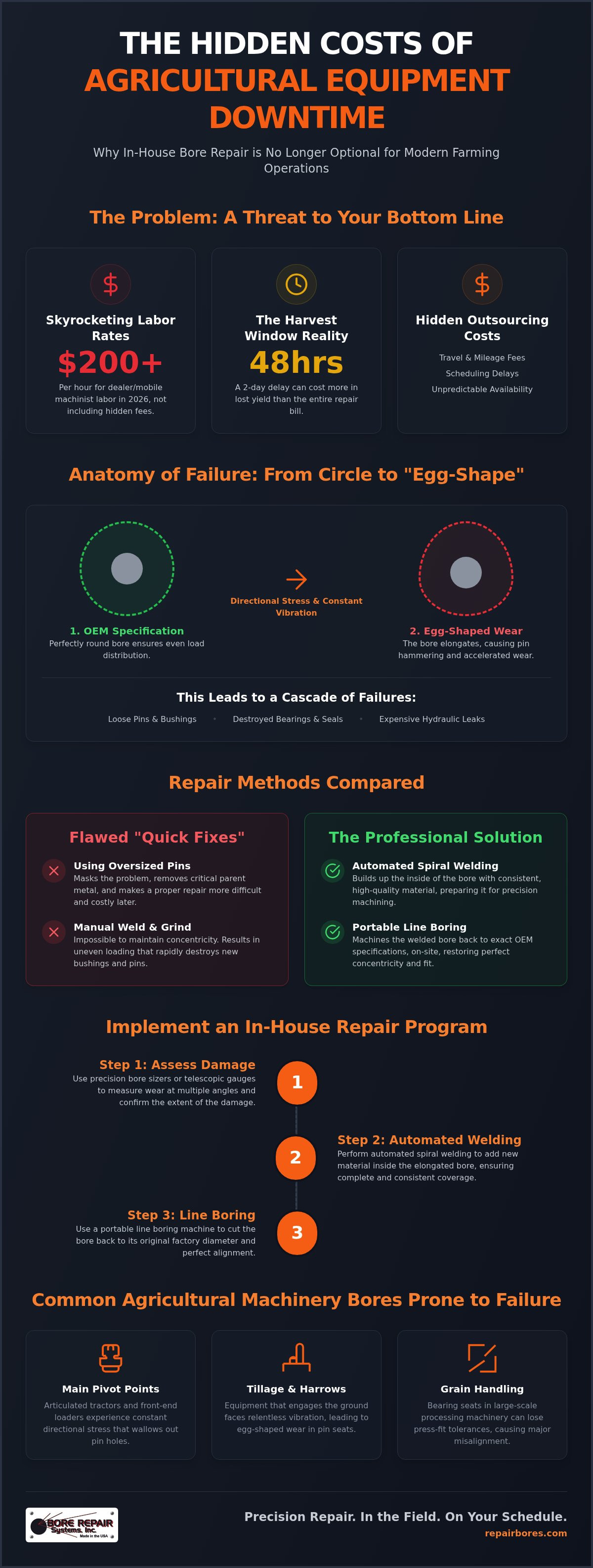
In 2026, farm operations face a tightening squeeze between rising machinery costs and shrinking windows for field work. When a pivot point fails on a primary tractor or harvester, the financial impact extends far beyond the repair bill. With dealer labor rates now exceeding $200 per hour, a simple mechanical failure can quickly escalate into a massive expense. The real danger, however, is the "harvest window" reality. A 48-hour delay during peak season can cost more than the entire repair itself if a storm moves in or a crop passes its prime. Relying on external contractors for agricultural equipment bore repair often means waiting days or weeks for a mobile machinist to arrive, leaving your most expensive assets idle while the weather turns.
Modern large-scale farming operations are shifting toward maintenance self-sufficiency to mitigate these risks. Outsourcing is no longer just expensive; it's unpredictable. Hidden costs like travel fees, mileage surcharges, and scheduling delays destroy the efficiency of a busy season. By bringing repair capabilities in-house, farms can address wear before it causes a catastrophic breakdown. This proactive approach ensures that machines are restored to original specifications on your schedule, not a contractor's.
Common Agricultural Machinery Bores Prone to Failure
Heavy-duty agricultural machinery relies on articulating joints to handle massive loads and uneven terrain. These high-stress points are the first to show signs of wear. You'll typically find bore failure in these areas:
Main Pivot Points: Articulated tractors and front-end loaders experience constant directional stress that wallows out pin holes.
Tillage and Harrows: Equipment that engages the ground faces relentless vibration, leading to egg-shaped wear in pin seats.
Grain Handling: Bearing seats in large-scale processing machinery can lose their press-fit tolerances, causing misalignment and belt or chain failure.
Maintaining the mechanical integrity of these components often requires a combination of precision repair and high-quality replacement parts. To explore a wide range of agricultural equipment and consumables, learn more about Strong Machinery Srl.
Why Traditional Repair Methods Fall Short
When a bore becomes loose, the instinct is often to find a quick fix to finish the day. Using "oversized pins" is a common temporary solution, but it's a dangerous trap. This method doesn't fix the hole; it just masks the problem while removing more parent metal, making the eventual proper repair much more difficult. Manual weld-and-grind techniques are equally problematic. It's nearly impossible to maintain concentricity or proper tolerances with a hand grinder. In high-torque applications, even a slight misalignment leads to uneven loading, which destroys new bushings and pins in a fraction of their expected service life. To see the tools designed to solve these issues, you can explore professional bore repair equipment that brings shop-level precision to the field.
Anatomy of Bore Failure: Understanding Egg-Shaped Wear
Bores in heavy agricultural equipment rarely wear out in a perfect circle. Instead, constant directional stress turns a standard circular bore into an oval or "egg" shape. This happens because the load on a pin or bushing isn't static. In a loader arm or hitch assembly, the force is applied repeatedly in specific directions during lifting or pulling. This concentrated pressure compresses the metal on one side of the bore more than the others. Over time, the hole elongates, creating a gap that allows the pin to hammer against the housing.
Vibration acts as a catalyst for this wear. As a tractor moves across uneven fields, the microscopic gaps between the pin and the bushing allow for high-frequency impacts. These impacts hammer at the bushing seat, eventually breaking down the mechanical fit. Once the fit is compromised, the wear accelerates exponentially. This is why a small amount of play in a joint can turn into a major repair requirement in just a few weeks of heavy use.
To determine the extent of the damage, technicians use precision bore sizers or telescopic gauges. Measuring at multiple angles reveals the deviation from the original diameter. Ignoring a single out-of-round bore leads to a cascading failure. A loose pin vibrates more, which then destroys the adjacent bearings and seals. This often results in hydraulic leaks as the cylinder rods are forced out of alignment, adding expensive hydraulic repairs to your maintenance list. If you aren't sure how to measure these tolerances, consult with a technical expert to discuss the right measurement tools for your shop.
Identifying Out-of-Round Bores in the Field
You don't always need specialized tools to spot early failure. Look for uneven wear patterns on the pins themselves or grease that leaks out from only one side of a joint. These are clear signs that the load is no longer distributed evenly. Using telescopic gauges can confirm the exact geometry before you begin the agricultural equipment bore repair process. Egg-shaped wear is the primary driver of premature component failure in 2026.
The Role of Mechanical Integrity in Farm Safety
Safety is the most critical reason to address bore wear. A wallowed-out pin hole creates a risk of catastrophic failure during high-speed transport or heavy lifting. If a pin shears or a joint disconnects under load, the results can be devastating for both the operator and the machine. Maintaining OEM specifications ensures that your hydraulic systems operate at peak efficiency without putting lateral stress on cylinder seals. Patchwork repairs might get you through a single afternoon, but they carry significant legal and insurance risks compared to a professional restoration that returns the machine to its original structural integrity.
Automated Bore Welding vs. Manual Agricultural Repairs
Manual welding is the traditional fallback for many farms, but it's fundamentally flawed for precision work. Hand-held "puddle" welding creates inconsistent buildup, slag inclusions, and uneven hard spots. These imperfections make the subsequent machining process a nightmare. In contrast, automated spiral welding provides a continuous, uniform bead that bonds perfectly with the parent metal. This consistency is vital for a successful agricultural equipment bore repair, ensuring that the final machined surface is free of voids or structural weak points.
Time is your most valuable resource during the season. A job that takes a skilled welder eight hours to complete manually can often be finished in just one hour using an automated system. This efficiency doesn't come at the cost of quality. Automated systems manage heat input far more effectively than a human operator can. By distributing the thermal load evenly around the circumference of the bore, you prevent the warping and distortion that often ruin critical agricultural castings or heavy weldments. You get a better result in a fraction of the time. It's that simple.
The Mechanics of Automated Bore Welders
Automated bore welders utilize a rotating torch that moves axially to create a precise spiral of weld metal inside the hole. This process eliminates the stop and start nature of manual welding, which is where most defects occur. Most professional systems are designed to integrate seamlessly with the standard MIG power sources already found in most farm shops. This compatibility simplifies the setup and reduces the need for specialized electrical infrastructure. To get a better grasp on the technology, learn more about what a bore welder is and how it works.
Line Boring: The Final Step in Precision Restoration
Welding is only half the battle. Once you've added material to the worn area, you must return the bore to its exact original dimensions. This is where line boring becomes essential. You can't rely on a hand-held reamer or a grinder to achieve the precision required for modern machinery. Line boring ensures the hole is perfectly round and concentric with the original axis. This level of accuracy allows for the interference fit necessary to seat new bushings properly, preventing them from spinning or migrating under load. For more complex challenges, consider restoring precision with misaligned bore repair techniques to ensure your equipment stays in the field longer.
Implementing an In-House Bore Repair Program
Moving from a service-dependent model to an in-house capability is a strategic shift that pays dividends in reduced downtime and lower long-term costs. In 2026, the most successful operations don't wait for a mobile machinist to fit them into a crowded schedule. Instead, they take control of their own agricultural equipment bore repair needs. The first step is a cold, hard look at your annual outsourcing spend. When you factor in dealer labor rates, travel surcharges, and the lost productivity of a machine sitting idle, the return on investment for professional-grade equipment becomes clear. You aren't just buying tools; you're buying independence from external contractor schedules.
Once you've committed to the transition, follow these four steps for a successful implementation:
Step 1: Financial Evaluation. Compare your total annual repair costs against the acquisition price of a portable system. Most large-scale operations find that the equipment pays for itself within the first few major repairs.
Step 2: Equipment Selection. Choose a system that handles your specific range. Your needs might span from small pin holes on tillage equipment to massive articulation joints on four-wheel-drive tractors.
Step 3: Operator Training. Precision results require a solid foundation. Prioritize technical training to ensure your team understands the nuances of setup and safety.
Step 4: Proactive Scheduling. Don't wait for a catastrophic failure. Establish a preventative maintenance schedule to address wear on high-stress pivot points during the off-season.
Selecting the Right Portable Equipment
Portability is non-negotiable for farm repairs. You need a system that can be transported to the machine, allowing for in-field restoration without total disassembly. This saves days of labor spent on teardown and transport. Check your power requirements early. Most professional systems are designed to run on the standard power available in a well-equipped farm shop or from a field truck's generator. For a deeper dive into technical specifications, consult the 2026 Buying Guide for professional bore welder systems.
Training Your Maintenance Team for Success
Modern bore repair systems are designed for simplicity, but the operator is still the most important factor in achieving a professional finish. A good training program covers everything from initial alignment to final tolerance checks. This reduces the learning curve and ensures your team can hit OEM specifications from day one. Seeing the equipment in use can demystify the technical aspects of the job. You can watch bore welder and portable boring videos to see the process in action and understand the workflow. If you're ready to start building your in-house capability, contact our team to discuss your shop's specific needs.
The Bore Repair Systems Advantage for Agriculture
Reliability in the field depends on one thing: simplicity. Complexity is the enemy of success when you're working in the dirt. We've spent over two decades engineering systems that prioritize mechanical integrity over marketing gimmicks. Our tools aren't just for the shop; they're built for the rugged reality of agricultural equipment bore repair. Whether you're restoring a pivot point on a four-wheel-drive tractor or fixing a wallowed-out hitch on a combine, our equipment delivers professional results without the need for total machine disassembly.
Being an American manufacturer means we're directly accountable to you. There's no waiting for overseas parts or navigating a corporate call center. When you call our team, you're talking to experts who understand the urgency of your harvest window. This direct support ensures that you have the advice and accessories you need to master agricultural equipment bore repair on your own terms. Our systems are versatile enough to handle your largest construction implements and your smallest tillage pins, making them a single-source solution for your entire operation.
Rugged Design for Field Environments
When the job is done and the equipment is back in service, many operators enjoy taking a break in the great outdoors. If you're interested in freshwater angling, you can find out more about guided fishing trips available in Pennsylvania.
Agricultural environments are brutal on precision tools. Dust, grit, and extreme temperatures will destroy equipment that isn't built for the task. Our systems feature built-to-last construction that survives these conditions day after day. We've simplified the setup process so you can get from "broken" to "boring" in minutes. This speed is critical when every hour of downtime costs you money. You can read customer feedback on our bore repair systems to see how other operators have successfully integrated these tools into their field maintenance routines.
Your Partner in Agricultural Maintenance
We don't just sell you a machine and walk away. We're your partner in long-term maintenance. Our commitment to ongoing technical education means your team will always have the knowledge to perform high-level repairs safely and accurately. We also offer customized accessory kits tailored specifically for the major agricultural machinery brands you use every day. This ensures you have the right spacers, bars, and cones for the job at hand. If you're ready to eliminate your dependency on external contractors and take control of your repair schedule, contact our experts to find the right system for your farm today.
Take Control of Your Harvest Schedule
Relying on outside contractors for agricultural equipment bore repair in 2026 is a gamble your operation doesn't need to take. We've explored how egg-shaped wear leads to cascading failures and why automated spiral welding provides a superior mechanical bond compared to manual methods. By implementing an in-house program, you eliminate the scheduling bottlenecks and rising labor rates that threaten your productivity during critical windows.
Our systems are Made in the USA and feature patented automated technology used by leading agricultural maintenance teams nationwide. These tools are designed for simplicity and reliability in the most rugged field conditions. You can restore your assets to OEM standards on your own timeline, ensuring your fleet stays in the dirt where it belongs. View our full range of Bore Repair Systems and Accessories and speak with our experts today. Your equipment is an investment; keeping it precise is the best way to protect its value for the long haul.
Frequently Asked Questions
Can I repair a worn bore without removing the part from the machine?
Yes, you can perform an agricultural equipment bore repair without total machine disassembly. Portable systems mount directly to the equipment in the field or shop. This eliminates the need to haul massive loader arms or articulated frames to a machine shop. By bringing the tool to the machine, you save days of labor typically spent on teardown and transport. This allows you to return to work faster during critical seasonal windows.
What is the difference between line boring and bore welding?
Bore welding and line boring are two halves of the same restoration process. Bore welding uses an automated system to add a uniform layer of metal to the worn, oversized interior of a hole. Line boring is the subsequent machining step that cuts that new weld buildup back to the precise OEM diameter. You need both to restore a wallowed-out pin hole to its original mechanical integrity and ensure a proper interference fit for new bushings.
How much time does an automated bore repair typically take?
While total time depends on the bore size and depth of wear, automated systems are significantly faster than manual methods. An automated bore welder can often complete a buildup pass in about an hour; this compares to the eight hours of labor required for manual puddle welding. Setup for the line boring machine typically takes minutes. This efficiency is critical during tight harvest windows when every hour of machine downtime impacts your farm's productivity.
Will an automated bore welder work with my existing shop welder?
Yes, most professional automated bore welders are designed to integrate with the standard MIG power sources already found in agricultural shops. You simply connect the bore welder to your existing wire feeder and power supply. This compatibility reduces the initial investment cost and simplifies the learning curve for your maintenance team. It allows you to leverage your current shop infrastructure while adding high-precision machining and welding capabilities to your in-house repair toolkit.
What size bores can be repaired with portable agricultural equipment?
Portable systems are highly versatile and can handle a wide range of diameters. Standard equipment typically repairs bores ranging from 1.5 inches to over 12 inches in diameter. This covers almost every common failure point on a farm, from small tillage pin holes to the massive center-pivot joints on articulated tractors. Specialized accessories can further extend this range, ensuring that one system can maintain your entire fleet of tractors, combines, and heavy implements.
Is special training required to operate a line boring machine?
While the equipment is designed for simplicity, professional training is highly recommended to ensure safety and precision. Operators need to understand proper alignment, feed rates, and tool positioning to achieve OEM-standard results. We provide comprehensive training programs that cover both line boring and bore welding. This education ensures your maintenance team can handle complex repairs confidently; this reduces the risk of errors and extends the service life of your expensive agricultural assets.
How do I know if my bore is too worn to be repaired?
Most bores can be restored as long as the surrounding parent metal maintains its structural integrity. If the wear has progressed so far that it has breached the outer housing or compromised the frame's strength, the part may need replacement. You can determine the extent of the damage by using precision measurement tools like telescopic gauges. If the hole is simply egg-shaped or oversized, automated welding and machining can return it to original specifications without issue.
What are the benefits of buying a bore welder versus hiring a service?
Buying your own equipment provides independence from external contractor schedules and rising dealer labor rates. When you own the capability, you can perform repairs on your own timeline; this is essential during harvest or planting. The long-term cost is significantly lower than paying for repeated mobile machining visits or transporting equipment to a shop. Additionally, having these tools in-house allows you to perform preventative maintenance on high-wear pivot points before they lead to catastrophic failure.


Comments