

Pin Bore Restoration Equipment: The Professional 2026 Guide

Waiting forty-eight hours for an external repair crew to show up while your primary excavator sits with an egg-shaped pivot bore isn't just an inconvenience. It's a heavy drain on your bottom line that often costs more than the repair itself. You know that relying on manual welding or third-party services leads to inconsistent results and repeat failures. Selecting the proper pin bore restoration equipment allows you to bypass these delays and return your heavy machinery to factory tolerances in-house, especially as the 2026 EPA Right to Repair guidance makes self-sufficiency more accessible than ever.
This guide will show you how to take control of your maintenance schedule by mastering the technical requirements of precision line boring and automated welding. We'll examine the specific tools needed to establish a repeatable, professional-grade repair process in your shop. This ensures you can restore every bore to OEM specifications with minimal downtime and lower long-term overhead. By the end of this article, you'll have a clear path to eliminating dependency on outside contractors and keeping your fleet running at peak efficiency.
Table of Contents
Understanding Pin Bore Wear and the Mechanics of Failure
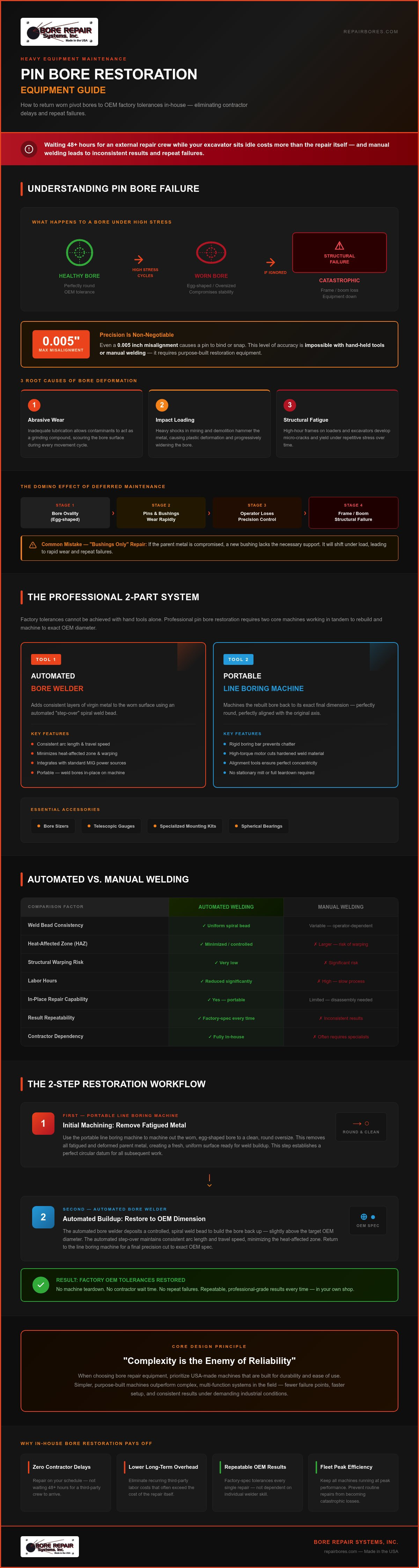
A pin bore is more than a simple hole; it's a precision-engineered pivot point. Pin bore restoration is the technical process of returning a worn or distorted bore to its original diameter and axial alignment. When heavy equipment operates under extreme loads, the parent metal eventually yields to high-stress cycles. This results in egg-shaped or oversized bores that compromise the entire machine's stability. Relying on "bushings only" repairs is a common mistake. If the parent metal is compromised, a new bushing lacks the necessary support. It will shift under load, leading to rapid wear and repeat failures.
The core of this repair involves precision machining, a process rooted in the fundamentals of Boring in manufacturing, which ensures the hole is perfectly round and aligned. High-quality pin bore restoration equipment allows you to address the root cause by rebuilding the parent metal itself. Precision remains the highest priority in these repairs. Even a minor misalignment of 0.005 inches can cause a pin to bind or snap. This level of accuracy is impossible to achieve with hand-held tools or manual welding.
Common Causes of Pin Bore Deformation
Abrasive wear: Inadequate lubrication allows contaminants to act as a grinding compound, scouring the bore surface during every movement.
Impact loading: Heavy shocks in mining and demolition applications hammer the metal, causing plastic deformation and widening the bore.
Structural fatigue: High-hour frames on loaders and excavators eventually develop micro-cracks and yield under repetitive stress.
The Consequences of Deferred Bore Maintenance
Ignoring bore wear creates a domino effect across the machine. Loose joints lead to accelerated wear on expensive pins and bushings, which are forced to absorb vibration they weren't designed for. Operators lose precision and control, making fine grading or delicate lifting nearly impossible. Bore ovality refers to the out-of-round distortion where a hole becomes elliptical; this deviation concentrates stress on specific areas and leads to rapid structural failure of the frame or boom. Investing in professional pin bore restoration equipment ensures these pivot points remain reliable and prevents a routine repair from turning into a catastrophic equipment loss.
Essential Equipment for Professional Pin Bore Restoration
Successful bore repair requires a two-part system designed for precision and durability. You cannot achieve factory tolerances with hand tools alone. Professional pin bore restoration equipment consists of an automated bore welder and a portable line boring machine. These tools work in tandem to rebuild the worn surface and then machine it back to the exact OEM diameter. This approach allows you to perform high-precision repairs without the need for a stationary mill or a total machine teardown.
Automated Bore Welding Systems
The bore welder is responsible for adding consistent layers of virgin metal to the worn surface. It uses an automated "step-over" feature to create a uniform, spiraling weld bead. This automation is superior to manual methods because it maintains a consistent arc length and travel speed. These factors are critical for following proper field welding procedures, which help minimize the heat-affected zone and prevent structural warping. Most professional bore welders are designed to integrate with standard MIG power sources already found in your shop. Their portable nature means you can weld bores in-place, drastically reducing the labor hours typically spent on disassembly.
Portable Line Boring Machines
Once the welding buildup is complete, the portable line boring machine restores the hole to its final dimension. The most important features of these machines are bar rigidity and motor torque. A rigid boring bar prevents chatter, ensuring a smooth surface finish that meets tight tolerances. High-torque drive motors allow the tool to cut through hardened weld material without stalling or vibrating. Alignment tools are equally essential; they ensure the new bore is perfectly concentric with the original axis of the machine. You can Explore our full range of bore repair products to see the different configurations available for various equipment sizes.
Beyond the primary machines, several accessories are necessary for a professional result. Bore sizers and telescopic gauges allow for accurate measurements between cutting passes. Specialized mounting kits and spherical bearings provide the stability needed to set up on irregular surfaces or tight spaces. Using the right combination of tools ensures the repair is repeatable and reliable. If you need help determining which setup fits your specific fleet, contact our technical team for a detailed equipment consultation.
Automated Bore Welding vs. Manual Repair Methods
Manual "slugging" or hand-welding might seem like a quick fix for a single job, but it's a false economy that compromises the repair's integrity. Manual welding results in a large, irregular heat-affected zone (HAZ). This excessive heat often warps the parent metal, leading to structural stress. Professional pin bore restoration equipment controls the heat input by maintaining a steady travel speed and arc voltage. This precision prevents "hard spots," which are localized areas of extreme hardness caused by inconsistent cooling. These spots are a nightmare for machinists because they can destroy cutting tools during the boring phase.
Labor efficiency is where the two methods diverge most sharply. Manual buildup requires a technician to stand over the bore for hours, managing the arc and cleaning slag. It's an exhausting, high-skill task that's prone to human error. Automated systems allow for a "set it and forget it" workflow. While the machine lays down a perfect, spiraling bead, your staff can focus on other revenue-generating tasks in the shop. You aren't just buying better results; you're buying back your team's time.
Precision and Metallurgical Integrity
Automated systems eliminate the variability of a manual hand. They provide deep, consistent penetration and a uniform bead profile across the entire circumference of the hole. This uniformity drastically reduces the risk of slag inclusions or internal voids that weaken the repair. A clean, dense weld deposit ensures the final machined surface has the structural integrity to handle the extreme impact loading typical of mining or demolition applications. When the weld is consistent, the final boring pass is smoother, leading to a longer service life for the pins and bushings.
Calculating the ROI of In-House Equipment
Outsourcing a single line boring job can cost thousands of dollars when you factor in travel surcharges and dealer labor rates, which in 2026 often exceed $200 per hour. Owning your equipment eliminates these recurring costs and the excessive downtime spent waiting for a contractor's schedule to open up. See how our customers evaluate ROI to understand the real-world impact of moving this capability in-house. For a shop performing just two repairs per month, the payback period is the duration required for the cumulative savings on outsourcing fees to equal the total equipment purchase price. In most heavy-duty environments, this investment pays for itself within the first year of operation.
Setting Up Your Pin Bore Restoration Workflow
Establishing an in-house workflow transforms a complex mechanical failure into a manageable routine. A methodical approach ensures that every repair is consistent and durable. High-quality pin bore restoration equipment simplifies these stages, allowing your shop to meet factory specifications without the need for external machining services. The process follows four distinct steps designed for maximum precision.
Step 1: Initial Machining. You must remove "tired" or fatigued metal before welding. This pass clears out the egg-shaped distortion and provides a clean, uncontaminated surface for the new weld to bond with.
Step 2: Automated Welding Buildup. Use an automated bore welder to apply consistent layers of virgin metal. The goal is to slightly undersize the bore, providing enough material for the final machining pass.
Step 3: Final Line Boring. This is the precision stage. The boring bar machines the new weld material to reach the exact OEM tolerances and surface finish.
Step 4: Quality Check. Use telescopic gauges or bore sizers to verify the diameter. A final pin fitment test confirms the repair is successful and ready for service.
Alignment and Setup Best Practices
Precision starts with the setup. Centering cones and spherical mounts allow for rapid, accurate alignment of the boring bar along the original axis. Once you achieve alignment, tack welding the mounts to the machine frame is a critical step. This ensures zero movement during high-torque boring passes. Any shift during the process can result in a misaligned hole that causes pin binding. You can watch our bore welder and boring videos for setup tips to see these techniques applied in real-world scenarios.
Operator Safety and Training Requirements
Investing in professional pin bore restoration equipment is only half the battle; ensuring your team knows how to use it safely is the other half. Automated welding environments require specific safety gear, including auto-darkening helmets and heat-resistant apparel. While the tools are designed to simplify the repair, professional training is the fastest path to mastery. It helps operators avoid common pitfalls like over-boring or inconsistent weld penetration. For more details on skill development, read our guide on Line Boring Operator Training: Mastering Precision Bore Repair in 2026.
If you are ready to bring these capabilities into your shop and eliminate equipment downtime, contact our technical team to discuss the right equipment package for your specific fleet.
Choosing the Right Partner for Bore Repair Equipment
Selecting pin bore restoration equipment is a major investment in your shop’s long-term capability. You need a partner who understands that complexity is the enemy of reliability. While some manufacturers pack their machines with unnecessary electronic "fluff," a veteran engineer knows that simplicity wins in the field. High-tech features are useless if they fail under the vibration and heat of a real-world workshop. Prioritize machines designed for the grit of heavy industrial environments. USA-made equipment offers a clear advantage here, providing the structural rigidity and mechanical integrity required for mining and construction applications.
Beyond the hardware, evaluate the technical support and long-term parts availability. A machine is only an asset as long as it’s running. You don't want to wait weeks for a proprietary circuit board from overseas while your fleet sits idle. A reliable partner maintains a deep inventory of replacement parts and provides direct access to technical experts who have actually performed these repairs. Look for a system that integrates the welding and boring processes seamlessly. When the bore welder and line boring machine are designed to work together, you eliminate compatibility headaches and ensure a faster, more accurate setup.
The Bore Repair Systems Advantage
Bore Repair Systems brings decades of hands-on expertise to every tool we manufacture. Our focus remains on creating automated welding and machining tools that thrive in the dirt, not just a controlled laboratory. We build our systems to be straightforward, acting as a mentor in the shop by providing the right tools for a professional-grade result. We prioritize dependability because we know your reputation depends on the quality of the repair. For more insights on selecting a provider, see our article on Bore Welding Machine Manufacturer: Choosing a Precision Equipment Partner in 2026.
Getting Started with Your Own System
Determining which machine size fits your fleet is the first step toward self-sufficiency. A system designed for compact excavators won't have the torque or reach needed for a 400-ton mining truck. Analyze the bore diameters across your equipment to select a package that offers the most versatility for your specific application. Don't overlook the value of hands-on training. It’s the fastest way to eliminate the learning curve and ensure your operators can hit OEM tolerances consistently from day one. If you’re ready to stop paying for external contractors and start keeping those profits in-house, contact our experts to find your restoration solution today.
Master Your Fleet Maintenance Strategy
Restoring worn pivot points to factory specifications is no longer a task you need to outsource. By implementing a professional workflow with high-quality pin bore restoration equipment, you eliminate the high costs of dealer labor and the frustration of waiting for external contractors. You've learned that precision relies on the synergy between automated bore welding and rigid line boring. This combination ensures every repair meets OEM tolerances and prevents premature pin failure while reducing long-term maintenance overhead.
Bore Repair Systems provides the tools you need to succeed. Our systems feature patented automated technology and are Made in the USA for maximum durability in heavy-duty environments. We don't just sell machines; we include comprehensive operator training to ensure your team achieves mastery quickly. It's time to take control of your maintenance schedule and keep your profits in the shop. View our professional bore repair equipment systems and start your journey toward maintenance self-sufficiency today. You have the expertise to keep your fleet running; we provide the equipment to make it happen.
Frequently Asked Questions
What is the difference between line boring and bore welding?
Bore welding is the process of adding layers of virgin metal to the interior of a worn hole, while line boring is the machining process that removes excess material to reach a specific diameter. These two methods are complementary. You first use a bore welder to rebuild the parent metal and then use a line boring machine to cut the hole back to factory tolerances. This ensures the bore is perfectly round and aligned.
Can I restore pin bores in the field without removing the component?
You can restore pin bores in the field by using portable pin bore restoration equipment designed for in-place machining. These systems mount directly to the frame or component, eliminating the need to strip the machine down and transport parts to a stationary shop. This approach significantly reduces downtime and labor costs. As long as you have enough clearance for the boring bar and welder, you can perform professional repairs on-site.
How do I fix egg-shaped pin holes in an excavator bucket?
Fixing egg-shaped holes requires a three-step mechanical process. First, you must perform an initial machining pass to remove the distorted, tired metal and create a concentric surface. Next, you apply an automated weld bead to build up the interior diameter. Finally, you use a line boring machine to cut the hole back to its original OEM specifications. This process ensures the new hole is perfectly round and provides proper support for bushings.
What power source is required for an automated bore welder?
Most automated bore welders are designed to integrate with standard MIG power sources already found in your shop. They typically require a constant voltage DC welder with a wire feeder. The bore welder controls the rotation and step-over movement, while your existing power source provides the arc and wire. This compatibility makes it straightforward to add automated bore welding capabilities to your maintenance department without needing entirely new welding power units.
Is it better to buy a bore welder or hire a repair service?
Buying your own equipment is the better investment if you have recurring repair needs. In 2026, dealer labor rates often exceed $200 per hour, and waiting for external contractors can cause days of equipment downtime. Owning the tools allows you to perform repairs on your own schedule and keep the profits in-house. For many operations, the equipment pays for itself within the first year by eliminating outsourcing fees and travel surcharges.
How long does a typical pin bore restoration take with automated equipment?
A typical pin bore restoration usually takes between one and two days depending on the size and severity of the wear. Automated systems accelerate this timeline by allowing the welding and machining phases to run with minimal operator intervention. While a manual repair might take twice as long and produce inconsistent results, automated equipment ensures a faster turnaround. This speed is critical for minimizing downtime during peak operational windows in construction or mining.
Do I need special training to operate a line boring machine?
Professional training is essential to ensure you achieve factory-grade precision and avoid costly mistakes. While the equipment is designed to be straightforward, mastering alignment and setup is the key to a successful repair. Comprehensive operator training programs teach you how to properly set up the boring bar, manage heat input during welding, and perform accurate measurements. This education is the fastest path to achieving repeatable, professional results and maximizing your investment.


Comments