

Line Boring Equipment: 2026 Professional Buyer’s Guide

Updated: 6 days ago
Every hour a machine sits idle while you wait for an outside specialist is profit leaking out of your shop. You've likely felt the frustration of watching a worn bore turn into a three-day delay and a massive invoice from a third-party contractor. It's a common bottleneck, but it doesn't have to be your reality. When you start looking for line boring equipment for sale, you aren't just buying a tool; you're investing in your own independence and shop efficiency.
We understand that the transition from outsourcing to in-house machining can feel complex. This 2026 professional buyer's guide simplifies that process. We'll show you how to evaluate portable systems that restore bores to OEM specs without the headache of traditional, bulky setups. You'll learn how to select a system that reduces repair windows from days to hours and provides the mechanical integrity your fleet requires. We will cover everything from patented drive technologies to the essential accessories and training that ensure your investment lasts a lifetime. By the end of this guide, you'll have the knowledge to eliminate equipment downtime and restore precision to your operations.
Table of Contents
The Business Case for Line Boring Equipment: ROI and Downtime Reduction
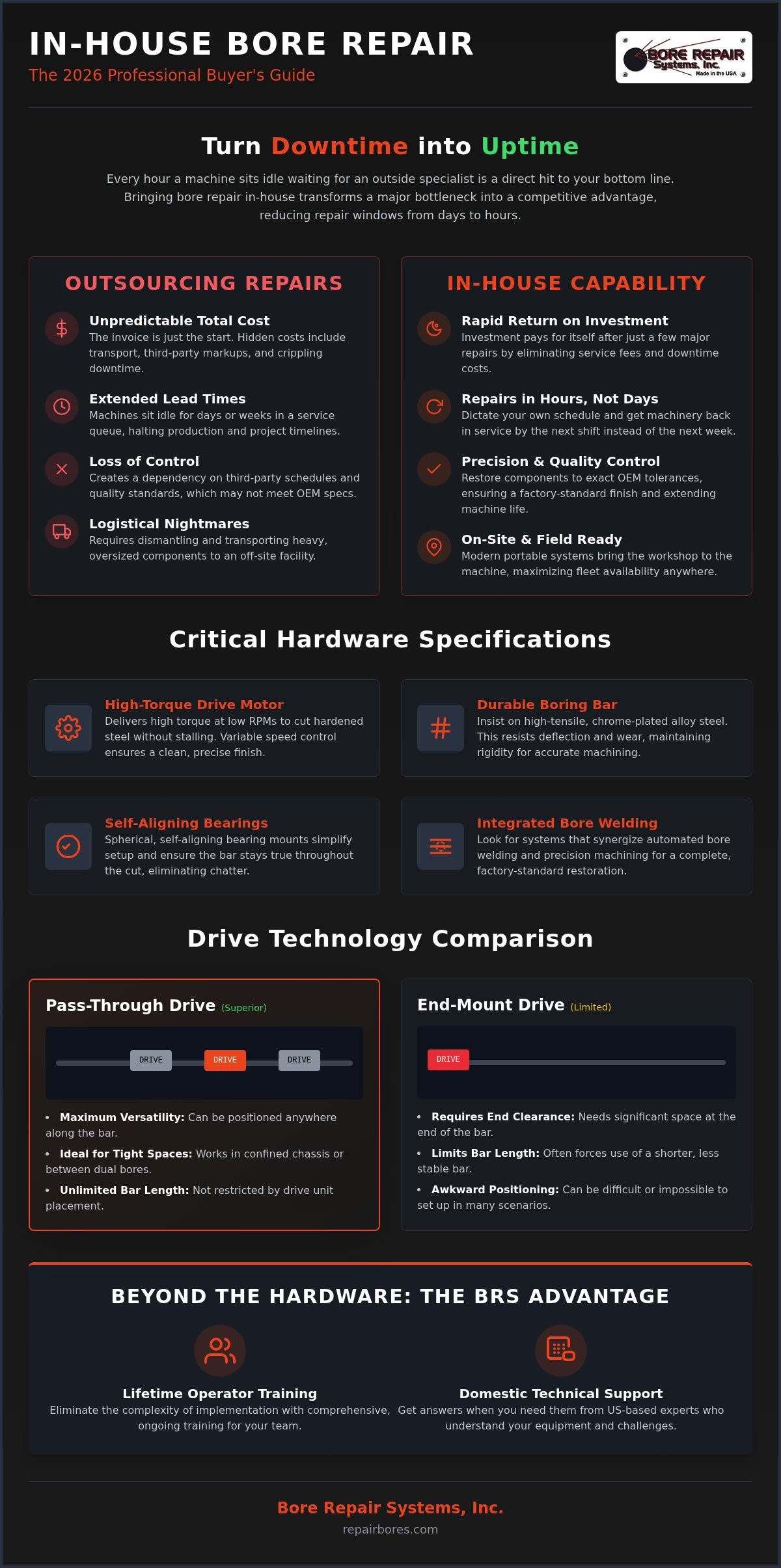
Owning your repair process isn't just about convenience; it's about the bottom line. When heavy equipment goes down due to a worn pivot point or hinge pin, the clock starts ticking on lost revenue. Many fleet managers look for line boring equipment for sale once they realize that the invoice from an outside machine shop is only a fraction of the total cost. You must also account for the logistics of dismantling the machine, transporting heavy components, and the days or weeks spent waiting in a service queue. These delays can easily double the actual repair cost in lost production time.
Bringing the Boring (manufacturing) process in-house allows you to dictate the schedule. You can restore components to original equipment manufacturer (OEM) tolerances without leaving the shop floor. This control ensures that the repair isn't just a temporary fix but a precision restoration that extends the life of the machine. By catching wear early, you can perform preventative maintenance during scheduled service windows. This proactive approach avoids the catastrophic failures that shut down entire jobsites and lead to emergency expenses.
Calculating your break-even point is a simple matter of looking at your repair history. Most shops find that their investment in professional equipment pays for itself after just a few major repairs, especially when you factor in the elimination of transport fees and third-party markups. It turns an unpredictable expense into a manageable in-house capability.
In-House Line Boring vs. Outsourcing
Outsourcing creates a dependency that high-stakes operations can't afford. The hidden costs are often found in the "dead time" where a machine sits disassembled, taking up valuable bay space while waiting for an outside technician to arrive. Professional systems offer a level of precision that manual welding and grinding simply cannot match. For a detailed breakdown of these variables, see our in-house line boring vs outsourcing guide. By keeping the work in-house, you ensure that quality standards are met every time.
Operational Efficiency in Field Service
Modern line boring equipment for sale is designed for the reality of the field. You don't need to haul a 50-ton excavator to a shop when the tools can come to the machine. Field-ready line boring is a critical capability for 2026 maintenance teams who need to maximize fleet availability in remote locations. This rapid response capability means a machine can be back in the dirt by the next shift instead of the next week. It transforms a logistical nightmare into a standard maintenance task, keeping your projects on schedule and your equipment in the field where it belongs.
Technical Specifications: What to Look for in Line Boring Equipment
When evaluating line boring equipment for sale, the technical specifications determine whether a tool is a shop asset or a liability. Precision starts with the drive motor. You need high torque at low RPMs to cut through hardened steel without stalling or vibrating. Variable speed control is equally vital. It allows you to adjust the feed rate to match the material hardness and bore diameter, ensuring a clean finish that meets OEM standards.
The backbone of any system is the boring bar itself. Insist on high-tensile, chrome-plated alloy steel bars. These materials resist deflection and wear over decades of use, maintaining the rigidity required for accurate machining. To eliminate chatter, look for robust bar support bearing designs. Spherical, self-aligning bearings simplify the initial setup and ensure the bar stays true throughout the entire cut. Advanced systems also include thru-bar snap ring groove machining. This feature allows you to cut the snap ring groove without removing the bar, which saves significant time on every repair job.
Pass-Through Drive vs. End-Mount Systems
Pass-through drive technology is the superior choice for versatility. Unlike end-mount systems that require significant clearance at the end of the bar, a pass-through drive can be positioned anywhere along the bar's length. This is a massive advantage when working in the tight confines of a machine's chassis or between dual bores. End-mount drives often limit your bar length and force awkward tool positioning. Modular pass-through components also speed up setup because you can slide the drive unit exactly where it's needed, rather than adjusting the entire workpiece to accommodate the tool.
Boring Bar Diameter and Stroke Length
Selecting the right bar diameter depends on your fleet's common pin hole sizes. A 1.5-inch or 2-inch bar covers most standard construction equipment, while larger mining and industrial machines may require 3-inch bars or greater. Stroke length is the other critical factor. A longer stroke allows you to machine multiple bores in a single setup, maintaining perfect alignment across the entire span. Consistent line boring machine maintenance is necessary to keep these bars straight and accurate over the long term. If you need assistance matching a system to your specific equipment requirements, view our full range of professional systems to find the right configuration.
Comparing Integrated Bore Repair Kits: Boring vs. Welding
Precision machining is only half of the repair equation. While boring removes material to create a perfect circle, you can't machine what isn't there. Most worn-out pivot points aren't just oversized; they're "egg-shaped" or gouged from years of service. This is why the synergy between automated bore welding and precision line boring is the gold standard for 2026 maintenance shops. When you evaluate line boring equipment for sale, you're looking for a system that can both build up the surface and cut it back to factory specs.
Automated welding creates a uniform, dense surface that is significantly easier to machine than manual weld patches. Manual welding often introduces hard spots and inconsistent cooling rates, which cause the boring tool to "jump" or chatter during the final pass. An automated overlay provides a consistent metallurgical bond and a predictable surface density. This consistency ensures that your finishing cuts are smooth and meet the tightest OEM tolerances. Beyond the quality of the finish, the structural integrity of an automated weld is superior, providing a long-lasting repair that resists future wear better than traditional manual methods.
The Role of Automated Bore Welders
Automated welders solve the "egg-shaped" hole problem by applying a continuous, spiral bead of weld metal inside the bore. This process eliminates the guesswork and physical strain of manual welding in tight spaces. For a deep dive into specific welding technologies, see our guide on finding a bore welder for sale. Systems like the BOA-408i have become the benchmark for automated field welding, allowing operators to set the parameters and let the machine handle the precision work. This automation ensures the bore is perfectly prepped for the machining phase.
Choosing a Complete Repair System
Investing in a matched kit from a single manufacturer is a strategic move for any shop. Matched systems ensure that the welding torch and the boring bar use the same mounting hardware and alignment components. This modularity allows you to switch between welding and boring modes without tearing down your entire setup. Using a complete, integrated system reduces tool-switching downtime by 40% compared to using mismatched equipment from different vendors. This efficiency means your machines spend less time in the shop and more time on the job site. When you're browsing line boring equipment for sale, prioritize kits that offer this seamless integration to maximize your operational speed.
Selection Criteria: Matching Equipment to Your Fleet Requirements
Choosing the right tool requires an honest assessment of your fleet's specific needs. Buying a massive industrial rig for a fleet of compact excavators is a waste of capital. Conversely, an underpowered system will fail when faced with the hardened steel of a mining bucket. When searching for line boring equipment for sale, prioritize the bore sizes you repair most frequently rather than the rare outliers. Your goal is to find a system that handles 90% of your workload with maximum efficiency.
Consider your primary work environment. Shop-based maintenance allows for permanent, heavy setups, but field teams need true portability. If your equipment is geographically dispersed, the weight and modularity of the system become primary selection factors. You need tools that one or two technicians can transport in a standard service truck and set up without the help of a crane. Durable, weather-resistant components are essential for field repairs in construction and mining sites where dust and moisture are constant factors. Reliability in the mud is just as important as precision in the shop.
Sizing for Construction and Earthmoving Gear
Most construction equipment, such as backhoes and mid-sized excavators, features bores in the 1.5-inch to 6-inch range. For these applications, a 1.25-inch or 1.5-inch boring bar is the industry standard. These smaller bars require compact drive heads that can fit inside tight bucket linkages and H-links where space is at a premium. If you are dealing with uneven wear or "egged" holes from years of service, utilize specific misaligned bore repair techniques to ensure the new pin seats correctly. Precision in these smaller bores is vital for preventing premature bushing failure and keeping your machines tight.
Industrial and Mining Equipment Needs
Large-scale bores in mining, power generation, and shipbuilding often exceed 12 inches in diameter. When looking for heavy-duty line boring equipment for sale, you must prioritize high-torque drives that handle the increased surface area of the cut without bogging down. Hardened steel components in these sectors are unforgiving; any lack of power in the drive unit will lead to tool stalling and poor surface finishes. Long-span boring across large frames also requires heavy-duty bar supports to prevent the bar from sagging or vibrating during the process. Robustness is not optional in these high-stakes environments. Before making a final decision, ensure the system you choose offers the modularity to grow with your fleet. Contact our experts today to find the ideal line boring system for your specific fleet requirements.
The Bore Repair Systems Advantage: Beyond the Hardware
Choosing the right hardware is only the first step toward shop independence. While searching for line boring equipment for sale, it's easy to get lost in torque ratings and bar diameters. However, the most sophisticated machine in the world is useless if your team can't operate it with confidence or if you can't get a replacement part during a critical repair. We've spent over 30 years refining our BOA systems with a philosophy of "simplicity by design." We believe that while the mechanical challenges you face are complex, the tools you use to solve them shouldn't be. By stripping away unnecessary bells and whistles, we've created a line of equipment that is as rugged as the machines it repairs.
Our systems are built in the USA to withstand the punishing environments of mining and heavy construction. Whether you're working in a climate-controlled shop or a mud-slicked job site, our patented pass-through drive technology and thru-bar snap ring groove systems are designed to perform. To complement this physical durability, many operators use Energy Control Systems to protect their equipment's sensitive electronics from power surges and electrical noise. This comprehensive protection ensures that your investment continues to generate ROI for decades, not just a few seasons. We don't just sell you a machine and walk away; we position ourselves as a seasoned partner in your maintenance operations.
Professional-grade repairs require more than just a manual. We eliminate the "complexity" objection by providing free, lifetime training for every piece of equipment we manufacture. This ensures that your team achieves professional results from the very first cut. Our line boring operator training covers everything from initial alignment to advanced finishing techniques. We also recognize that workforces change. That's why we offer refresher training for new hires at no additional cost. Investing in line boring training is the most effective way to maximize the ROI of your repair team and ensure long-term precision.
Direct Manufacturer Support and Innovation
When you have a technical question, you shouldn't have to navigate a corporate call center. As a dedicated bore welding machine manufacturer, we provide direct access to the engineers who designed your system. This direct line of communication means you get pragmatic, expert advice based on real-world mechanical experience. We've seen every possible equipment failure, and we use that knowledge to help you troubleshoot your specific challenges. We invite you to contact us for a customized equipment consultation. Let's discuss your fleet's requirements and find a solution that keeps your machines in the dirt and your profits in your pocket.
Take Control of Your Shop's Productivity
Investing in the right tools is the difference between waiting for a repair and finishing one. You've seen how bringing bore repair in-house eliminates the high cost of downtime and restores machines to OEM specs. By selecting a system that matches your fleet's specific requirements, you turn a logistical bottleneck into a core competency. When you evaluate line boring equipment for sale, look for more than just a motor and a bar. You need a partner that offers proven reliability and the technical support to ensure your success.
Bore Repair Systems brings 30+ years of industrial repair expertise and patented, USA-made BOA technology to your workshop. We don't just ship hardware; we provide the knowledge to use it effectively. Every purchase includes free lifetime training to ensure your operators master the equipment and deliver professional results on every job. Your fleet is too valuable to leave to chance. Take the next step toward mechanical independence and long-term profitability today.
Frequently Asked Questions
What is the typical diameter range for portable line boring equipment?
Portable systems typically cover bores from 1.5 inches to over 24 inches in diameter. Most maintenance teams looking for line boring equipment for sale prioritize the 1.5 to 6-inch range. This size covers the majority of construction and earthmoving machinery pivot points. Larger industrial systems are required for mining buckets and power generation components. The specific range for your shop depends on the boring bar diameter and the drive unit's torque capacity.
Do I need a separate bore welder if I buy a line boring machine?
You can machine a bore without a welder, but you can't restore an oversized or "egg-shaped" hole without adding metal first. Automated bore welders are the most efficient way to build up worn surfaces before machining. Using an integrated system ensures that the weld overlay is uniform and perfectly aligned with the boring bar. This combination provides a factory-standard finish that manual welding and grinding simply can't achieve.
How long does it take to learn how to operate a line boring system?
A technician can understand the basic setup and operation within a single day of focused instruction. However, achieving consistent precision across various applications often requires several hands-on projects. To bridge this gap, Bore Repair Systems provides free lifetime training for all equipment owners. This support allows new hires or veteran operators to refresh their skills and master complex repairs without the steep learning curve typical of traditional machining tools.
Can portable line boring machines achieve the same precision as shop-based lathes?
High-quality portable machines achieve the same tolerances as a stationary lathe, often within thousandths of an inch. Precision depends on the rigidity of the boring bar and the stability of the support bearings. When you use high-tensile, chrome-plated bars and secure mounting brackets, you can restore bores to original OEM specifications in the field. This capability eliminates the need to transport heavy components to a machine shop for precision work.
What power requirements are common for portable line boring drive motors?
Most portable drive motors operate on standard 110V or 220V electric power. This makes them easy to use in any shop or service truck with a generator. These electric systems provide variable speed control and high torque for common construction bores. For extremely large industrial bores that require maximum cutting power, hydraulic drive systems are used. These require a separate hydraulic power pack but offer the torque needed for heavy-duty material removal.
Is it possible to machine snap ring grooves with a portable line boring bar?
Yes, you can machine snap ring grooves with a portable system if it features the right technology. Bore Repair Systems offers a patented thru-bar snap ring groove machining system. This allows operators to cut grooves without removing the boring bar. This feature is a significant advantage when looking for line boring equipment for sale because it saves hours of setup time and ensures the groove is perfectly concentric with the new bore.
How do I choose between a hydraulic and an electric drive system?
Electric drive systems are the preferred choice for most construction and field service applications due to their portability. They plug into standard outlets and provide enough torque for bores up to 6 or 8 inches. Hydraulic systems are reserved for massive industrial projects where extreme torque is mandatory. If your work involves standard earthmoving gear, the simplicity and lower maintenance requirements of an electric drive system are usually superior for your team.


Comments