

In-House Bore Repair: Strategic ROI Guide for 2026

Updated: Sep 5
How much did you pay for your last field machining invoice, and how many days did that machine sit idle while you waited for a contractor to arrive? If you're managing a fleet in 2026, you already know that outsourcing critical maintenance is a gamble with your bottom line. You're likely dealing with high third-party invoices and variable repair quality that often forces you to redo work. Developing a robust in-house bore repair justification isn't just about buying a new tool. It's a strategic move to recapture the profit margins you're currently handing to someone else.
You need total control over your repair schedules and the mechanical integrity of your equipment. This guide provides the financial and operational framework required to bring these capabilities under your own roof. We'll examine the true cost-per-repair, the fact that some portable systems pay for themselves in as few as five repairs, and the training path needed to turn your current mechanics into precision machinists. It's time to stop the cycle of expensive outsourcing and start maintaining your fleet on your own terms.
Table of Contents
The Financial Reality: The Hidden Costs of Outsourcing Bore Repairs
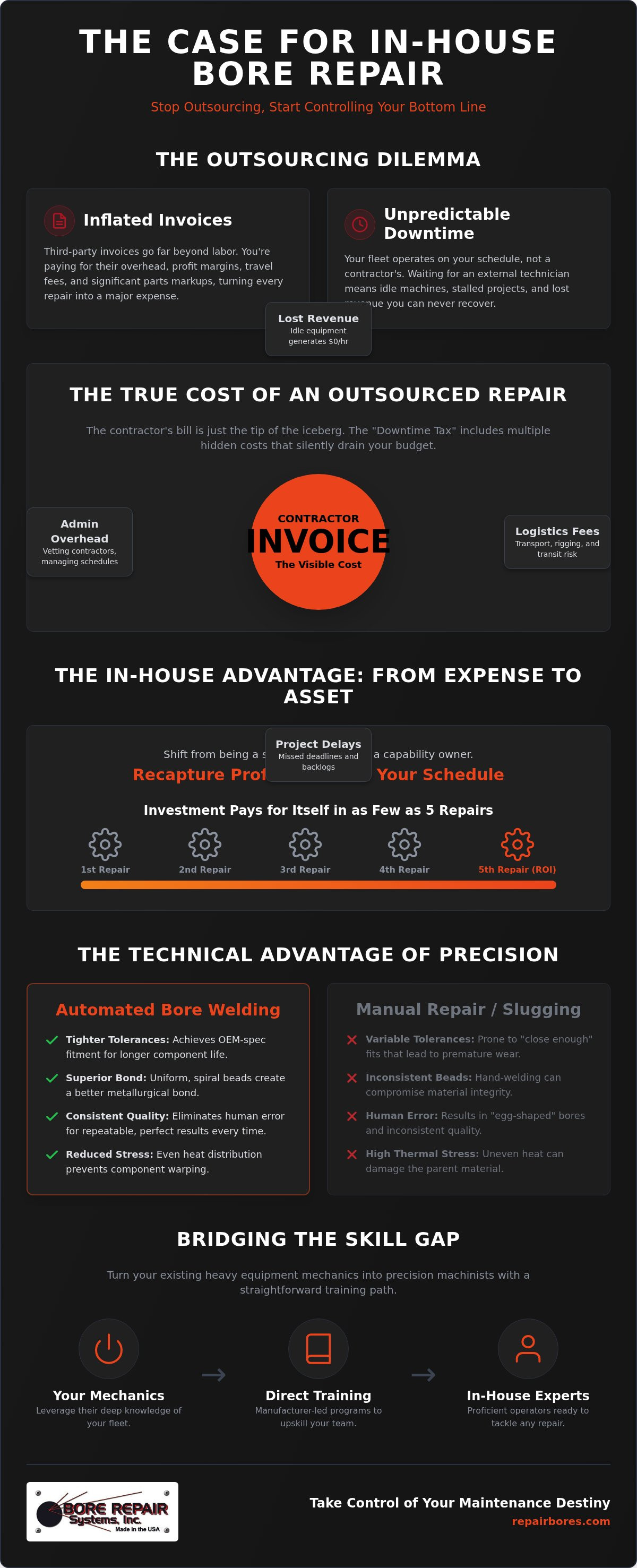
Most maintenance managers look at the bottom line of a contractor's invoice and assume that's the total cost of the job. It isn't. The true expense of outsourcing includes the hours your equipment sits idle, the logistical headaches of moving heavy iron, and the administrative friction of managing third-party schedules. Developing a solid in-house bore repair justification requires you to look past the line items on a bill and analyze the "Downtime Tax" currently draining your budget.
Direct costs are easy to track; they include labor rates, travel fees, and parts markups. Indirect costs are harder to pin down but often more damaging. These include the time your shop foreman spends vetting contractors and the lost productivity when a repair window slides. When you rely on external shops, you aren't the priority. Their delays become your missed deadlines.
Quantifying Lost Opportunity Costs
Heavy machinery doesn't make money while it's parked in the yard. If a primary excavator or loader is out of commission, the revenue it generates per hour vanishes. A two-week wait for a third-party machinist can stall an entire project. These delays compound across your fleet, creating a maintenance backlog that's nearly impossible to clear. Every hour spent waiting for an external specialist is an hour of lost production you'll never recover. If your equipment generates hundreds of dollars in revenue per hour, a single week of waiting can cost more than the repair itself.
Logistical friction adds another layer of waste. Transporting heavy components to an external machine shop introduces risk and significant expense. You're paying for freight, rigging, and the potential for damage during transit. Worse, if the outsourced shop misses a tolerance, the rework cycle starts all over again. You lose more time, pay for more shipping, and suffer through even more downtime.
Recapturing the Contractor's Profit Margin
When you hire an outside service, you're paying for their overhead, their equipment, and their profit. By bringing these repairs in-house, you transition from a service consumer to a capability owner. You start building internal equity through specialized tool ownership. Calculating your Return on Investment (ROI) becomes straightforward when you compare the cost of a bore welder to the thousands spent on markups for professional field machining.
You aren't just saving on labor. You're recapturing the significant markups contractors apply to parts and specialized services. This shift allows you to control your own destiny. Instead of being at the mercy of a contractor's availability, you can prioritize repairs based on your actual operational needs. It turns a recurring expense into a permanent asset.
Technical Advantages of In-House Precision Machining
Precision isn't just a goal; it's a requirement for machine longevity. When you outsource, you're often buying a "close enough" fit that meets the contractor's schedule rather than your own standards. A core part of any in-house bore repair justification is the ability to enforce total quality control. By performing the work yourself, you ensure the tightest possible tolerances, which directly translates to longer component life and fewer emergency breakdowns.
Automated Bore Welding vs. Manual Repair
Manual "slugging" or hand-welding buildup is prone to human error. It creates uneven heat distribution and inconsistent bead placement, which can compromise the metallurgical integrity of the housing. Automated bore welding systems eliminate these variables. They provide a uniform, spiral bead that ensures consistent penetration and a predictable surface for the final machining pass. This consistency reduces thermal stress on the component and creates a superior metallurgical bond.
Research into the financial effects of outsourcing suggests that the long-term cost of poor quality often outweighs the upfront savings of a cheap external fix. Automated systems ensure a "perfect" surface finish every time, making the subsequent boring pass faster and more accurate. This leads to a smoother mechanical interface that resists future wear better than a manual patch job. To support these high-quality standards with professional record-keeping, you can visit SOCWeld to learn how to automate and manage your welding documentation.
Modern heavy equipment requires OEM-spec pin and bushing fitment to function correctly. In-house control allows you to use digital measurement tools to verify bore concentricity at every stage of the process. This prevents the "egg-shaped" bore phenomenon common with rushed manual repairs. When you control the process, you can also easily integrate specialized misaligned bore repair techniques to restore equipment to factory geometry.
Repeatable machining passes mean you don't over-cut or weaken the base material. You're simply restoring what was lost to wear. This level of precision is difficult to guarantee when a contractor is rushing to get to the next job site. If you're ready to take back control of your shop's output, evaluating a high-quality bore welding machine manufacturer is the first step toward technical independence.
Calculating the ROI: When Does In-House Equipment Pay for Itself?
Determining the exact moment an equipment purchase shifts from an expense to a profit center is the core of any in-house bore repair justification. For most shops, the payback period is shorter than expected. Industry data indicates that a professional portable line boring and welding system can pay for itself in as few as 2 to 5 repairs. When you consider that a single complex bore repair from a contractor can reach five figures, the math for self-sufficiency becomes undeniable.
Amortizing the cost of a bore welder for sale across your entire fleet allows you to distribute the capital expenditure over multiple years and projects. Unlike a contractor's invoice, which is a sunk cost, a bore welder is a long-term asset. It retains significant resale value and provides decades of utility. You're trading a recurring liability for a permanent shop capability that increases your business's overall valuation.
Outsourced vs. In-House Cost Comparison
The gap between contractor rates and in-house labor is where you recapture your margin. In 2026, outsourced machining services often command hourly rates between $75 and $250. In contrast, the national median wage for a heavy equipment mechanic is approximately $31.50 per hour, with senior field mechanics earning up to $45. Even when you factor in the cost of consumables, electricity, and shop overhead, your internal cost-per-hour remains a fraction of what you'd pay a third party.
Speed is the other half of the profitability equation. In-house repairs eliminate the "Downtime Tax" discussed earlier. You don't have to wait for a contractor's opening or deal with their travel delays. Faster turnaround times keep your fleet in the field, where it generates revenue. When you control the schedule, you can perform preventative bore maintenance during planned downtime, avoiding the catastrophic failures that lead to emergency contractor call-outs.
Tax Incentives and Capital Expenditure
Capital equipment purchases in the United States often qualify for Section 179 tax deductions. This allow businesses to deduct the full purchase price of qualifying equipment from their gross income during the tax year it's placed in service. This incentive significantly lowers the net cost of the investment. It's a powerful tool for preserving cash flow while upgrading your shop's technical reach.
Beyond the hardware, the investing in training for your maintenance team creates a secondary ROI. Skilled technicians are more efficient and produce higher-quality work, which reduces the likelihood of rework. By upskilling your current staff, you mitigate the risks of a tight labor market and ensure that your investment in equipment is matched by an investment in human capital.
Overcoming the Implementation Barrier: Training and Setup
The biggest obstacle to self-sufficiency isn't usually the capital expenditure. It's the perceived complexity of the process. Many shop managers hesitate because they believe they need a master machinist on staff to operate precision equipment. This is a misconception. Modern automated tools are designed to simplify the technical workload, making a strong in-house bore repair justification even easier to present to stakeholders. Precision is a habit, and with the right setup, your existing team can master it.
Success starts with a dedicated bore repair station. You don't need a massive footprint, but you do need a clean, organized area where components can be securely mounted and aligned. Standardizing your internal repair workflow ensures repeatable results. When every technician follows the same setup and machining sequence, the margin for error drops significantly. This internal consistency is what allows you to match or exceed the quality of specialized external shops.
The 5-Step Roadmap to In-House Capability
Step 1: Assessing fleet repair volume. Audit your maintenance logs from the last 24 months. Identify common bore sizes and the frequency of failures to determine your primary equipment needs.
Step 2: Selecting the right line boring machine accessories. Base your tooling choices on the specific geometry of your equipment. Having the correct centering cones and mounting fixtures is critical for fast setups.
Step 3: Enrolling staff in line boring operator training. Manufacturer-direct education bridges the skill gap quickly. Your team learns the nuances of feed rates, tool sharpening, and automated welding patterns.
Step 4: Executing a supervised 'first repair'. Run your first real-world job under the guidance of an expert or following a strict manufacturer checklist. This builds the confidence necessary to take on more complex fleet-wide repairs.
Safety and Compliance Standards
Precision machining in 2026 requires strict adherence to industrial safety protocols. Automated welding generates fumes and intense UV light that must be managed with proper ventilation and shielding. Machining chips are sharp and hot; a clean shop environment prevents accidents and protects your equipment from contamination. A comprehensive in-house bore repair justification must also account for these operational safety standards. Regular maintenance of your boring bars and welders ensures long-term accuracy and operator safety. If you're ready to start building your shop's technical independence, view our professional bore repair equipment and training programs.
Recapturing Control: The Bore Repair Systems, Inc. Advantage
Choosing to bring precision machining in-house is a major operational shift. It's a move that replaces external dependency with internal capability. However, the strength of your in-house bore repair justification depends heavily on the reliability of the equipment you choose. Investing in American-made systems from Bore Repair Systems, Inc. isn't just a matter of preference; it's a strategic decision to protect your industrial uptime. When a machine is down, you can't afford to wait for parts to clear international customs or for technical support to wake up in a different time zone.
Bore Repair Systems, Inc. operates as more than just a hardware provider. We act as a seasoned partner in your shop's transition. A high-quality bore welding machine manufacturer should prioritize technical education as much as equipment durability. We understand that our success is tied to your ability to perform precision repairs correctly the first time. By providing patented automated technology and comprehensive training, we ensure that your team has the tools and the knowledge to eliminate the cycle of expensive outsourcing for good.
Direct Access to Technical Support
Precision equipment is an investment in your shop's future, and that investment needs to be supported. Because our systems are designed and manufactured in the USA, you have direct access to the engineers who built them. This eliminates the communication friction often found with imported equipment. If you have a complex mechanical challenge or need a specific accessory, help is a phone call away. Our systems are engineered for simplicity. We've stripped away unnecessary complications to ensure that your technicians can focus on achieving the tightest tolerances without navigating a steep learning curve.
This long-term partnership approach helps you maintain the mechanical integrity of your fleet year after year. We provide the technical depth required to handle everything from routine bushing fits to complex misaligned bore restorations. You aren't just buying a boring bar; you're acquiring a permanent increase in your shop's profit potential. Your in-house bore repair justification is ultimately validated by the long-term reliability of the components you service.
Your Next Steps Toward Independence
The transition from a service consumer to a capability owner starts with a clear-eyed look at your current maintenance spending. You've already identified the hidden costs of contractors and the revenue lost to equipment downtime. Now it's time to quantify the specific ROI for your facility. Your next step is to evaluate how our automated systems fit into your existing workflow and fleet requirements.
Request a customized ROI analysis. We can help you map your historical repair volume against the cost of in-house equipment to find your exact break-even point.
Schedule a system demonstration. See how automated bore welding and line boring machines function in a real-world shop environment.
Audit your team's current skill set. Identify which mechanics are the best candidates for advanced operator training to lead your new machining department.
Stop letting third-party schedules dictate your productivity. By taking the first step toward technical independence, you're securing a more profitable and reliable future for your maintenance department. It's time to own the repair and keep the margin. View our full catalog of American-made bore repair systems and start your transition today.
Securing Technical Independence for Your Fleet
Transitioning to self-sufficiency is a strategic necessity in 2026. You've seen how the "Downtime Tax" and contractor markups erode your profitability. By mastering automated bore welding and line boring, you reclaim control over your maintenance schedule and the mechanical integrity of your machines. A strong in-house bore repair justification rests on this ability to turn a recurring expense into a permanent shop asset that increases the value of your operation.
Bore Repair Systems, Inc. provides the roadmap for this transition. We back our patented automated technology with US-based manufacturer support and proven training success stories that bridge the skill gap for your existing team. It's time to stop paying for a contractor's overhead and start investing in your own capability. Recapture your profit margins with a custom Bore Repair ROI Analysis and see exactly how fast your investment will pay for itself. Your fleet's reliability is too important to leave in someone else's hands.
Frequently Asked Questions
How many repairs do I need to perform to reach the break-even point?
Most shops reach the break-even point in as few as 2 to 5 repairs. This rapid return on investment occurs because you eliminate the high daily rates and travel fees charged by external machining contractors. When you factor in the "Downtime Tax" saved by keeping equipment in the field, the equipment often pays for itself within the first year of operation. This financial performance is a primary driver for any in-house bore repair justification.
Do I need to hire a specialized machinist to operate a line boring machine?
You don't need to hire a master machinist to achieve professional results. Our systems are designed for simplicity and ease of use, allowing your current heavy equipment mechanics to handle precision boring tasks after proper instruction. By upskilling your existing team, you avoid the high costs of specialized recruitment while building a more versatile workforce. We provide the technical education necessary to bridge the gap between general mechanical work and precision field machining.
Can automated bore welders handle vertical or overhead repairs?
Automated bore welders are fully capable of performing vertical and overhead repairs. These systems utilize a controlled spiral bead process that manages the weld puddle regardless of the machine's orientation. This all-position capability allows you to repair bores on large components without the need for teardown or repositioning. It ensures a consistent, high-quality buildup that is difficult to achieve with manual welding methods, especially in challenging gravity-fed positions.
What is the typical learning curve for a maintenance technician?
A typical maintenance technician can become proficient in operating our systems within a few days of intensive, manufacturer-direct training. The learning curve is intentionally short because the equipment handles the complex coordination of feed rates and weld bead placement. Once a technician understands the setup and alignment procedures, they can produce repeatable, factory-spec results. This speed to proficiency is a key component of a successful in-house bore repair justification.
How does in-house repair affect my equipment's resale value?
In-house repair capabilities significantly improve your equipment's resale value by ensuring that maintenance is performed to tight tolerances. Buyers look for machines with documented, precision repairs rather than those with sloppy manual patches or egg-shaped bores. By maintaining factory geometry throughout the machine's life, you protect the mechanical integrity of the frame and linkages. This demonstrates a high standard of care that commands a premium price in the used equipment market, where sourcing quality machinery from a trusted supplier like F.A. Maker ensures long-term operational reliability.
Professional bore repair stations generally operate on standard industrial power. Most of our portable line boring and welding systems require either 110V or 220V single-phase power, depending on the specific model and the size of the bores being serviced. This makes them compatible with most existing shop environments and portable generators used in the field. You won't need specialized high-voltage infrastructure to begin performing precision repairs in your facility or at a job site.
Is it possible to lease bore repair equipment to avoid high upfront costs?
Leasing is a viable and popular option for businesses looking to preserve cash flow while acquiring professional-grade tools. Many equipment financing programs allow you to spread the cost of bore welders and boring machines over several years. This approach often results in monthly payments that are lower than the cost of a single outsourced repair. It allows you to start generating ROI immediately without the burden of a large upfront capital expenditure.
How do I justify the cost of training to my company's stakeholders?
Justify training costs by highlighting the reduction in rework and the increase in equipment uptime. Professional training ensures that your team uses the equipment safely and efficiently, preventing costly mistakes that can damage expensive components. Explain to stakeholders that training is a one-time investment that creates a permanent internal capability. It turns your staff into "capability owners," reducing your long-term reliance on external contractors and their unpredictable schedules and pricing.


Comments