

How to Repair Worn Bore Holes: Professional Guide

Updated: Sep 4
A shim is not a repair; it's a countdown to the next breakdown. When you're dealing with heavy equipment, "close enough" tolerances lead to catastrophic failures and mounting costs. You understand the pressure of high machine downtime and the headache of manual welding that never stays true. Learning how to repair worn bore holes using professional methods is the only way to stop the cycle of temporary patches and restore mechanical integrity. This is about more than just filling a hole; it's about returning a machine to its peak operational state.
We agree that your equipment should work as hard as you do, which requires repairs that meet or exceed factory specifications every time. This guide promises to walk you through the professional process of restoring egg-shaped or wallowed-out bores using automated welding and precision line boring techniques. You'll learn how to minimize equipment downtime and ensure a professional, long-lasting result that stands up to heavy use. We will cover everything from proper alignment to the final machining pass, giving you the expertise to handle these critical repairs in-house with total confidence.
Table of Contents
Understanding Worn Bores: Why Pivot Points and Pin Holes Fail
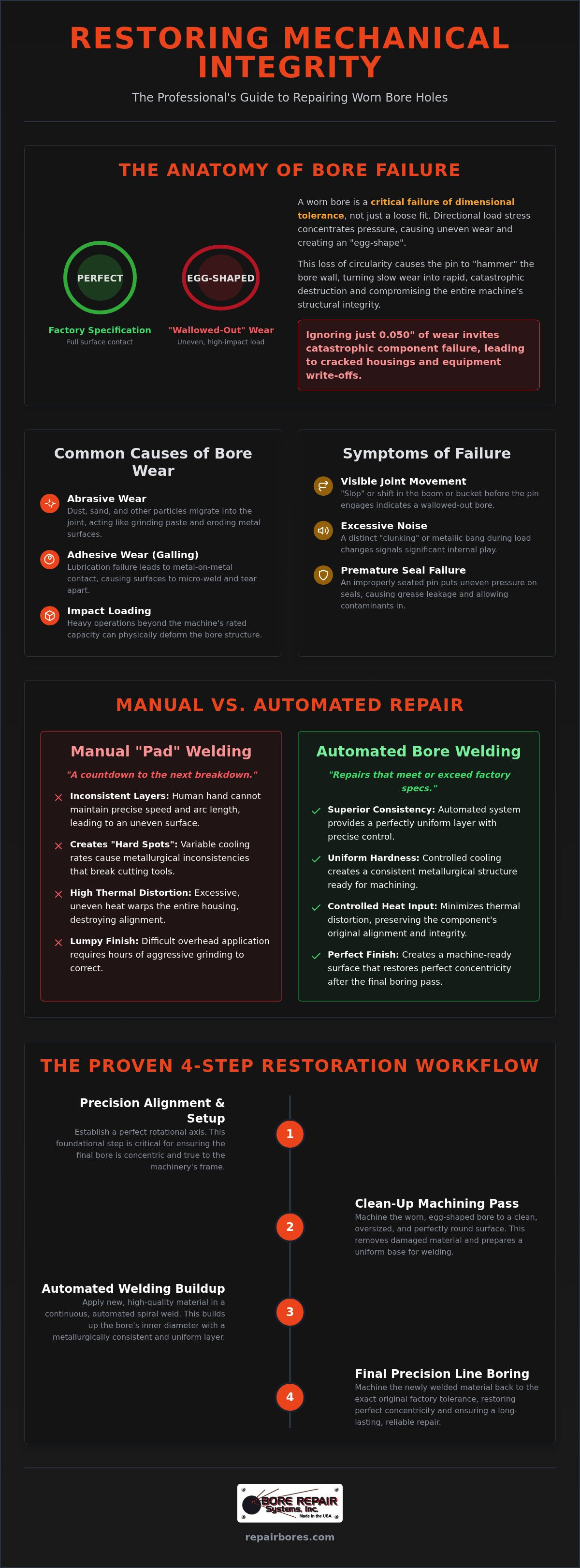
A worn bore is more than just a loose hole; it is a critical failure of dimensional tolerance. In heavy machinery, bores serve as the foundation for pivot points, housing the pins and bushings that allow for fluid movement. When a bore loses its circularity, the entire mechanical assembly suffers. This isn't just a matter of "slop" in the controls. It is a loss of structural integrity that affects the machine's ability to transfer force safely and accurately. For a deep dive into the engineering principles of creating these precision diameters, Boring (manufacturing) offers the technical background on how these interfaces are established.
The most common failure pattern is the "egg-shaped" bore. This phenomenon occurs because equipment rarely experiences uniform loads. An excavator bucket, for instance, applies massive force in specific directions during a dig cycle. This directional load stress concentrates pressure on one side of the bore wall, causing the metal to compress and wear unevenly. Once the hole begins to oval, the pin no longer makes full surface contact. It starts to "hammer" against the wall with every movement, turning a slow wear process into rapid destruction.
Vibration and friction are the silent killers of pivot points. As the gap between the pin and the bore wall increases, the vibration intensity multiplies. If you ignore as little as 0.050" of wear, you are inviting catastrophic component failure. At this stage, the loose pin acts like a slide hammer, sending shockwaves through the frame. This can lead to cracked housings or warped bores that are impossible to fix with simple bushing replacements. Knowing how to repair worn bore holes at the first sign of trouble is the difference between a routine maintenance task and a total equipment write-off.
Common Causes of Bore Wear in Heavy Equipment
Wear rarely has a single source. It's usually a combination of environmental and operational factors. Abrasive wear is the most frequent culprit, occurring when dust, sand, or granite fines migrate into the joint. These particles act like grinding paste, eating away at the metal. Adhesive wear, or galling, happens when lubrication fails. Without a grease barrier, metal-on-metal contact causes the surfaces to microscopic-weld and tear apart. Finally, impact loading from heavy excavation or mining operations can physically deform the bore, especially if the machine is pushed beyond its rated capacity.
Symptoms of Mechanical Integrity Loss
You don't need a micrometer to tell when a bore is failing. Visible movement in the joints during operation is the most obvious sign. If the boom or bucket shifts before the pin catches, the bore is wallowed out. Listen for excessive noise; a distinct "clunking" or metallic bang during load changes indicates significant play. You should also watch for premature seal failure and grease leakage. When a pin isn't seated correctly, it puts uneven pressure on the seals, allowing contaminants in and forced-out grease to signal that the internal tolerances are gone. If you see these signs, it's time to look at professional bore repair equipment to restore the machine to factory specs.
Manual vs. Automated Bore Repair: Choosing the Right Path
Deciding how to repair worn bore holes often comes down to a choice between traditional manual buildup and modern automated systems. While a skilled welder can lay a bead, manual "pad" welding is notoriously inconsistent. The human hand cannot maintain the precise travel speed and arc length required for a perfectly uniform layer inside a cylinder. This inconsistency creates "hard spots" where the cooling rate varies. These hard spots are a nightmare for machinists, often leading to broken cutting tools or "chatter" during the final boring process.
Manual welding also introduces significant thermal distortion. To fill a wallowed-out bore, a manual operator often pumps excessive heat into specific areas to ensure penetration. This uneven heat distribution can warp the entire housing. If the housing warps, the alignment is lost, making it impossible to return the component to factory specifications without expensive, large-scale machining. You aren't just filling a hole; you're managing the heat signature of the entire part.
The Pitfalls of Manual Buildup
Maintaining a consistent bead in a 360-degree overhead environment is a physical struggle for any operator. It's nearly impossible to avoid "lumpy" finishes that require hours of aggressive grinding before a boring bar can even be set up. This grinding is not just labor-intensive; it's imprecise. Beyond the surface, manual welds are prone to porosity and slag inclusions. These internal defects weaken the mechanical integrity of the repair. They often lead to premature cracking under the heavy impact loads typical of mining or excavation work. You end up with a repair that looks acceptable on the surface but lacks the structural depth of the original metal.
Advantages of Automated Bore Welding Systems
Automated bore welders solve these issues by providing 100% surface coverage with mechanical precision. These systems ensure consistent metallurgy by maintaining a steady, controlled heat input throughout the entire 360-degree rotation. This uniform heating drastically reduces the risk of cracking or warping the base metal. It keeps the structural integrity of the component intact while adding the necessary material for restoration.
Efficiency is the primary driver for switching to automation. Verified industry data shows that automated systems can reduce welding time by 50% to 75% compared to manual methods. Because the weld is smooth and uniform, the "clean-up" machining pass is faster and easier on your tooling. These systems integrate seamlessly with line boring bars. This allows for a rapid transition from welding to machining without tearing down your setup. If you're ready to upgrade your shop's capabilities, you can reach out to our technical team for guidance on the right equipment for your specific needs.
Step-by-Step: How to Rebuild Worn Bores with Automated Systems
Professional bore restoration is a systematic, two-stage process. You cannot simply fill a hole with metal and hope for the best. True restoration requires a controlled buildup of material followed by precision machining to return the component to its original factory dimensions. This workflow ensures that the new metal bonds correctly and that the finished bore is perfectly concentric with the machine's original axis. Following a sequential plan is the only way to guarantee a repair that lasts as long as a new part.
Phase 1: Preparation and Alignment
Before you begin welding, perform a "roughing" or clean-up pass with the boring bar. This step removes work-hardened material that often develops in high-stress pivot points. Work-hardened steel is brittle and resists proper weld penetration. By machining away a small amount of the old surface, you expose fresh, weldable metal that ensures a superior bond for the new buildup.
Once the bore is prepped, swap the machining tool for the automated welder. Choosing the right consumables is the first step in how to repair worn bore holes with professional results. Match your wire and shielding gas to the base metal of the equipment. Set your spiral pitch and travel speed to achieve a 50% bead overlap. This specific overlap ensures 100% surface coverage and creates a smooth, "machinable" finish that isn't excessively lumpy or uneven.
Monitor the weld closely as the system progresses. You want a uniform spiral of metal that provides enough "meat" for the final machining pass without overfilling the bore. Excessive overfill just wastes time and cutting tools during the boring stage. The beauty of modern automated systems is that they allow you to transition from welding back to line boring without moving the mounting hardware. For a visual breakdown of this transition, you can view our bore welder and portable boring videos to see the hardware in action. By keeping the mounting plates in place, you maintain your perfect center and eliminate the risk of misalignment during the final machining phase.
Precision Machining: Restoring Factory Tolerances with Line Boring
Line boring is the final, non-negotiable step in the restoration process. While the welding phase adds the necessary material, line boring provides the precision. It is the process of machining a bore back to its exact diameter using a rotating cutting tool on a rigid bar. After any welding process, the metal surface is too irregular for a pin or bushing. Line boring ensures that the new bore is perfectly concentric with the original centerline of the component. To master these skills, you can learn more about line boring operator training to ensure your team achieves professional results every time.
Rigidity is everything in this phase. If your boring bar or mounting setup is weak, you'll experience "chatter." These are vibrations that leave a wavy, irregular finish on the metal surface. A rigid setup allows the cutting tool to peel away the weld material smoothly, maintaining a true path without deflection. This is how you achieve the tight tolerances required by heavy equipment manufacturers. Without a stable setup, you risk ruining the work you've done during the welding stage.
Achieving the Perfect Surface Finish
The quality of your finish depends on three variables: tool geometry, feed rates, and spindle speed. Weld material is often harder than the base steel. You must select the right carbide grade to handle the interrupted cuts and varied hardness. If your feeds and speeds are incorrect, the tool will deflect, leading to an undersized or tapered hole. Once the machining is complete, verify the work with precision inside micrometers. This is the only way to confirm a perfect fit for your pins and bushings.
Restoring Alignment Across Multiple Bores
One of the biggest challenges in how to repair worn bore holes involves inline bores, such as those found on excavator bucket ears or loader arms. These holes must be perfectly co-axial. If the bores are even slightly out of alignment, the pin will bind. This leads to rapid wear or physical damage to the frame. A single, continuous boring bar is the solution. By running the bar through both holes simultaneously, you ensure they share the same axis. For more complex scenarios, you can explore misaligned bore repair techniques to handle severe frame distortion.
Precision machining is what separates a professional repair from a temporary fix. If you need assistance selecting the right portable machine tools for your facility, contact our experts today to discuss your specific requirements.
Implementing a Professional Bore Repair Strategy In-House
Bringing bore repair in-house is a strategic shift that transforms maintenance from a reactive expense into a controlled capability. Relying on field machining contractors means you're at the mercy of their schedule and travel rates, which can reach $189 per hour according to industry averages. By owning the equipment, you eliminate these variables and the high cost of transportation to a workshop. Industry data suggests a portable line boring machine often pays for itself in as few as 2 to 5 repairs. This is a significant return on investment for any fleet manager looking to slash downtime and keep their machines in the dirt where they belong.
Portable machine tools offer the flexibility to perform repairs in the shop or directly on the machine in the field. This versatility ensures that you can address wear before it leads to the catastrophic failures we discussed in previous sections. For a detailed look at the latest technology available this year, check out our Professional Bore Welder Systems: 2026 Buying Guide. Mastering how to repair worn bore holes internally gives your team the power to maintain factory tolerances without waiting for outside help or paying for someone else's overhead.
Training Your Team for Success
High-quality hardware is only half the battle. Your equipment is only as good as the operator behind it. Investing in technical education ensures that your maintenance team understands the nuances of heat management, spiral welding, and machining precision. Professional training and certification programs help maintain fleet safety by ensuring every repair meets or exceeds engineering standards. You can start building this knowledge base by reviewing our Bore Welding and Portable Boring Videos to understand the precise workflow required for a successful restoration.
Selecting the Right Equipment Partner
When you decide to implement an in-house strategy, the source of your tools matters. Look for USA-made durability and a partner that provides reachable technical support. You don't want to be stuck with a broken machine and a manual that doesn't make sense. A reliable partner ensures that accessories and replacement parts are always available for varied bore sizes across your entire fleet. This comprehensive support is what keeps your operation profitable. If you're ready to take control of your maintenance schedule and stop overpaying for repairs, contact our experts to find the right system for your fleet.
Take Control of Your Equipment Restoration
Restoring mechanical integrity isn't about filling gaps with manual welds; it's about a systematic approach that returns every component to factory tolerances. You've seen why egg-shaped wear occurs and how the combination of automated welding and precision line boring provides a permanent resolution. By bringing these capabilities in-house, you eliminate the high costs of field contractors and the uncertainty of manual "pad" welding.
Mastering how to repair worn bore holes requires the right tools and the knowledge to use them. Bore Repair Systems, Inc. - Bore Repair Made Easy with our USA made Lineboring and Boreweld solutions provides USA-manufactured precision equipment trusted by mining and construction fleets globally. Every system we sell is backed by industry-leading technical training included with your purchase. This ensures your maintenance team can execute professional-grade repairs from day one.
Stop struggling with temporary fixes that lead to catastrophic failures. You have the ability to restore your fleet's productivity and maximize the lifespan of your heavy machinery. Request a Quote for Your Bore Repair System today to upgrade your shop's capabilities and keep your equipment in the dirt.
Frequently Asked Questions
Can I repair a worn bore hole by just welding it by hand?
Hand welding is possible but rarely provides a professional finish. It often results in uneven hardness and internal porosity. These "hard spots" make the subsequent machining process difficult and can damage your cutting tools. If you're learning how to repair worn bore holes for heavy equipment, automation is the only way to ensure the metallurgical consistency and 100% surface coverage required for a long-lasting repair.
How much wear is too much before a bore needs a complete rebuild?
Total rebuilds are necessary once the bore exceeds the press-fit tolerances of your bushings. Ignoring even 0.050" of wear can accelerate the "hammering" effect that leads to cracked housings. Once the hole becomes egg-shaped, simple bushing replacements won't work because the pin will only contact a small portion of the bore wall. Professional restoration should begin as soon as visible movement or excessive vibration is detected in the joint.
What is the difference between bore sleeving and bore welding?
Bore sleeving is a mechanical fix that involves machining a hole oversized and pressing in a sacrificial sleeve. This often fails in high-impact environments because the sleeve can spin or walk out. Bore welding creates a permanent metallurgical bond with the base metal. By adding new steel and machining it back to size, you restore the original structural integrity of the component rather than just adding a temporary filler.
Do I need to remove the component from the machine to repair the bore?
You don't need to disassemble the entire machine or transport large components to a machine shop. Portable line boring machines and automated welders mount directly to the equipment frame. This allows you to perform professional repairs in your own shop or out in the field. This capability significantly reduces downtime and eliminates the logistical costs of moving heavy excavator arms or loader frames to an outside facility.
How long does a typical automated bore repair take?
While every job is unique, automated systems are significantly faster than manual buildup. An automated welder can finish a pass in 25% of the time it takes a manual operator. A typical cycle involving a clean-up pass, welding, and final machining for a single bore often takes between three and five hours. This speed allows your team to complete multiple repairs in a single shift and return the machine to service quickly.
What equipment is needed for a professional in-field bore repair?
A professional setup requires three core components: an automated bore welder, a portable line boring machine, and the necessary mounting hardware. You'll also need a power source and shielding gas for the welding phase. Using a system where the welder and boring bar share the same mounting plates is ideal. This ensures that the buildup and the final machining pass stay perfectly aligned with the original axis of the hole.
Is training required to operate an automated bore welder?
Operating this equipment requires technical knowledge to achieve factory tolerances. While the tools simplify the process, the operator must understand alignment, heat input, and tool geometry. Professional training programs, like those provided by Bore Repair Systems, cover these critical skills. Proper instruction ensures that your maintenance team can handle complex repairs safely and effectively, protecting your investment in both the equipment and your fleet's mechanical integrity.
Can egg-shaped holes be restored to perfectly round?
Yes, restoring "egg-shaped" or wallowed-out bores is the primary function of professional line boring equipment. The process starts by establishing the original centerline of the hole using centering cones or a dial indicator. Once the automated welder adds new material, the boring bar machines the buildup into a perfect circle. This removes the ovality caused by directional load stress and returns the bore to the exact circular dimensions specified by the manufacturer.


Comments