

Hidden Risks of Outsourcing Bore Repair for Fleet Managers

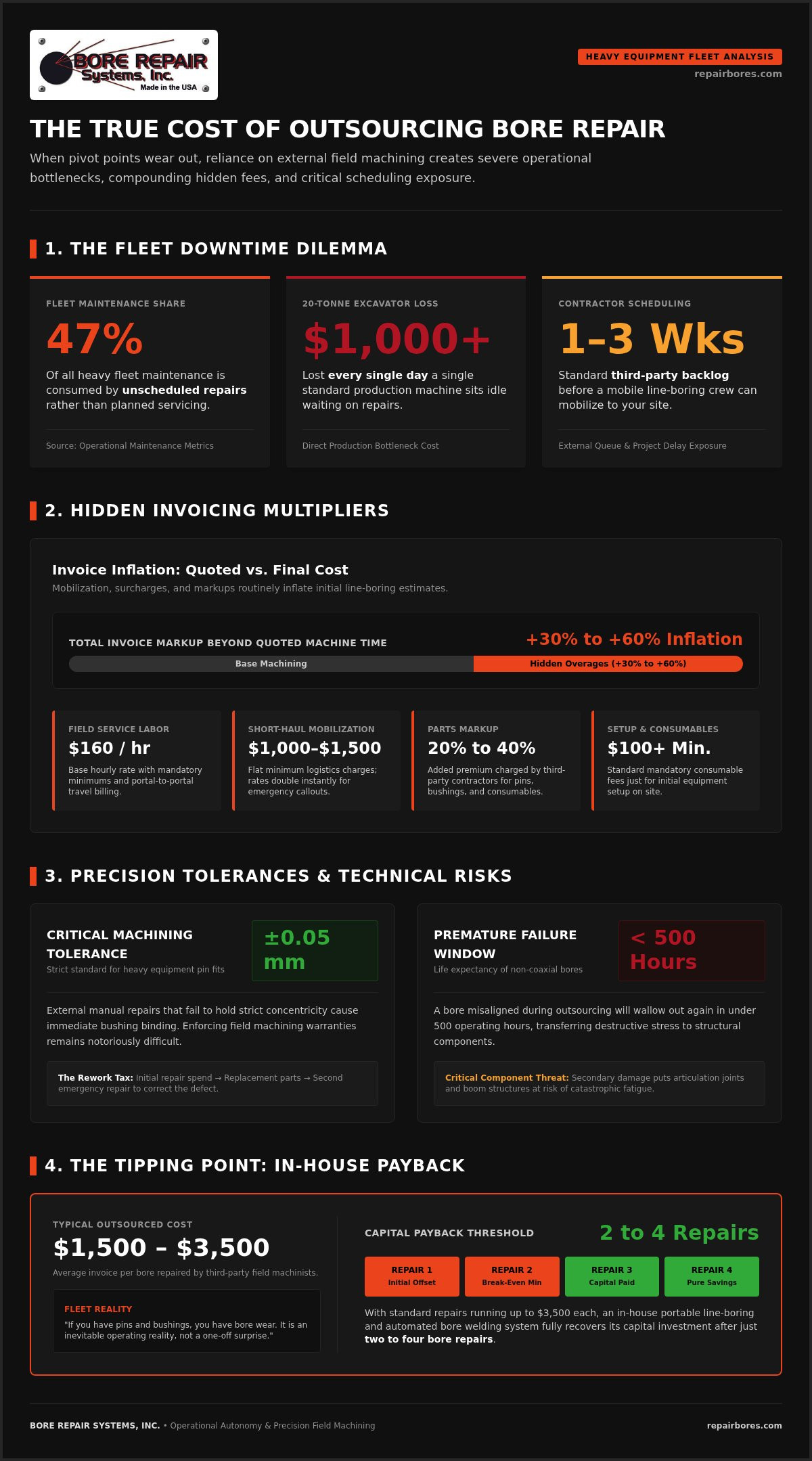
When nearly 47% of your fleet maintenance consists of unscheduled repairs, a broken-down 20-tonne excavator is more than a mechanical failure. It is a production bottleneck that costs over $1,000 every single day it sits idle in 2026. If you rely on external contractors, you aren't just paying for a fix. You're surrendering your production schedule to someone else's backlog. The hidden risks of outsourcing bore repair often outweigh the perceived convenience of calling in a third party. You have likely felt the sting of unpredictable lead times or mobilization fees that inflate a simple machining job by 60%.
It is a frustrating cycle, but you can break it. This article exposes the operational, financial, and quality risks of relying on external contractors and shows how in-house solutions protect your bottom line. We will break down the true cost of contractor delays, the danger of variable repair quality that leads to expensive rework, and how standardizing your process with portable machine tools reduces downtime. Discover how taking control of your boring and welding operations ensures your fleet stays where it belongs: on the job site and earning revenue.
Table of Contents
The Reality of Outsourcing Bore Repair in 2026
Outsourcing is the practice of hiring external field machining specialists to perform the line boring process and bore welding on heavy equipment. For many fleet managers, it's the default response to a worn-out pivot point. But in 2026, the industrial landscape has shifted. The risks of outsourcing bore repair are no longer just about the hourly rate; they're about the total loss of control over your machine's lifecycle.
We call this the "Outsourcing Trap." You see a single invoice and think you've saved money by avoiding a capital purchase. In reality, you're paying for a contractor’s travel, their specialized labor markup, and their 20% to 40% premium on replacement parts. Current market trends show field service rates hitting $160 per hour with mandatory minimums. When you add the fact that skilled machinists are in short supply, you're often paying premium rates for a technician who might be learning on your dime.
Why Companies Initially Choose to Outsource
Most managers start outsourcing because they worry about the technical skill gap. Welding a bore perfectly concentric is a high-stakes job. They also want to avoid upfront costs on specialized boring equipment. It feels easier to treat a wallowed-out bore as a "one-off" problem rather than a recurring fleet expense. This mentality ignores the long-term reality of heavy equipment maintenance. If you have pins and bushings, you have bore wear. It's an inevitable part of the job. Treating it as a surprise leads to reactive, expensive decisions.
The Threshold: When Outsourcing Becomes a Liability
At what point does a service call become a liability? Industry data suggests the tipping point is closer than you think. With average outsourced repairs costing between $1,500 and $3,500 per bore, an in-house system pays for itself in as few as two to four repairs. If you're managing more than a handful of machines, you've likely already passed the threshold where outsourcing stops making financial sense.
Beyond the money, there's the reliability factor. In 2026, "on-call" often means "on-hold." Contractors are facing 1- to 3-week backlogs. If your excavator is down, you can't afford to be fifth on a contractor's list. This is why the risks of outsourcing bore repair now include massive project delay penalties. Transitioning to operational autonomy by investing in your own portable machine tools isn't just a budget move; it's a survival strategy for your production schedule.
Hidden Financial Risks: Beyond the Contractor's Invoice
The invoice on your desk rarely tells the full story of your maintenance spend. While the hourly rate for field machining might look manageable on paper, the secondary costs associated with the risks of outsourcing bore repair can quickly drain a fleet's budget. You aren't just paying for the metal removed; you're paying for the contractor's overhead, their logistics, and the inherent inefficiency of third-party coordination.
Analyzing Mobilization and Emergency Fees
Mobilization is where the invisible costs start. In 2026, short-haul moves for heavy components carry flat minimums between $1,000 and $1,500. If you need an emergency repair to keep a project from hitting liquidated damages, those rates can double instantly. Contractors bill portal-to-portal, meaning you pay their full hourly rate while their technician sits in traffic or stops for fuel. You're also likely seeing minimum consumable charges of $100 or more just for the basic setup of their gear.
In the current market, mobilization, technician travel, fuel surcharges, and tool wear fees typically inflate final line-boring invoices by 30% to 60% beyond the actual quoted machine time.
The Rework Tax: Liability vs. Reality
Who pays when an external repair fails? Enforcing a warranty on a field-machined bore is notoriously difficult, making quality control one of the primary risks of outsourcing bore repair. If a contractor fails to hold the required ±0.05 mm tolerance, the new pin and bushing will bind or fail prematurely. This leads to what we call the "rework tax." You pay for the initial repair, the replacement parts, and then a second repair to fix the first one. This cycle is supported by NIST research on maintenance and downtime costs, which shows how reactive maintenance strategies multiply operational losses through higher defect rates.
Poor repairs also cause secondary damage to expensive components. A bore that isn't perfectly coaxial will wallow out again within 500 operating hours, potentially ruining the articulation joints or booms of the machine. Managing these contractor relationships and quality disputes takes your best people away from higher-value tasks, creating an opportunity cost that is rarely captured on a balance sheet. You can see how other managers have eliminated these headaches by reviewing real-world customer feedback on in-house systems. If you're tired of paying for a contractor's windshield time, reach out to our team to discuss how to keep those margins in your own shop.
Quality Control and Technical Consistency Risks
Quality is the most significant gamble in the field machining industry. When you sign a service contract, you're often playing what we call the "Contractor Lottery." You pay for the reputation of a firm, but you have no control over the individual technician who arrives at your site. One of the primary risks of outsourcing bore repair is the high variance in skill levels between a veteran machinist and a junior tech sent to handle a "routine" job. On a critical repair for a high-reach excavator or a primary crusher, that skill gap can be the difference between a successful fix and a catastrophic structural failure.
Relying on external contractors also results in a steady loss of institutional knowledge. Your shop team knows your equipment. They understand how a specific loader operates in your environment and where it typically fails. When you outsource, that data walks out the door with the contractor. Your team misses the chance to analyze wear patterns and implement preventative measures. Over time, this makes your fleet maintenance purely reactive and prevents you from ever getting ahead of the repair cycle.
Skill Variance in the Field Machining Industry
Verifying a contractor's specific experience with your particular machinery is a constant challenge. A technician might be an expert on stationary shop lathes but lack the experience to set up a portable bar in the mud under a machine. This is where automated systems provide a level of consistency that manual outsourcing simply cannot match. By bringing the technology in-house, you remove the human variable from the welding process. Understanding what a bore welder is and why you need one helps you see how automation allows your existing shop staff to achieve professional results without needing 20 years of specialized field machining experience.
The Precision Gap in Outsourced Repairs
Precision isn't optional in heavy equipment linkages. OEM standards often require diameter tolerances within ±0.05 mm to ensure proper interference or clearance fits. If an outsourced contractor fails to align dual bores coaxially across a span, the replacement pin will bind immediately. This creates massive friction, generates heat, and leads to premature wear in the very linkages you just paid to restore. Manual bore welding creates uneven heat distribution that leads to localized thermal distortion, potentially compromising the structural integrity of the parent metal.
Owning the repair process allows you to own the data. When your team performs the machining, you can log every specification, tolerance, and surface finish in your own fleet tracking system. This technical consistency ensures that every machine in your fleet meets the same high standards, regardless of which shift performed the work. It turns a specialized "dark art" into a repeatable, high-precision shop process that protects your assets and your operators.
Scheduling Bottlenecks and Equipment Downtime
Your equipment only generates revenue when it's moving dirt. When a pivot point fails, the clock starts ticking on your overhead. One of the most frustrating risks of outsourcing bore repair is the "Next in Line" problem. Unless you are a massive tier-one contractor with a multi-million dollar service agreement, you are likely a low-priority client for a busy repair shop. You're forced to wait for their technicians to finish larger jobs before they even look at your machine. This turns what should be a simple four-hour repair into a four-day shutdown.
Taking control of your own repairs allows for on-site, on-demand maintenance. When you own the equipment, you don't wait for a contractor to clear their schedule. You pull the machine into the shop, set up the bar, and start welding immediately. This operational autonomy is the only way to ensure a minor wear issue doesn't escalate into a project-halting crisis. You can see the speed and efficiency of these in-house repairs by viewing our bore welder and portable boring videos.
The Contractor Availability Crisis
Finding a specialized line boring contractor on short notice is becoming nearly impossible. In 2026, mobile contractors frequently operate on one- to three-week scheduling backlogs. This shortage of skilled labor puts fleet managers in a vulnerable position. If you manage to get a tech on-site, you also face the risk of "scope creep." Once a contractor is there, they may find additional "necessary" repairs that inflate the bill and extend the downtime. This lack of predictability makes it impossible to provide accurate timelines to your project stakeholders.
Downtime Cost Modeling
The math on downtime is brutal. Industry benchmarks from 2026 show that unplanned fleet asset downtime costs between $448 and $760 per day at a baseline. For critical heavy equipment on public infrastructure projects, project delay liquidated damages can reach $3,498 per day. Every hour you spend waiting for a contractor's truck to pull into your yard is an hour of lost profit and idle operator wages.
In-house equipment changes the maintenance dynamic from reactive to proactive. Instead of waiting for a bore to wallow out completely, your team can perform preventative bore welding during scheduled service intervals. This keeps tolerances tight and prevents the "cascading failure" where a loose pin ruins an entire housing. There is also a significant psychological benefit to your crew. When they have the tools to fix problems immediately, morale stays high, and the "make-do" culture that leads to accidents disappears. If you're ready to stop waiting and start fixing, contact us today for an equipment consultation.
Mitigating Risk with In-House Bore Repair Systems
The 2026 roadmap for high-efficiency fleet management is built on the concept of operational autonomy. Successfully moving away from the risks of outsourcing bore repair requires a shift from reactive service calls to a self-reliant maintenance department. Instead of viewing line boring as a specialized "outside" job, managers are now integrating it into their standard shop protocols. This transition begins with identifying the specific pivot points across your fleet that suffer from the most frequent wear.
Automated systems are the engine of this transition. A patented automated bore welder removes the manual inconsistency that makes outsourcing so unpredictable. It allows your current team to produce factory-spec welds with technical precision. When you control the process, you control both the quality and the timeline. You no longer have to worry about a contractor’s junior technician learning on your expensive equipment.
The financial justification for this shift is clear. With outsourced repairs typically costing between $1,500 and $3,500 per bore, an in-house portable system pays for itself in as few as two to four repairs. Considering entry-to-mid-range turnkey systems range from $4,000 to $12,000, the capital expenditure is often recovered within a single quarter. You aren't just buying tools; you're stopping the financial leak caused by mobilization fees and vendor markups on consumables.
Selecting the Right Equipment for Your Fleet
Choosing the right setup depends on your specific machine inventory. You must match your line boring bars and welders to the specific diameters of your equipment pivot points, which typically range from 40 mm to 300 mm. Portability is a non-negotiable feature. You need equipment that can be set up in the field without requiring a total teardown of the machine stick or boom. To explore the specific configurations available for your machinery, you can review our full range of bore repair products.
Bridging the Skill Gap with Training
Quality equipment is only half the solution. Professional training acts as the insurance policy for your investment. It ensures your operators understand setup geometry, feed rates, and thermal management to avoid the distortion issues common in manual repairs. At Bore Repair Systems, Inc., we provide the comprehensive training necessary to turn your mechanics into proficient machinists. We help you mitigate the risks of outsourcing bore repair by giving your team the expertise to handle every job in-house with confidence. When your crew is equipped with the right knowledge, your dependency on external schedules ends. Contact our experts to discuss your in-house transition and take back control of your fleet's bottom line.
Take Back Control of Your Fleet Maintenance
Relying on external contractors means your production schedule is always at the mercy of someone else's backlog. We have explored how the risks of outsourcing bore repair extend far beyond the initial invoice, impacting everything from your annual budget to the structural integrity of your machinery. By bringing these operations in-house, you eliminate the "Next in Line" problem and the high cost of contractor travel fees. You gain the ability to perform high-precision repairs on your own timeline, ensuring your equipment stays on the job site where it belongs.
Bore Repair Systems provides the tools and expertise to make this transition seamless. Our patented automated bore welding technology and Made in the USA durability ensure your shop is equipped for the long haul. We don't just sell machines; we provide comprehensive operator training programs that bridge the skill gap and turn your mechanics into precision machinists. It's time to stop paying for a contractor's windshield time and start investing in your own team's success. Take Control of Your Maintenance: Contact Bore Repair Systems Today. Your fleet is the backbone of your business; keep it moving with confidence.
Frequently Asked Questions
What are the most common hidden costs when outsourcing bore repair?
The most common hidden costs include mobilization fees and portal-to-portal travel billing. Contractors often add a 20% to 40% markup on consumables and replacement parts like bushings. These "invisible" charges typically inflate a standard invoice by 30% to 60% beyond the actual machining time. When you manage your own repairs, you eliminate these surcharges entirely. You also avoid the high hourly rates for specialized field labor that continue to climb in 2026.
Is it difficult to train my current mechanics to use a bore welder?
Training is straightforward when you have the right educational support. Bore Repair Systems provides comprehensive programs designed to bridge the skill gap for your existing shop team. Automated bore welders simplify the process by removing the need for manual torch manipulation. This allows a standard mechanic to achieve factory-spec results without years of specialized welding experience. Our training ensures your operators are proficient in setup and precision machining from day one.
How long does it typically take for an in-house bore repair system to pay for itself?
Most fleet managers see a full return on investment after just two to four repairs. With outsourced field machining costs ranging from $1,500 to $3,500 per bore, the savings accumulate rapidly. When you factor in the elimination of mobilization fees and reduced machine downtime, the payback period is often less than one business quarter. Investing in your own equipment turns a recurring expense into a long-term asset for your maintenance department.
Can automated bore welders really match the quality of a specialist contractor?
Automated bore welders often exceed the quality of manual contractor repairs. They provide consistent bead placement and controlled heat distribution, which prevents the thermal distortion common in manual welding. This technology eliminates the "Contractor Lottery" risk where you might receive a junior technician for a critical structural repair. By using patented automated technology, your team can maintain tighter tolerances and ensure perfect concentricity across every machine in your fleet.
What happens if an outsourced bore repair fails shortly after the machine returns to service?
One of the major risks of outsourcing bore repair is the difficulty of enforcing warranties on field work. If a repair fails shortly after service, you are often stuck with a "rework tax." This includes paying for a second repair, new pins, and additional downtime. Contractors may blame machine operation rather than their own machining tolerances. Owning your equipment ensures you control the quality and can address wear issues before they cause failure.
How does owning a portable line boring machine reduce equipment downtime?
Owning a portable line boring machine allows you to skip the 1- to 3-week backlogs typical of mobile contractors. You can perform repairs on-site and on-demand, turning a multi-day shutdown into a single-shift fix. This operational autonomy means you aren't waiting for a third party to prioritize your machine. You can also perform proactive bore welding during scheduled maintenance intervals, which prevents the catastrophic failures that lead to unplanned project delays and penalties.
What safety risks are associated with manual bore welding versus automated systems?
Manual bore welding involves significant safety hazards, including prolonged exposure to intense heat, fumes, and repetitive strain in cramped spaces. Automated systems allow the operator to monitor the welding process from a safe distance, significantly reducing flash and respiratory risks. Our Made in the USA equipment is designed for stability and safety, ensuring your team can perform heavy-duty repairs without the physical toll associated with traditional manual field machining and welding methods.
Is in-house bore repair feasible for small fleets with only a few machines?
In-house repair is highly feasible for small fleets because it protects your limited assets from unpredictable downtime. A single machine failure can halt your entire operation, and waiting for a contractor makes that shutdown longer. Small fleets often face the highest mobilization fees relative to the job size. By investing in professional-grade tools, you gain the same operational autonomy as larger firms. This ensures your few machines stay productive and your project deadlines remain secure.


Comments