

Excavator Boom Bore Repair: Restoring Precision to Heavy Equipment

What if you could stop paying for expensive on-site repair crews and fix your own equipment in-house with factory-level precision? You know the frustration of watching a multi-ton machine sit idle just because of a worn, egg-shaped pin hole. Manual weld repairs often fail under the extreme stress of heavy digging; they just don't have the structural bond needed for long-term durability. Waiting for a specialized service technician to arrive kills your productivity and adds unnecessary costs to your bottom line. It's a common bottleneck that eats into your margins and slows down every project on the schedule.
This guide shows you how to master excavator boom bore repair by using automated welding and precision boring to restore your machine to original specifications. You'll learn how to permanently fix distorted holes and regain the mechanical integrity your equipment needs to stay in the field. We'll walk through the dual-phase process of automated material build-up and precision machining. This approach gives you the knowledge to handle these repairs yourself, ensuring your fleet stays operational without the wait times or high overhead of outside contractors.
Table of Contents
Understanding Excavator Boom Bore Wear and Failure
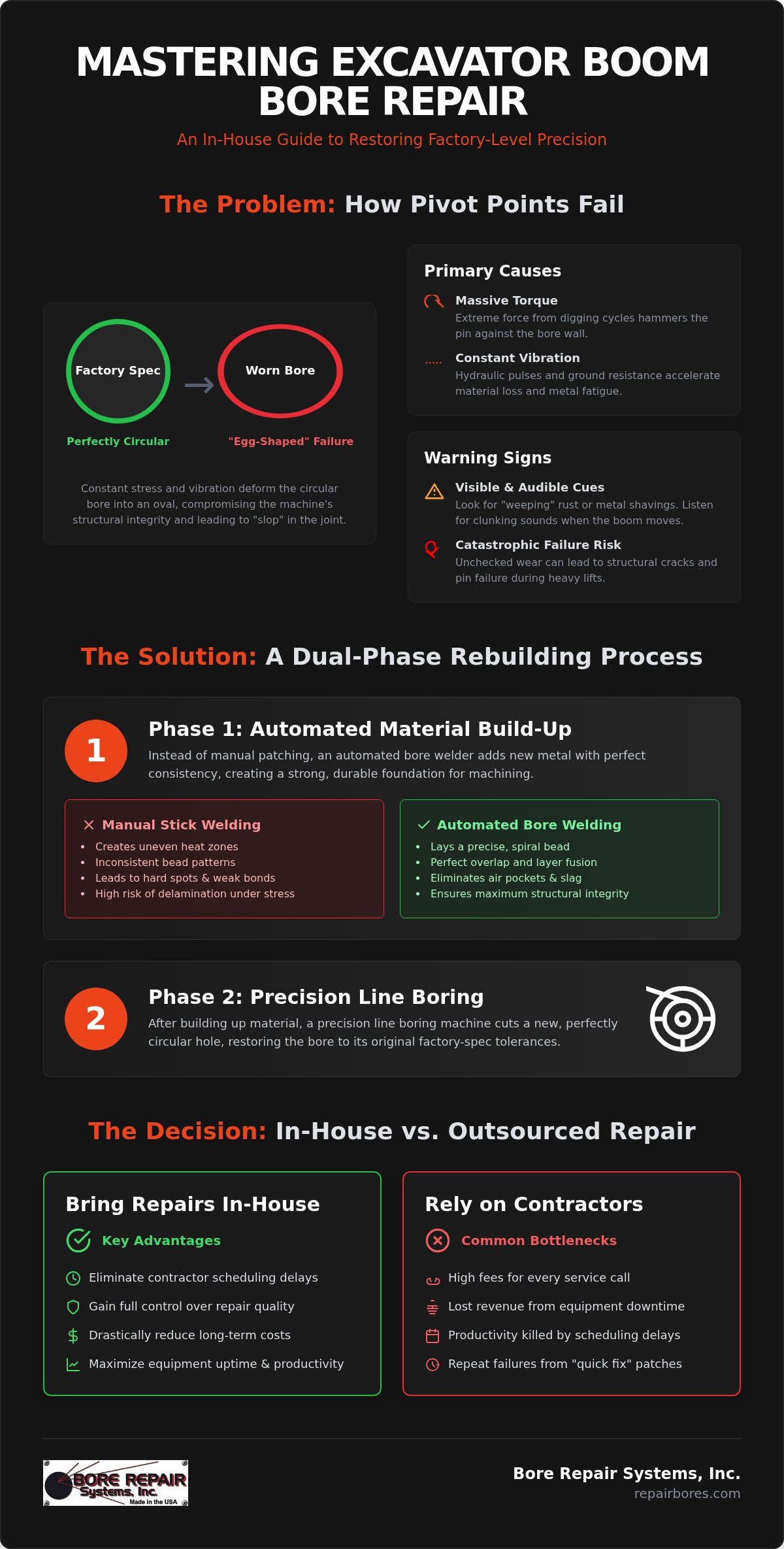
Excavator booms are built for power, but their pivot points are their greatest mechanical vulnerability. Every time a bucket bites into the earth, massive torque translates directly into the boom bores. This constant cycle of loading and unloading causes the pin to hammer against the bore wall. Over time, this mechanical stress deforms the circular hole into an oval, commonly called an "egg-shaped" bore. It's a fundamental failure of the metal housing that standard maintenance cannot prevent once the wear cycle begins.
The physics of this wear is simple but destructive. Unlike a rotating shaft that wears evenly, an excavator pin mostly pushes in one direction during a dig cycle. Vibration from hydraulic pulses and ground resistance accelerates the material loss. If you ignore this wear, the loose joint creates a "slop" that forces the engine to work harder to maintain control, leading to increased fuel consumption. Eventually, the uneven load distribution causes structural cracking around the eye of the boom. This damage can lead to a catastrophic pin failure during a heavy lift, putting both the machine and the operator at risk.
Identifying Egg-Shaped Pin Holes
You don't always need a micrometer to spot the problem. Look for "weeping" rust or metal shavings around the pivot point. If the machine clunks when the boom changes direction, the bore is likely deformed. To confirm the damage, remove the pin and measure the bore at multiple angles with precision calipers. If the vertical measurement exceeds the horizontal by even a small margin, standard bushings won't solve the problem. You need a proper excavator boom bore repair to restore the structural housing itself, as a new bushing in a deformed hole will simply fail again within weeks.
The True Cost of Equipment Downtime
When heavy equipment sits idle, the lost revenue adds up by the hour. A sloppy boom joint makes precision digging impossible, turning a simple grading job into a time-consuming struggle. Some shops try "quick fixes" like welding in a shim or using an oversized bushing, but these rarely last. As we move through 2026, the shortage of skilled technicians makes these repeat failures even more expensive. Investing in a permanent excavator boom bore repair using automated welding and machining is the only way to ensure the machine stays productive and safe on the job site.
The Mechanics of Precision Bore Rebuilding
Rebuilding a bore isn't a single-step job. You can't just bore out an egg-shaped hole and call it done. Doing so would require oversized, custom bushings, which often weakens the boom's structural housing. A professional excavator boom bore repair requires a methodical two-step approach: material build-up followed by precision machining. This dual-phase process ensures you're working with a solid metallurgical bond rather than a temporary patch. By adding metal back to the worn areas, you restore the original dimensions and maintain the structural integrity of the arm.
The first phase focuses on the fusion of new metal to the existing bore. This isn't just about filling a hole; it's about creating a surface that can withstand the same hydraulic forces as the original factory steel. If the weld doesn't bond correctly, it will delaminate under the pressure of heavy lifting. This technical precision is what separates a professional restoration from a "quick fix" that fails within a few hundred hours of operation.
Automated Bore Welding vs. Manual Build-up
Manual stick welding is a gamble in a high-stress environment. It creates uneven heat zones and inconsistent bead patterns, leading to hard spots that can snap a boring tool during the machining phase. In contrast, automated welders lay down a precise, spiral bead with perfect overlap. This consistency reduces the amount of machining needed and ensures the new material is fully fused to the base metal without air pockets or slag inclusions. Learn more about what a bore welder is to understand how this technology simplifies the welding process and protects your equipment from heat-related warping.
Line Boring for Factory-Spec Tolerances
Once the material is built up, the second phase begins. This is where line boring restores the perfect circle. Line boring is not just about making a hole; it's about restoring concentricity across multiple pivot points. This fits into a broader strategy of predictive maintenance that prevents the machine from shaking itself apart during operation. The boring bar acts as the reference point for the entire excavator boom bore repair, ensuring that both sides of a boom arm are perfectly aligned.
Without this alignment, your pins will bind, and your new bushings will wear out in days. Precision boring allows you to achieve the exact interference fit required by the manufacturer. Using portable machine tools means you can perform these repairs right on the chassis, saving you the labor of a full teardown. If you're ready to upgrade your shop's capabilities and stop relying on outside vendors, you can speak with a technician about the right equipment for your fleet.
In-House Bore Repair vs. Outsourced Field Services
Deciding whether to call a contractor or handle a repair yourself is a matter of control. When a machine goes down, every hour of waiting is lost revenue that you can't recover. Bore Repair Systems, Inc. - Bore Repair Made Easy with our USA made Lineboring and Boreweld solutions offers the tools to break this cycle of dependency. Owning a portable bore welder and line boring machine does more than just save money on a single job. It increases your entire service capability. You stop being a customer and start being a provider. This shift allows you to perform an excavator boom bore repair the moment the wear is detected, rather than waiting for a failure that sidelines the equipment for weeks. Proactive repairs are always cheaper than reactive ones.
The Cost of Outsourcing Field Repairs
Typical mobilization fees and daily rates for specialized technicians can be high. During peak construction seasons, lead times for a contractor often stretch into weeks. There's also the problem of quality control. When you perform an excavator boom bore repair in-house, you know exactly who did the work. You aren't gambling on the skills of a third party technician who might be rushing to get to their next billable site. Outsourcing might seem like the easy path, but it puts your schedule and your machine's mechanical integrity in someone else's hands.
ROI of Investing in Portable Machine Tools
Investing in your own equipment changes the math of your maintenance budget. A detailed look at the ROI of in-house line boring vs outsourcing shows that most shops recover their investment within the first few jobs. Instead of paying for a contractor's profit margin, you're building equity in your own tools. This responsiveness is a massive competitive advantage in 2026, where equipment availability often dictates project success. Bore Repair Systems, Inc. - Bore Repair Made Easy with our USA made Lineboring and Boreweld solutions ensures your shop can handle any bore failure that comes through the door. Training your existing mechanics to use automated systems keeps high value skills in house and ensures your shop stays responsive to equipment needs.
Step-by-Step Excavator Boom Bore Repair Process
A successful excavator boom bore repair starts with a clean slate. You must strip the joint down to bare metal. Grease and dirt are the enemies of a good weld. Remove old bushings and use a wire wheel or grinder to clear out any carbon or scale. This isn't just about appearance; it's about ensuring the new metal fuses perfectly with the boom. Once the bore is clean, you can focus on the geometry of the repair. Establishing a true reference line is the only way to ensure the machine functions like new.
Precision Alignment and Setup
You can't rely on guesswork here. Centering the boring bar is what determines the success of the entire job. If the bar isn't aligned with the boom's axis, your pins will bind and your bushings will fail. Use centering tools or dial indicators to lock the bar into the true center of the bore. Secure your mounting brackets with solid tack welds to prevent any movement during the machining process. Stability is everything when you're aiming for factory tolerances. Watch boring and welding videos for visual guidance to see how professional setups handle these high-stress joints.
Executing the Automated Weld and Final Pass
Now, the automated bore welder takes over. It lays down a consistent bead that manual welding can't match. Set your amperage and rotation speed to ensure deep penetration and a smooth build-up. Watch your heat. If the boom arm gets too hot, you risk warping the structural steel. Allow for natural cooling cycles to maintain the metallurgical integrity of the arm. This methodical approach prevents the distortion that often ruins manual repairs.
Once the welding is complete, switch back to the boring tool for the final pass. This is where you reach the exact diameter required for a press-fit bushing. Take your time with the final cuts to ensure a mirror finish. Check your measurements one last time with a micrometer before you press in the new bushings and install the pivot pin. If you're looking to upgrade your shop's efficiency and stop relying on outside help, contact our experts to find the right boring and welding system for your fleet.
Professional Equipment and Training for Boom Repairs
Selecting the right tools is the difference between a repair that lasts a decade and one that fails in a week. When you're dealing with an excavator boom bore repair, the scale of the equipment matters. You don't want a machine that's too light for heavy duty work, but you also don't need a massive, stationary system that requires you to disassemble the entire machine. Portability is the key to field efficiency. You need equipment that's rugged enough for the workshop but light enough to mount directly on the chassis of a 200 class excavator or larger. It's about bringing the precision of a machine shop directly to the iron.
Bore Repair Systems, Inc. - Bore Repair Made Easy with our USA made Lineboring and Boreweld solutions supports American businesses by providing more than just hardware; we provide the technical education needed to use it effectively. We understand that in 2026, your time is your most valuable asset. Our American made industrial strength equipment is designed to be straightforward and dependable. We focus on making the repair process as efficient as possible so you can get your machines back into the dirt without unnecessary complication or downtime.
Selecting the Right Bore Welder and Boring Bar
Look for systems that offer a balance of power and precision. The bore diameter dictates your choice; smaller pins might require a compact welder, while main boom pivots need a bar with more reach and torque. It's about having the right accessories, like specialized mounting plates and centering cones, that specifically fit the geometry of heavy equipment arms. Explore our full line of bore repair products to see how our tools are built for industrial strength. For a deeper dive into specs and features, check out our Professional Bore Welder Systems: 2026 Buying Guide.
Mastering the Craft with Expert Training
The best equipment in the world won't save you if the operator doesn't understand the fundamentals of alignment and heat control. Training is the fastest path to professional results. It's where you learn to avoid common mistakes like over welding or miscalculating the interference fit for a bushing. At Bore Repair Systems, Inc. - Bore Repair Made Easy with our USA made Lineboring and Boreweld solutions, we don't just sell you a machine; we act as a partner in your success. Our specialized training programs ensure your team has the confidence to handle any failure. This hands on knowledge transforms a mechanic into a precision machinist. Read our guide on Line Boring Operator Training: Mastering Precision Bore Repair in 2026 to see what your team can achieve. If you're ready to stop outsourcing and start building in house expertise, contact us today to discuss equipment and training options.
Take Control of Your Fleet Maintenance
Waiting for a third-party technician is a choice you don't have to make. By mastering the dual-phase process of automated welding and precision machining, you transform a major mechanical failure into a routine maintenance task. You've seen how identifying egg-shaped holes early and applying a proper metallurgical bond saves your boom from structural cracking. Bringing these capabilities in-house isn't just about saving on mobilization fees; it's about the long-term mechanical integrity of your entire fleet.
Bore Repair Systems provides the tools and the knowledge to eliminate equipment slop for good. Our American-made precision equipment is backed by decades of industrial expertise. We don't just ship a machine; we provide comprehensive operator training to ensure your team achieves factory-spec results on every excavator boom bore repair. It's time to stop paying for downtime and start investing in your shop's future.
Request a Quote for Bore Repair Equipment & Training and see how easy it is to restore your machines to original specifications.
Frequently Asked Questions
Can I fix an egg-shaped bore without welding it first?
No, you cannot properly restore an egg-shaped bore without welding it first. Boring is a subtractive process that only removes metal. If you simply bore out a deformed hole, you'll end up with a diameter that's too large for standard factory bushings. This requires expensive custom parts and can weaken the boom's structural eye. A professional excavator boom bore repair always starts by adding material back with a bore welder to ensure enough metal exists for a precision finish.
How long does a typical excavator boom bore repair take?
A standard repair usually takes between four and eight hours per bore, depending on the severity of the wear. The setup and alignment phases consume the most time because precision is non-negotiable. Once the boring bar is centered and the automated welder is active, the material build-up happens quickly. Using portable machine tools allows you to complete the entire cycle in a single shift, significantly reducing the downtime compared to waiting for a third-party service crew.
Do I need to remove the boom from the excavator to perform the repair?
You don't have to remove the boom from the chassis to perform the repair. Portable line boring machines and bore welders are designed to mount directly onto the equipment in the shop or the field. This saves you the labor-intensive process of a full teardown and the risk of damaging hydraulic lines during disassembly. By bringing the tools to the iron, you maintain the machine's structural integrity while completing the excavator boom bore repair right where it sits.
What is the difference between line boring and standard boring?
Line boring differs from standard boring because it uses a long, supported bar to maintain perfect alignment across multiple pivot points. While standard boring might just clean up a single hole, line boring ensures that two or more bores are perfectly concentric along the same axis. This is critical for excavator booms where a single pin must pass through multiple sections. Without the precision of a line boring bar, your new pins will bind and cause immediate wear.
Is automated bore welding better than manual welding for boom repairs?
Automated bore welding is superior to manual welding because it provides a consistent, spiral bead with controlled heat input. Manual welding often results in hard spots or air pockets that make the subsequent machining phase difficult and unpredictable. Automated systems ensure a perfect metallurgical bond across the entire surface of the bore. This consistency prevents the delamination and structural failure that often occur when manual weld repairs are subjected to the high-stress loads of heavy digging.
How do I know if my excavator boom is too worn to be repaired?
Most bores are repairable unless the structural eye of the boom has developed deep, non-surface cracks that compromise the parent metal's strength. If the egg-shaped deformation has removed so much material that the safety margin of the boom housing is gone, the component might be scrap. However, in the vast majority of cases, automated welding can restore even severely worn holes. A thorough inspection and cleaning will reveal if the metal is still sound enough for a rebuild.
What kind of training is required to operate a bore welder safely?
Safe operation requires technical training focused on machine setup, alignment, and hydraulic or electrical safety. Operators must learn how to calculate feed rates and amperage settings to ensure deep weld penetration without warping the boom. Bore Repair Systems provides comprehensive training that covers everything from mounting the boring bar to executing the final pass. This education is the fastest way to avoid common operator mistakes and ensure your shop produces factory-quality repairs from day one.
Can these machines be used for other heavy equipment repairs like loaders or dozers?
These machines are highly versatile and work on almost any pivot point found on heavy equipment. Beyond excavator booms, you can use them to fix articulation joints on loaders, blade supports on dozers, and hinge pins on haul trucks. The portable nature of the equipment makes it a universal solution for any machinery with worn bores. Owning these tools allows your shop to handle a wide variety of industrial repairs across your entire fleet without relying on outside contractors.


Comments