

Bore Welding Certification: 2026 Professional Guide

How much revenue did your shop lose last month simply waiting for a mobile welder to arrive? When a critical piece of equipment goes down due to a worn pivot point or an egged-out bore, every hour of delay eats directly into your profit margins. Relying on outside vendors often leads to inconsistent results and scheduling headaches that keep your machines out of the dirt for far too long.
We understand that maintaining a fleet requires more than just high-quality tools; it requires a team with the technical precision to use them. Investing in professional bore welding certification training is the most effective way to eliminate reliance on third-party contractors and take control of your repair schedule. By mastering these automated systems, your technicians can deliver repeatable, factory-standard results every time.
This 2026 guide provides a clear roadmap for achieving professional certification. You will learn the essential technical standards, operational best practices, and the specific skills needed to reduce equipment downtime while ensuring mechanical integrity across all your heavy machinery repairs.
Table of Contents
The Critical Role of Bore Welding Certification in 2026
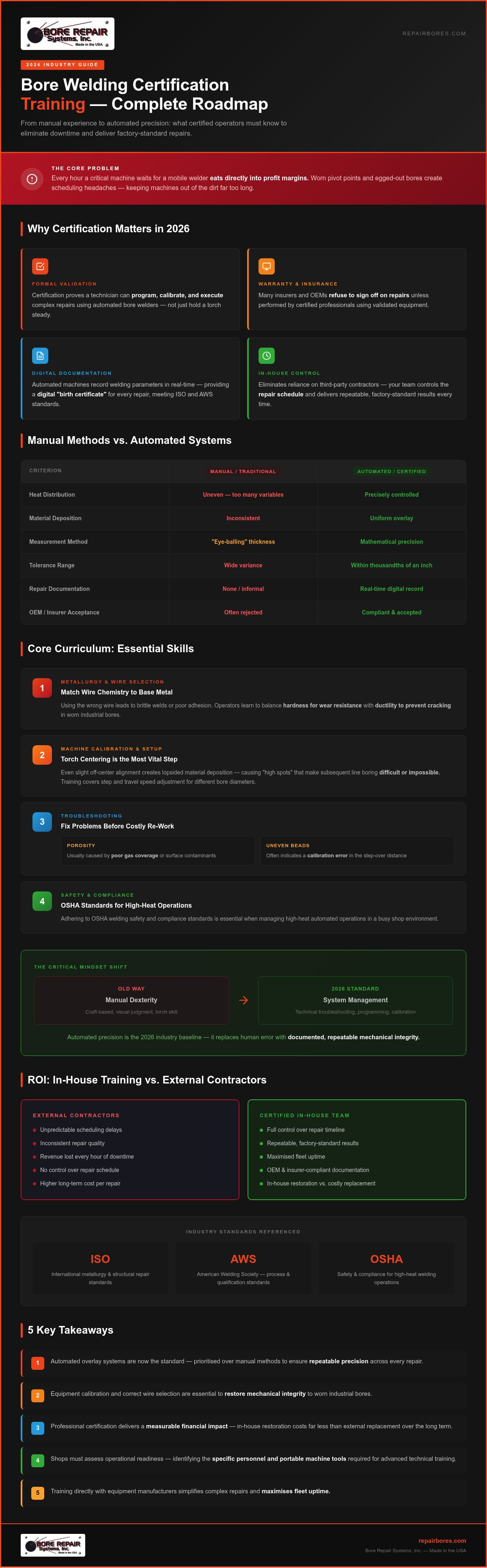
Bore welding certification isn't just a badge of attendance. It's a formal validation of an operator’s ability to manage automated overlay and precision machining tasks. In 2026, the industry has moved past the era where a steady hand with a torch was sufficient. Modern certification proves a technician can program, calibrate, and execute complex repairs using a bore welder to meet strict mechanical specifications. Formal bore welding certification training provides a structured path to mastering these high-stakes repairs.
This shift toward automation is driven by the need for consistency. Manual torch rebuilding introduces too many variables, leading to uneven heat distribution and inconsistent material deposition. Certified operators ensure that every repair follows a documented, repeatable process. This level of precision is now a requirement for equipment warranty compliance and insurance coverage. Many insurers and OEMs refuse to sign off on repairs unless they are performed by certified professionals using validated equipment.
Industry Standards for Precision Bore Repair
Heavy equipment in mining and construction operates under extreme stress. Bores must maintain tight tolerances, often within thousandths of an inch, to prevent premature pin and bushing failure. Achieving these results requires a deep understanding of welding processes and industry standards, specifically those outlined by ISO and the American Welding Society (AWS). Certification programs now emphasize automated documentation. Machines record the welding parameters in real-time, providing a digital "birth certificate" for the repair. This data-driven approach ensures that the repair meets the exact metallurgy and structural requirements of the parent metal.
Why Manual Experience Isn't Enough
Veteran welders often rely on visual cues to judge weld thickness. While "eye-balling" worked for decades, it's a liability in modern industrial bores. Automated systems eliminate the guesswork by controlling travel speed, wire feed, and step-over with mathematical precision. Transitioning to these systems requires a different mindset. It's no longer about manual dexterity; it's about system management and technical troubleshooting. This is why bore welding certification training is essential even for experienced shop hands. It bridges the gap between traditional craft and modern mechanical engineering. Automated precision is the 2026 industry baseline because it replaces human error with documented, repeatable mechanical integrity.
Core Curriculum: Essential Skills for Certified Bore Welders
Professional bore welding certification training focuses on the intersection of metallurgy and mechanical engineering. You aren't just filling a hole with metal; you're rebuilding a critical mechanical interface that must withstand thousands of pounds of pressure. A comprehensive curriculum moves beyond basic torch work to prioritize the technical management of automated systems. This ensures every repair is repeatable and meets the structural requirements of the original equipment manufacturer.
Understanding metallurgy is a non-negotiable skill for any certified operator. Using the wrong wire for a specific base metal leads to brittle welds or poor adhesion. Operators learn to select the correct wire chemistry for worn industrial bores, balancing hardness for wear resistance with ductility to prevent cracking. This training also covers critical troubleshooting for common field issues like porosity and uneven beads. Porosity usually stems from poor gas coverage or surface contaminants, while uneven beads often indicate a calibration error in the step-over distance. Mastering these variables allows your team to fix problems before they require expensive re-work.
Machine Calibration and Setup
Centering the welding torch is the most vital step in the setup process. If the torch is even slightly off-center, material deposition will be lopsided. This creates "high spots" that make the subsequent line boring process difficult or impossible. Certified training teaches technicians how to adjust step and travel speeds for different bore diameters to ensure a uniform surface. Safety is also a primary focus. Adhering to OSHA welding safety and compliance standards is essential when managing high-heat automated operations in a busy shop environment. If you have questions about specific equipment configurations, you can reach out to our technical team for guidance.
Precision Machining and Post-Weld Boring
The job isn't finished until the bore is returned to its exact factory specifications. This phase of the curriculum integrates the welding process with precision line boring. Technicians learn to use bore sizers and micrometers to verify accuracy within thousandths of an inch. By mastering the sync between the welder and the boring bar, operators can achieve a perfect fit for new pins and bushings. This level of precision is what differentiates a certified repair from a temporary patch, directly extending the service life of your heavy machinery and reducing long-term maintenance costs.
Evaluating the ROI: Certified Training vs. Field Experience
Field experience is a valuable asset, but it is often a slow and expensive teacher. When a technician learns through trial and error on a critical piece of equipment, the business pays for every mistake. Uncertified operators are more likely to produce inconsistent weld beads or improper heat penetration, leading to "re-work" that doubles the time a machine stays in the shop. Investing in bore welding certification training replaces this guesswork with a standardized, high-precision process that protects your bottom line.
The financial impact extends beyond labor hours. Successful rebuilding of components like loader arms or articulated joints saves thousands of dollars compared to purchasing new factory replacements. Additionally, certified training preserves the life of your equipment. Operators who understand proper calibration and load limits prevent unnecessary wear on line boring machines and bore welders. They don't snap boring bars or burn out motors because they understand the mechanical limits of the tools they use. This proactive approach ensures your equipment remains operational for years instead of months.
Calculating Downtime Reduction
Downtime is the single greatest expense in heavy equipment maintenance. In high-stakes environments like mining or large-scale construction, every hour a machine sits idle represents lost production revenue. Industry professionals report that certified operators complete complex repairs significantly faster than those without formal training. This efficiency comes from a "first-time-right" mentality. By following a validated setup procedure, technicians eliminate the need for secondary corrections. You can see the real-world impact of this efficiency in our bore repair systems customer feedback, where shops report measurable improvements in turnaround times after implementing standardized training.
Attracting and Retaining Skilled Technicians
Investing in your team is a powerful retention strategy. Skilled labor is in high demand, and providing a path to professional certification makes your shop a more attractive place to work. Employees view certification as a valuable career advancement tool that validates their expertise. According to the U.S. Bureau of Labor Statistics data on the welder career outlook and certification value, specialized skills lead to higher stability and better long-term earnings. By offering bore welding certification training, you build an elite in-house maintenance team capable of handling complex repairs that others have to outsource. This creates a culture of competence and reduces the high costs associated with staff turnover.
Operational Readiness: Preparing Your Shop for Professional Training
Preparation determines the success of your bore welding certification training. A shop that isn't ready wastes time and money. Start by auditing your current inventory of line boring machines and bore welders. Ensure your hardware supports the precision required for modern certification standards. Watching Bore Welder and Portable Boring Videos ahead of time helps your staff identify gaps in their current setup and familiarizes them with the automated process.
Scheduling is your next priority. Choose a low-cycle maintenance period where your best technicians aren't pulled away by emergency repairs. Training requires undivided attention. If your team is worried about a backlog of machines, they won't absorb the technical nuances of automated overlay. A calm environment allows for better focus and faster skill acquisition.
Equipment Audit and Preparation
Clean and calibrate your machines before the trainer arrives. This isn't a suggestion; it's a requirement for efficiency. You should also stock up on essential consumables. Ensure you have enough welding wire, shielding gas, and cutting bits to last through multiple practice runs. Review our list of Essential Bore Welding Accessories to fill any holes in your inventory. A well-prepared shop allows the instructor to move straight into advanced technical standards.
Selecting the Right Trainees
Prerequisite skills are vital for anyone undergoing bore welding certification training. Trainees need a solid foundation in basic welding and mechanical aptitude. They must be comfortable with precision measurement and technical troubleshooting. For larger maintenance teams, the "train-the-trainer" model is highly effective. By certifying your lead technicians first, you create an internal resource for ongoing quality control. Set specific performance goals for every participant. They should leave the session capable of executing a full bore restoration to factory specs without supervision.
To prepare your team for the next level of repair precision, contact our training specialists today.
Bore Repair Systems: Specialized Training for Precision Results
Bore Repair Systems, Inc. - Bore Repair Made Easy with our USA made Lineboring and Boreweld solutions - is the industry leader for a reason. We don't just sell tools; we solve mechanical problems. Complexity is the enemy of reliability, and our bore welding certification training simplifies the entire restoration process. Training directly with the equipment manufacturer gives your team an advantage that generic trade schools cannot match. You learn the specific tolerances, quirks, and capabilities of the machines you use every day, ensuring that your investment in hardware pays off through superior repair quality.
Our approach is fundamentally pragmatic. We understand that a technician's time is valuable, so we cut through the marketing fluff to focus on what works in the shop and the field. By mastering our patented automated technology, your team moves from guessing at weld thickness to executing documented, repeatable repairs. This transition is essential for maintaining mechanical integrity in a demanding 2026 industrial environment.
The Bore Repair Systems, Inc. Training Methodology
Our methodology is built on decades of experience in heavy equipment maintenance. We focus on hands-on learning with our patented automated bore welders. This isn't theoretical study; it is practical, shop-floor instruction tailored to your specific fleet challenges. Whether you deal with articulated joints in construction or pivot points in mining, the curriculum adapts to your needs. We prioritize mechanical integrity, ease of use, and long-term durability. By the end of the session, your operators will understand how to achieve a factory-standard finish without the typical stress of manual rebuilding.
Beyond the Training: A Partnership for Success
Certification is just the beginning of our relationship. We act as a seasoned partner in the field, providing technical support when you encounter a unique repair hurdle. Our "straight-talking expert" approach means you get clear, no-nonsense answers when time is of the essence. For shops looking to push their capabilities even further, we offer Advanced Bore Welding Techniques Training. This module covers the most difficult precision repairs your team will face. You can also follow us on Instagram @bore_welding_line_boring for daily field tips and hardware updates.
Don't let equipment wear dictate your production schedule. Take control of your repairs and maximize the utility of your portable machine tools. Contact our experts to schedule your professional training and start building a more reliable maintenance operation today.
Mastering the Standard for Industrial Bore Restoration
Transitioning your shop from manual guesswork to automated precision is a strategic requirement for modern maintenance operations. Professional certification validates that your technicians can manage complex metallurgy and tight tolerances with repeatable accuracy. This shift directly impacts your bottom line by reducing equipment downtime and eliminating the high costs of outsourced repairs. By mastering the core curriculum of automated systems, your team ensures that every pivot point and articulated joint is restored to factory specifications.
Bore Repair Systems brings decades of industrial expertise to every training session. We leverage patented automated technology and provide manufacturer-direct technical support to simplify your most difficult mechanical challenges. Investing in bore welding certification training is the final step in turning your portable machine tools into high-performance assets. Your shop gains the independence to handle complex repairs in-house with total confidence.
Ready to upgrade your team's capabilities and reduce your dependency on third-party vendors? Schedule Your Professional Bore Welding Training Today to start delivering superior results. Let's get your equipment back to work with the mechanical integrity it deserves.
Frequently Asked Questions
What is the difference between a welding certificate and bore welding certification?
A general welding certificate validates basic manual skills like stick or MIG welding. In contrast, bore welding certification training focuses on the technical management of automated systems. It proves an operator can program and calibrate equipment for precise material deposition. While a traditional welder relies on hand-eye coordination, a certified bore welder masters the intersection of metallurgy and automated mechanical engineering to restore worn industrial components to factory specifications.
How long does a typical professional bore welding training course take?
The duration depends on the specific goals of your maintenance team. Most professional courses range from two to five days of intensive instruction. This timeframe allows technicians to move from basic machine setup to complex multi-pass overlay techniques. The goal is to ensure every participant can execute a repeatable, high-precision repair without supervision. Investing this time upfront prevents the costly trial-and-error mistakes often seen with uncertified shop hands in the field.
Do I need to own a specific brand of equipment to attend training?
You don't necessarily need to own specific hardware to start, but training is most effective when performed on the systems your team will use daily. Bore Repair Systems provides instruction specifically for our professional-grade automated welders and line boring machines. Training directly with the equipment manufacturer ensures you understand the exact calibration steps and technical capabilities of the hardware. This manufacturer-direct knowledge is essential for maximizing the utility and longevity of your portable machine tools.
Is there a prerequisite for attending automated bore welding certification training?
Prerequisite skills include a solid foundation in basic welding processes and general mechanical aptitude. Operators should be comfortable using precision measurement tools like micrometers and bore sizers. Because modern bore welding certification training focuses heavily on automated system management, technicians also need strong technical troubleshooting skills. Having these fundamentals in place allows the training to focus on advanced overlay techniques rather than basic shop safety or elementary welding beads.
Can training be conducted at our facility or must we travel?
Instruction is available through multiple formats to suit your shop’s needs. Training can be conducted at your own facility, allowing your team to learn in their actual working environment using their specific fleet of heavy equipment. Alternatively, manufacturer-site training provides a dedicated space away from daily shop distractions. Both options focus on hands-on learning to ensure your technicians gain the practical experience needed to reduce machine downtime and improve overall repair quality.
How often should bore welding certifications be renewed to meet 2026 standards?
Industry standards in 2026 suggest reviewing certifications every two to three years. This frequency ensures your team stays current with the latest software updates and automated documentation requirements. As insurance and warranty compliance standards become more stringent, keeping your certifications up to date proves your shop consistently meets modern mechanical integrity benchmarks. Regular training also refreshes best practices for equipment maintenance, which helps extend the service life of your line boring accessories.
Does certification cover both line boring and bore welding?
Comprehensive certification programs cover the entire restoration cycle, including both line boring and bore welding. You cannot achieve a professional result by mastering only one half of the process. Operators must learn how to weld the bore to the correct thickness and then machine it back to precise factory tolerances. This integrated approach ensures that the finished repair provides a perfect fit for pins and bushings, which is critical for heavy equipment durability.
What are the safety requirements for operators during the training program?
Safety requirements follow standard industrial protocols and OSHA guidelines for high-heat operations. Operators must use appropriate personal protective equipment, including auto-darkening welding helmets, flame-resistant clothing, and leather gloves. Training also covers the specific safety measures for managing automated machinery, such as clear zones for moving parts and proper ventilation for welding fumes. Maintaining a clean and organized workspace is emphasized as a primary factor in preventing accidents during the calibration and welding phases.


Comments