

Heavy Equipment Downtime Cost Analysis: Bore Repair vs. Replacement ROI (2026)

Updated: Sep 1
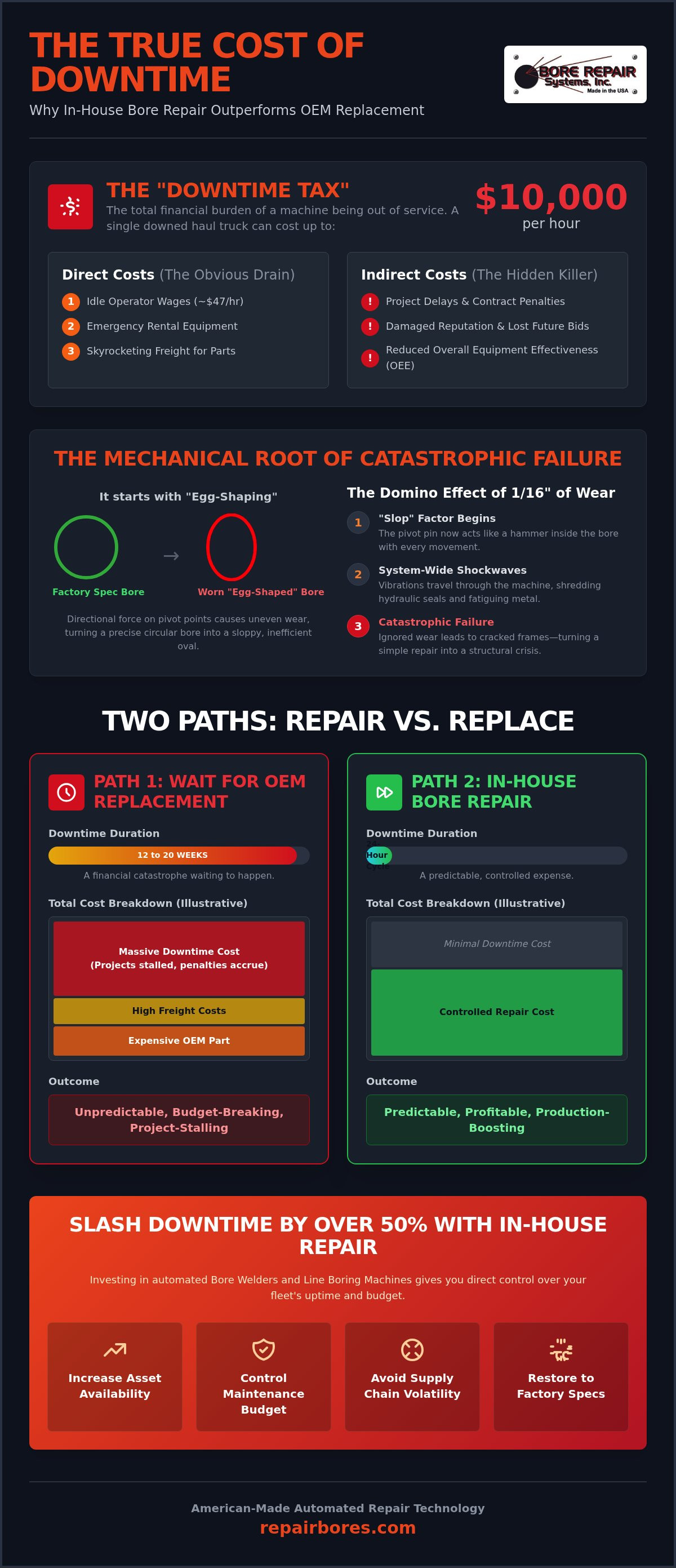
Could waiting for a new OEM excavator boom be the most expensive mistake your maintenance department makes this year? With lead times for major components stretching up to 20 weeks in 2026, a machine sitting idle isn't just a scheduling headache. It's a massive drain on your bottom line. Performing a rigorous heavy equipment downtime cost analysis reveals that the true price of idleness often exceeds the cost of the replacement part itself. In large-scale mining operations, for example, a single haul truck being down can bleed up to $10,000 every hour.
You already know that every day a machine spends on blocks is a day it isn't generating revenue. It's frustrating to watch projects stall while you're at the mercy of unpredictable supply chains and skyrocketing freight costs for massive steel components. This guide will show you how to quantify those hidden losses and explain why automated bore restoration delivers a faster, higher ROI than traditional replacement.
We'll break down the financial impact of the "Downtime Tax" and demonstrate how utilizing Bore Welders and Line Boring Machines can slash your machinery's time out of service by 50% or more. You'll learn how to increase asset availability and keep your maintenance budget under control by avoiding expensive, unnecessary part replacements.
Table of Contents
Quantifying the 'Downtime Tax': A Financial Analysis of Idle Machinery
When a primary production machine stops, the clock starts ticking on what we call the "Downtime Tax." This isn't just the price of a replacement part or a mechanic's hourly rate. It's the total financial burden of a machine being out of service. To run a profitable fleet in 2026, a heavy equipment downtime cost analysis must account for the ripple effects that spread through your entire operation. If you only look at the repair invoice, you're missing 80% of the actual loss.
Direct vs. Indirect Costs in Heavy Industry
Direct costs are the easiest to track but often the most painful to pay. In 2026, the median hourly wage for a heavy equipment operator is $28.78, but when you factor in union benefits, that cost can jump by another $18 per hour. If that operator is sitting in the breakroom because their loader has a wallowed-out pivot pin, you're burning capital. When you add the cost of a rental replacement and emergency freight for massive steel components, the daily drain is staggering. For a large mining haul truck, this idleness can cost between $5,000 and $10,000 every single hour.
Indirect costs are harder to see but can sink a company. Project delays often trigger liquidated damages or penalty clauses in contracts. Your reputation suffers when you can't meet deadlines, making it harder to win future bids. Industry leaders use Overall Equipment Effectiveness (OEE) to quantify these production losses. Today's "just-in-time" logistics environment means there's no buffer; a single downed machine can halt an entire job site, leaving a full crew and a fleet of support trucks waiting on one repair.
The Role of Lead Times in Downtime Calculations
The most dangerous variable in your heavy equipment downtime cost analysis is the OEM lead time. As of 2026, lead times for major components like excavator booms are stretching between 12 and 20 weeks. If a machine is out of stock, your downtime costs don't just add up; they multiply. A 24-hour in-house repair cycle using Line Boring Machines is a predictable expense. Waiting three months for a factory part is a financial catastrophe.
Sourcing challenges are even more acute for legacy equipment. As manufacturers prioritize new builds, parts for older but reliable assets become harder to find. This scarcity forces many fleet managers to choose between an expensive, uncertain wait for a replacement or a controlled, precision restoration. When a component is backordered, the "Downtime Tax" can easily exceed the value of the machine itself.
The Mechanical Root of Downtime: Why Worn Bores Stop Production
A comprehensive heavy equipment downtime cost analysis often reveals that the most expensive failures start small. In pivot points and linkages, wear doesn't happen evenly. Because machines operate against specific resistance arcs, bores experience directional force. This physics-driven process results in "egg-shaping," where a circular hole becomes an oval. Once the bore loses its concentricity, the mechanical integrity of the entire assembly is compromised. Precision is lost, and the machine's efficiency drops immediately.
The "slop" factor is the primary catalyst for catastrophic failure. A mere 1/16th inch of wear might seem negligible, but it creates a gap that allows the pivot pin to act like a hammer. Every movement of the excavator arm or loader bucket sends shockwaves through the machine. These vibrations shred hydraulic seals and eventually lead to cracked frames. High-wear zones like articulated steering joints and bucket linkages are particularly vulnerable. Ignoring this wear doesn't just delay a repair; it turns a simple bore job into a structural welding nightmare that can sideline an asset for weeks.
Identifying Egg-Shaped Bores and Pivot Pin Wear
Operators usually notice the problem before the mechanics do. You'll feel a loss of precision in the controls, often described as "drifting" or "chatter" during heavy lifts. In the field, look for shiny metal or "bleeding" rust around the pin. These are signs of metal-on-metal contact where there should be a tight, lubricated fit. If the pin is vibrating inside the bore, the hydraulic system is already working harder to compensate for the mechanical inefficiency, driving up fuel consumption and component fatigue.
The Failure of Temporary Fixes
When downtime costs are mounting, it's tempting to use an oversized pin as a quick fix. Don't do it. An oversized pin masks the slop but doesn't solve the ovality of the hole. It actually accelerates wear by creating uneven pressure points. Similarly, manual hand-welding without precision machining creates hard spots that are nearly impossible to bore through later. Proper repairing worn bores in heavy equipment requires restoring the bore to its original factory diameter. For fleets looking to eliminate these recurring issues, investing in precision equipment from Bore Repair Systems, Inc. ensures every repair meets OEM specifications and stays within your maintenance budget.
ROI Case Study: Bore Repair Instead of Replacement
To understand the true value of in-house restoration, we need to look at the hard numbers. Consider a common scenario: a 50-ton excavator boom with a wallowed-out pivot bore. A standard heavy equipment downtime cost analysis usually pits two options against each other. You can either buy a new component from the OEM or repair the existing steel. In 2026, the financial gap between these two choices has never been wider.
Direct Cost Comparison: New Parts vs. Restoration
The "Buy New" route is a major capital hit. A replacement boom for a 50-ton machine often exceeds $25,000. Because these are massive, heavy components, you'll also face at least $3,000 in specialized freight charges. This doesn't include the labor for full disassembly and re-commissioning. In contrast, the "Repair" route using automated Bore Welders and Line Boring Machines costs approximately $4,000 in labor and consumables.
The math is straightforward. Choosing bore repair instead of replacement nets an immediate direct savings of $24,000. For most fleets, this single repair pays for half the cost of a mid-range automated system. The equipment typically reaches its break-even point after just two or three major restorations. After that, every repair is pure profit for the maintenance department.
Downtime Reduction Analysis
While direct savings are significant, the real ROI is found in the calendar. The current industry average lead time for major OEM booms is 12 to 20 weeks, though even a conservative 8-week estimate results in 320 hours of idle time. When a machine sits, it isn't just a lost asset; it's a hole in your production schedule. At a conservative downtime cost of $500 per hour, that 8-week wait costs your company $160,000 in lost revenue.
In-house repair changes the timeline completely. A precision bore restoration typically takes 16 hours or less. By cutting the wait from 320 hours to 16, you've regained 304 hours of production. This in-field capability is a game-changer for remote operations. For instance, one forestry equipment bore repair case study showed a contractor saved $40,000 in a single week by performing a field repair instead of waiting for a replacement frame. They kept the job moving while their competitors were still waiting for a shipping confirmation. Precision tools don't just fix holes; they protect your schedule from the "Downtime Tax."
Strategic Implementation: Building In-House Repair Capability
Transitioning from a reactive maintenance model to an in-house capability requires a structured plan. It's not enough to know you're losing money; you need the hardware and the skill to stop the bleed. Use the data from your heavy equipment downtime cost analysis to identify which assets are recurring offenders. If your loaders or articulated dump trucks are constantly waiting for mobile contractors or backordered parts, that's your starting point for a strategic shift.
The implementation process follows four logical steps. First, audit your fleet's downtime history to find specific wear patterns. Second, evaluate the ROI of purchasing bore welder for sale systems that pay for themselves in just a few uses. Third, select Line Boring Machines that match your fleet’s most common bore diameters. Finally, commit to professional training to ensure your team produces OEM-spec results every time.
Selecting the Right Portable Equipment
A successful repair setup relies on coordinated systems. You need a Bore Welder and a Line Boring Machine that work together seamlessly to restore metal and then machine it back to precision. Look for high-torque motors and automated welding patterns that can handle the heavy-duty cycles of mining and construction gear. Portability is a non-negotiable requirement for field repairs. Without the right line boring machine accessories, such as specialized mounting brackets or precision measuring tools, even the best machine will struggle with complex setups in tight spaces.
The ROI of Professional Training
Precision machining is a skill, not just a process. Investing in line boring operator training is the fastest way to eliminate costly operator errors and safety risks. When your crew masters excavator pin hole repair, they aren't just filling a hole; they're restoring a machine to factory tolerances. This expertise ensures that automated welding safety protocols are followed and that the final finish is perfectly concentric. Training bridges the gap between owning a tool and mastering a solution, ensuring your heavy equipment downtime cost analysis remains focused on savings rather than rework.
Ready to take control of your maintenance schedule? Explore our full range of American-made Line Boring Machines and Bore Welders to start saving today.
Bore Repair Systems: Engineering Solutions for National Fleets
Bore Repair Systems, Inc. stands as the authority in automated repair technology. While software can track your losses, our hardware stops them. We design our equipment for the realities of the field, where conditions are harsh and precision is non-negotiable. By bringing repair capabilities in-house, your fleet moves toward total asset self-sufficiency. You no longer have to wait for a third-party contractor's schedule or an OEM's shipping confirmation. You own the solution.
A rigorous heavy equipment downtime cost analysis often points to a single conclusion: the fastest way to return a machine to service is to fix it where it sits. Our American-made Bore Welders and Line Boring Machines are engineered to simplify complex machining tasks. We prioritize durability and mechanical integrity, ensuring that every repair meets or exceeds factory specifications. This focus on reliability is why national fleets across the mining, construction, and forestry sectors trust our systems to protect their bottom line.
Precision-Engineered Bore Welders and Boring Machines
The core of our technology is automated spiral welding. This process ensures consistent metallurgical integrity by applying a uniform layer of weld material without the inconsistencies of manual work. Because our systems are US-made, you benefit from direct access to technical support and immediate parts availability. We understand that every hour matters. Our machines feature faster setup times and automated cycles that reduce labor costs. A single technician can manage the repair process, allowing the rest of your crew to focus on other critical maintenance tasks.
Investing in Training for Long-Term Savings
Equipment is only as effective as the person operating it. We believe that line boring training is a fundamental component of a successful maintenance strategy. Our programs turn your existing technicians into precision machinists. We offer customized training sessions specifically designed for the unique challenges of mining, construction, and forestry maintenance teams. These programs cover everything from basic setup to advanced troubleshooting in the field.
Mastering these skills ensures that your heavy equipment downtime cost analysis reflects permanent savings rather than temporary fixes. When your team can perform an OEM-spec restoration in-house, you eliminate the "Downtime Tax" once and for all. Contact Bore Repair Systems today for a comprehensive fleet downtime audit and see how our automated solutions can transform your maintenance department.
Achieve Total Fleet Self-Sufficiency
Applying a rigorous heavy equipment downtime cost analysis to your maintenance strategy reveals a clear path to higher profitability. You've seen that the true cost of idleness far outweighs the sticker price of a repair. By bypassing 20-week OEM lead times and performing precision restorations in-house, you protect your production schedule from the "Downtime Tax." This isn't just about saving money on parts; it's about keeping your crew moving and your contracts on time.
Our systems are proudly manufactured in the USA and utilize patented automated welding technology to ensure consistent, metallurgical integrity. We've delivered a proven ROI for national mining and construction fleets by turning weeks of waiting into hours of work. You have the power to eliminate the uncertainty of the global supply chain with the right equipment and professional expertise. Precision tools don't just fix holes; they safeguard your bottom line.
Don't wait for a backordered component to stall your operation. View Our Professional Bore Repair Systems and Training Programs to see how we can help you restore your machinery to factory specs. It's time to put your fleet back to work.
Frequently Asked Questions
How do I calculate the hourly cost of downtime for my specific equipment?
Sum your operator wages, rental fees, and lost production revenue to find the baseline. Use your heavy equipment downtime cost analysis to factor in project delay penalties and emergency logistics. Don't forget the hourly overhead of idle support crews. Most managers use a formula of (Hourly Labor + Hourly Rental + Hourly Revenue Loss). It's a hard number that clarifies why in-house repair is essential.
Is a repaired bore as strong as a brand-new OEM component?
A properly repaired bore is often superior to the original casting. Automated bore welding uses high-quality filler material that's often harder and more wear-resistant than the base metal. By restoring the pivot point to factory tolerances, you eliminate the impact loading caused by slop. This restores the mechanical integrity of the assembly. It isn't just a patch; it's a structural restoration to OEM specifications.
What is the typical 'break-even' point when buying a bore repair system?
Most fleets reach the break-even point after just two or three major bore restorations. When you compare the capital investment of a system to the cost of purchasing new booms or frames, the ROI is immediate. Your heavy equipment downtime cost analysis should show that avoiding even one extended lead time for an OEM component can cover the initial equipment cost. It's a capital investment that pays dividends for years.
Can I perform line boring and bore welding in the field without a shop?
Yes, our Line Boring Machines and Bore Welders are designed specifically for field portability. You don't need a dedicated machine shop to achieve precision results. The equipment mounts directly to the workpiece, allowing technicians to perform repairs on-site. This eliminates the need for full machine disassembly and the high costs of transporting massive components to a central repair facility. It's the most efficient way to reduce machinery idleness.
How long does it take to train a technician to use an automated bore welder?
A technician can typically master the basics of an automated bore welder in two to three days of professional training. Our programs focus on setup, precision alignment, and automated spiral welding patterns. While it takes time to become a master machinist, the automated features of the equipment simplify the learning curve. This quick transition allows your team to start performing in-house repairs and slashing downtime almost immediately.
What types of heavy equipment bores are most commonly repaired?
The most common repairs involve excavator bucket and boom pivot points, loader articulated joints, and dozer blade linkages. Any component that uses a pin and bushing system is a candidate for wear. We also see frequent repairs on crane outriggers and forestry equipment frames. These high-stress areas are prone to egg-shaping and require regular restoration to maintain machine precision and prevent structural cracking.
How do I know if a bore is too worn to be safely restored?
A bore is generally too worn to restore if the wear has compromised the structural thickness of the surrounding steel. If the wall thickness is insufficient to support the load after machining, replacement is necessary. However, automated bore welding can build up significant amounts of material. A professional inspection will determine if the base metal still has the integrity to host a new weld. Most wear cases are fully restorable.
Does automated bore welding cause thermal distortion in the component?
Automated spiral welding minimizes thermal distortion by providing a controlled, consistent heat input. Unlike manual hand-welding, which creates concentrated heat zones and hard spots, the automated process distributes heat evenly around the bore. This precision prevents the warping of the component. It ensures that the metallurgical integrity of the part remains intact throughout the repair process. This is why automated systems are preferred for critical structural components.


Comments