

Forestry Equipment Bore Repair: A Professional Reference for 2026

Updated: Sep 1
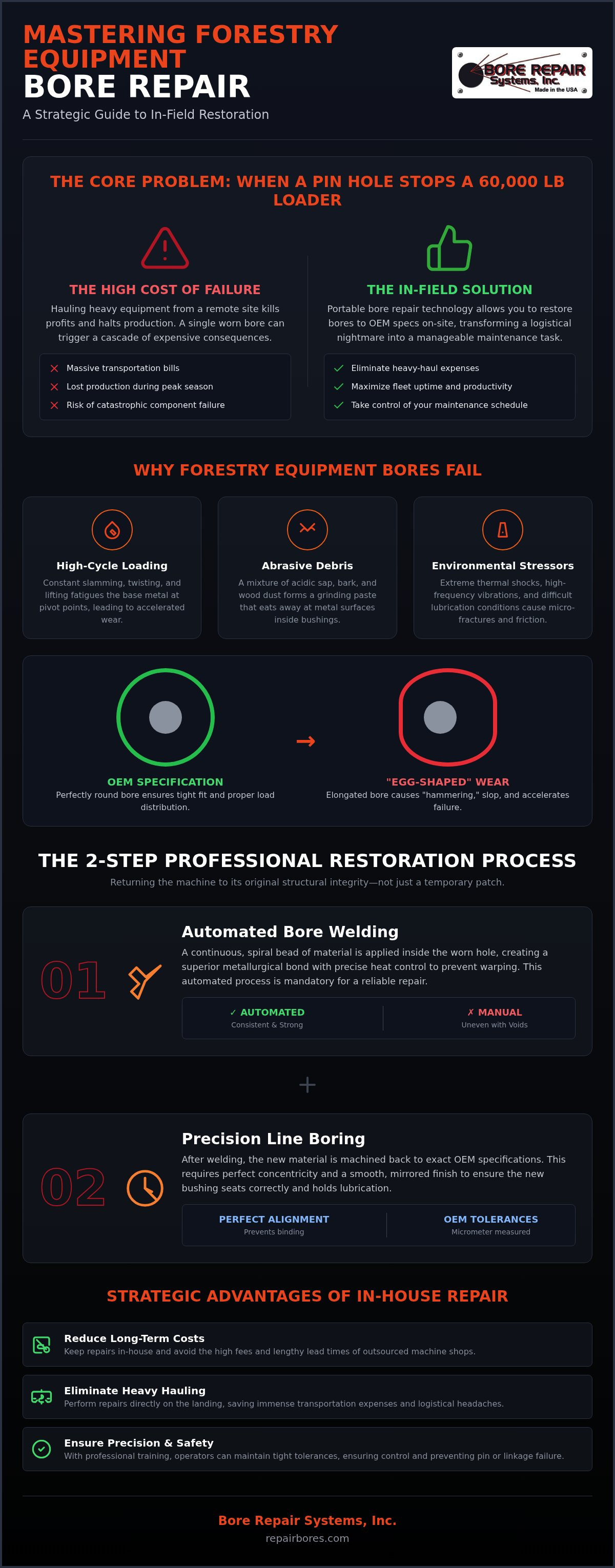
How much does it actually cost to haul a 60,000-pound loader out of a remote logging site just because a grapple pin hole is egg-shaped and loose? For most logging operations, the transportation bill alone is enough to kill the week's profit, and that doesn't even account for the lost production during peak harvesting season. You know that dirt and debris are unavoidable in the woods, acting like sandpaper on your feller bunchers and loaders. Once that play starts in the joints, it's a fast track to catastrophic failure. Mastering forestry equipment bore repair isn't just a maintenance task; it's a strategic survival tool for your business.
You need a way to restore bores to OEM specifications without the logistical nightmare of a machine shop visit. This reference guide provides the technical roadmap to handle these repairs in-house using portable line boring and automated welding technology. We'll break down how to eliminate slop in your hinges, lower your long-term maintenance expenses, and ensure your equipment stays where it belongs: on the job site. It's time to stop letting worn metal dictate your schedule and start taking control of your fleet's uptime.
Table of Contents
Why Forestry Equipment Bores Fail Prematurely
Forestry machines don't operate in the controlled environments typical of most heavy equipment applications. Feller buncher heads and linkages endure high-cycle loading every few minutes throughout a shift. This constant slamming, twisting, and lifting creates immense pressure on pivot points. Over time, the base metal simply fatigues under the load. If you don't stay ahead of the wear with proactive forestry equipment bore repair, the damage moves from the replaceable bushing to the structural housing itself.
Abrasive debris is a silent killer in the woods. Unlike the common dirt found in a construction trench, forest grit contains acidic sap, bark shards, and fine wood dust. This mixture works its way into the bushings and acts like a grinding paste. It doesn't just wear the metal; it eats it. Once the gap between the pin and the bore exceeds OEM specifications, the "hammering" effect begins. Every movement becomes a micro-impact that accelerates wear exponentially with every log handled.
This leads to the "egg-shaping" phenomenon. The bore doesn't wear in a perfect circle; it elongates in the direction of the primary load. Simply slapping a bead of weld in there with a stick welder isn't a viable fix. You can't eyeball a perfect circle or maintain consistent metallurgy by hand. Without proper automated build-up and precision machining, a standard weld leaves hard spots and voids. These inconsistencies cause the new pin to fail even faster and can lead to structural cracks that eventually result in a catastrophic boom failure.
Environmental Stressors in Logging
Metal expands and contracts constantly in the field. In the winter, a machine might start at sub-zero temperatures and reach high operating heat in minutes. These thermal shocks stress the bore seats and can cause microscopic fractures. Remote sites also make regular lubrication difficult. When grease is skipped, metal-on-metal friction takes over immediately. Add the high-frequency vibration from a 3,000 RPM saw disc, and your bore alignment won't last long without professional intervention.
The Cost of Mechanical Play
Slop in the joints isn't just a nuisance; it's a direct financial drain. When a grapple or boom has "play," the operator loses precision. This makes sorting logs slower and more frustrating. Misalignment also forces hydraulic cylinders to work at odd angles, which blows out seals and scores expensive rods. Most importantly, a loose pivot pin is a safety hazard. A pin that shears or a linkage that snaps in the woods puts everyone on the landing at risk. Keeping bores tight is the only way to maintain control and safety.
The Two-Step Process for Professional Bore Restoration
Professional restoration isn't about a quick patch; it's about returning the machine to its original structural integrity. The process begins with a thorough assessment of the damage. You've got to remove every trace of grease, rust, and forest debris before any metal is added. Any contaminant left in the bore will cause porosity in the weld, leading to a weak repair that won't stand up to the stress of the landing. Once the surface is clean and prepped, the restoration follows a strict two-step mechanical sequence to ensure the joint is as strong as the day it left the factory.
Step 1: Automated Bore Welding
Manual "pad welding" is a common mistake in field repairs. Hand-welding results in uneven thickness, hard spots, and internal voids that compromise the repair. For a reliable forestry equipment bore repair, automated technology is mandatory. An automated bore welder applies a continuous, spiral bead of material inside the worn hole. This creates a superior metallurgical bond with the base metal. It also provides precise control over heat input. By managing the thermal cycle and bead overlap, you prevent the component from warping or losing its heat-treat properties. This level of consistency is what allows a repaired joint to survive the high-cycle loading of a feller buncher or grapple.
Step 2: Precision Line Boring
After building up the material, you've got to machine it back to exact tolerances. This requires a portable line boring machine. The first priority is setting up the boring bar for perfect concentricity. If the new hole is even a fraction of a millimeter off-center, the entire linkage will be misaligned. This leads to binding and rapid pin failure. You machine the welded material in several passes, using micrometer measurements to ensure you reach the OEM specification. Achieving the correct surface finish is the final requirement. A smooth, mirrored finish ensures the new bushing seats correctly and maintains a consistent grease film. If you want to see the equipment necessary for these steps, you can explore professional-grade bore repair systems designed specifically for field use.
The final stage is the fitment of new pins and bushings. Because you've restored the bore to its original dimensions, these parts should slide in with the intended press-fit. This eliminates the mechanical "slop" that causes precision loss and hydraulic strain. Doing this work correctly in the woods saves you the thousands of dollars typically spent on heavy-haul logistics and outside shop labor. It puts the control back in your hands and keeps your iron working through the peak of the season.
Strategic Advantages of In-Field Portable Repair
Shipping a machine to a regional machine shop is the traditional response to bore wear, but it's rarely the most efficient one. When you outsource, you aren't just paying for the repair. You're paying for the logistics, the permits, and the wait time. Performing forestry equipment bore repair directly on the landing or at your own yard changes the math entirely. It shifts the focus from managing a crisis to executing a controlled maintenance task. You gain the ability to fix components during scheduled downtime or when inclement weather pulls the crew out of the woods anyway.
The difference in machine-down time is staggering. A typical shop repair can take two weeks when you factor in transport and the shop's existing backlog. In contrast, an in-field repair usually takes one to two days. You eliminate the "queue" at the repair facility and keep your iron in the dirt. This level of responsiveness is critical during peak harvesting windows when every hour of daylight represents revenue that can't be recovered later in the year.
Overcoming Remote Location Logistics
Logging sites are notoriously difficult to access. Bringing a lowboy trailer into a remote block to pick up a disabled loader is a logistical nightmare. It requires road prep, specialized transport, and often multiple pilots. Portable bore repair equipment fits into the back of a standard service truck. Instead of moving the 60,000-pound machine to the tool, you bring the tool to the machine. This mobility allows you to address wear before it leads to a total breakdown, saving the component and the transport bill simultaneously.
ROI of In-House Bore Repair Equipment
The financial argument for owning your equipment is clear. When you evaluate in-house line boring vs outsourcing, the savings on a single major boom repair can often cover a significant portion of the initial investment. You aren't just saving on shop labor rates; you're eliminating the thousands of dollars spent on heavy-haul trucking. Because these tools are built for the rigors of field use and made in the USA, they're assets that last for decades. They provide a permanent solution to a recurring problem, ensuring that your long-term maintenance expenses remain predictable and manageable.
Critical Forestry Components Requiring Regular Bore Maintenance
Forestry iron lives a hard life. While a standard excavator might dig in soft soil, a feller buncher or log loader deals with unpredictable, dynamic loads that shift as trees are felled and moved. This constant movement puts extreme stress on specific pivot points. If you don't perform regular forestry equipment bore repair on these high-wear areas, you risk more than just a loose pin. You risk the structural integrity of the entire machine. Identifying these critical zones early allows you to schedule repairs before a crack develops in a boom arm or a rotation housing.
Grapple Saw Pivot Points: The constant cycling of the saw bar and the weight of the logs create oval-shaped wear in the pivot housing.
Rotation Housings: Continuous 360-degree rotation under load wears out the main bearing seats and attachment bores.
Skidder Center-Joints: The oscillation and steering pins on a skidder carry the weight of the entire machine over uneven terrain, making them prime candidates for bore restoration.
Feller Buncher and Harvester Heads
The wrist and head attachment points on a feller buncher are arguably the most abused bores in the industry. They handle the weight of the tree and the vibration of the saw head simultaneously. Grabbing arms also suffer from high-stress pivot wear as they clamp down on varying trunk diameters. For harvester boom tips, technicians often apply excavator pin hole repair techniques to ensure the harvester head remains stable during the processing cycle. Maintaining the tilt frame bores is equally vital. If the tilt frame develops slop, the operator loses the ability to place trees accurately, which increases the risk of damage to the remaining stand.
Forwarder and Loader Booms
Log loaders and forwarders rely on their reach. Wear usually starts in the main pillar or the kingpost where the boom attaches to the chassis. This is the foundation of the entire lifting system. On telescopic booms, the internal slide points and cylinder mounts require precise alignment to prevent binding. Learning how to repair worn bores in heavy equipment specifically for high-reach applications is essential for safety. When a jib cylinder mount wears out, it creates a whip effect at the end of the boom. This vibration destroys bushings and stresses hydraulic lines. Keeping up with forestry equipment bore repair on these high-reach components prevents the "hunting" movement that frustrates operators and slows down production.
Don't wait for a total component failure to address these issues. You can browse our full line of bore welding and line boring machines to find the right setup for your specific fleet and keep your forestry gear in top condition.
Implementing an In-House Bore Repair Program
Transitioning from outsourced repairs to an in-house program is a strategic move that requires more than just purchasing hardware. It's about establishing a repeatable process that ensures every machine in your fleet stays within OEM tolerances. For a logging operation, forestry equipment bore repair becomes a profit center when you stop paying for shop markups and transportation. Success depends on three pillars: the right equipment, specialized operator skills, and a proactive inspection schedule that catches wear before it requires a catastrophic rebuild.
Training and Skill Development
Buying the machine is the easy part. Ensuring your team can use it effectively is where the real return on investment happens. Professional line boring operator training is essential because field machining presents challenges you won't find in a climate-controlled shop. Your technicians need to understand how to maintain concentricity on a worn feller buncher head while working on a landing. Transitioning your existing welders to automated systems is usually a smooth process. These tools are designed to simplify the mechanical task, but the operator still needs to understand heat management and metallurgical bonding. Investing in line boring training prevents the "trial and error" phase that leads to ruined components and wasted downtime.
Selecting the Right Equipment
Your equipment needs to match the scale of your fleet. A system that works for a small grapple might not have the torque or reach for a skidder's center-joint. When you're evaluating a bore welder for sale, look for a system that emphasizes portability and ruggedness. Forestry joints are notoriously difficult to access. You'll need specific bore welding accessories like offset heads or telescoping torches to reach into tight linkages. Similarly, having a variety of line boring machine accessories, such as different bar lengths and specialized mounting plates, allows you to handle various repair scenarios without improvising in the field. USA-made equipment ensures you have long-term support and parts availability when you're in the middle of a harvesting contract.
The final step is establishing a preventative maintenance schedule. Don't wait for a pin to shear before you check for wear. Integrate bore inspections into your standard 500-hour service intervals. By catching egg-shaping early, the forestry equipment bore repair process is faster, uses less consumable material, and prevents structural cracks. This proactive approach ensures your equipment remains dependable through the toughest seasons and keeps your long-term repair expenses under tight control.
Taking Command of Your Fleet's Mechanical Integrity
Operating in the woods demands equipment that doesn't quit when the loading gets heavy. You've seen how abrasive debris and high-cycle stress lead to egg-shaped bores, but you don't have to accept the high cost of transportation and shop downtime as a cost of doing business. By mastering forestry equipment bore repair in-house, you eliminate the logistical bottlenecks that stall production. You gain the precision of OEM specifications with the speed of a field repair.
Success in the field requires the right tools and the knowledge to use them. Bore Repair Systems, Inc. provides Made in the USA specialized machinery designed for the rigors of the landing. We back our equipment with expert technical training to ensure your team can handle any repair from a skidder center-joint to a feller buncher head. It's why our systems are the trusted choice for major forestry and mining fleets nationwide. Stop letting worn metal dictate your harvesting schedule.
View our complete line of portable bore repair systems and start building a more resilient, profitable operation today. You have the iron; now you have the means to keep it working.
Frequently Asked Questions
Can I repair a forestry bore without removing the entire boom?
Yes, you can perform repairs without dismantling the entire boom or chassis. Portable bore repair systems are designed to mount directly to the machine's component in the field. This eliminates the need for massive overhead cranes or specialized disassembly tools. As long as you have enough clearance for the boring bar and welder to rotate, you can restore the bore while the boom remains attached.
How much wear is too much before a bore becomes unrepairable?
Most bores are repairable as long as the surrounding structural steel hasn't developed deep, non-repairable cracks. If the "egg-shaping" has removed a significant amount of material, the automated welder simply requires more passes to build the wall back up to size. However, if the wear has reached the edge of the component or compromised the structural integrity of the arm, plate replacement might be necessary.
What is the difference between line boring and standard drilling?
Line boring uses a fixed bar supported by bearings to ensure the new hole is perfectly round and aligned with other pivot points. Standard drilling follows the existing path of a hole and can easily drift, which doesn't fix alignment issues. In forestry equipment bore repair, precision alignment is critical to prevent the new pins from binding or shearing under the heavy loads of a harvester head.
Do I need a special welder for automated bore welding?
You need a specialized automated bore welder that works in conjunction with a standard MIG wire feeder. These systems use a rotating torch to apply a continuous, even bead of metal inside the diameter of the hole. This automation provides a consistent metallurgical bond and uniform thickness that manual welding cannot match. Using a dedicated system prevents the hard spots and voids that cause hand-welded repairs to fail.
How long does a typical forestry pin hole repair take in the field?
A standard repair usually takes between four and eight hours depending on the diameter and the amount of wear. This timeframe includes the initial setup, the welding passes to build up material, and the final machining to OEM specs. While this is a full day of work, it's significantly faster than the days or weeks lost when shipping a component to a regional machine shop for the same service.
Is it possible to line bore hardened steel bushings?
You shouldn't attempt to bore through hardened steel bushings. The correct procedure is to remove the worn bushing, build up the base metal of the housing using an automated welder, and then machine the housing to the correct press-fit diameter. Once the housing is restored, you install a new factory-spec bushing. This ensures the joint has the proper hardness and fitment required to survive heavy impact loads.
What power source is required for portable bore repair equipment?
Portable line boring and welding systems typically operate on standard 110V or 220V AC power. On remote logging sites, this is easily supplied by a service truck's generator or a portable job site unit. The welding component also requires a DC power source from a standard MIG welder. These requirements are designed to be compatible with the equipment already found in most professional field service trucks.
Can one machine handle different bore sizes on various forestry attachments?
One machine can handle a broad range of bore sizes by using different bar diameters and mounting accessories. Most professional systems are modular, allowing you to switch from a small grapple pivot to a large skidder center-joint in minutes. This versatility makes the equipment a high-value asset for mixed fleets. Having the right forestry equipment bore repair setup means you're prepared for everything with a single investment.


Comments