

Bore Sleeving vs. Bore Welding: The Professional Guide to Bore Repair

Updated: 5 days ago
Pressing in a sleeve might look like the fastest way to get an excavator back in the dirt, but that "quick fix" often sets the stage for a much more expensive failure down the road. You've likely dealt with the frustration of a temporary repair vibrating loose or a manual weld job that simply won't meet original tolerances. When comparing bore sleeving vs bore welding, it's clear that the wrong choice leads to a cycle of disassembly and downtime that eats your margins and stalls your projects.
This professional guide breaks down these two leading restoration methods to help you choose a permanent solution that holds up under heavy-duty stress. We'll examine why automated bore welding is the superior choice for heavy equipment, offering consistent quality that can reduce labor costs by up to 70% compared to manual methods. You'll learn how to bring your bores back to OEM specs, minimize machine downtime, and ensure your equipment stays in the field where it belongs.
Table of Contents
Understanding Bore Sleeving vs. Bore Welding
Bore restoration is the technical process of returning a worn or oversized pivot point to its original dimensional tolerances. For heavy equipment operators, this isn't just maintenance; it's a critical safety requirement. Over time, the constant stress of operation causes holes to elongate, which compromises the machine's precision and safety. When you evaluate bore sleeving vs bore welding, you're deciding between two fundamentally different engineering approaches to material restoration.
Bore sleeving requires machining the existing hole larger to accommodate a sacrificial steel liner. This sleeve is then pressed into place using an interference fit. While it provides a new wear surface, it relies on mechanical friction to stay seated. In contrast, bore welding adds new metal directly to the worn surface to rebuild the component's base material. Understanding what is welding in this context is essential. It creates a permanent metallurgical bond that integrates with the original casting or plate. Choosing the wrong method for your specific application often leads to premature pin failure or irreversible structural damage to the machine frame.
The Mechanics of Bore Wear
Bore wear is rarely uniform. Directional loads from digging, lifting, or grading apply intense pressure to specific sides of a pivot point. This creates an "egg-shaped" profile that a standard pin can no longer support. Constant vibration and high-frequency friction eventually strip away the hardened surface of the bore. Common symptoms of this degradation include:
Excessive "slop" or play in the joints during operation.
Metal shavings or dust accumulating near the pivot point.
Visible galling or scoring on the pin and bore surfaces.
Stress cracks forming around the edge of the bore.
If you don't catch these issues early, minor tolerance problems evolve into structural failures that can compromise the entire assembly.
When Quick Fixes Fail
Ignoring worn bores on an excavator or loader is an expensive mistake. A loose joint creates "impact loading," where the pin slams against the bore wall during every movement cycle. This hammering effect accelerates wear exponentially. Temporary repairs, like shim stock or oversized pins, might get you through a single shift, but they can't handle the multi-ton forces of industrial work. These failures often lead to catastrophic frame or boom collapses that are far more expensive than a proper repair. A precision-oriented repair strategy restores the structural integrity of your equipment and ensures long-term reliability. The decision between bore sleeving vs bore welding determines if your machine stays in the dirt or ends up in the scrap yard.
The 3-Step Bore Welding Cycle
The "Bore-Weld-Bore" cycle is the industrial gold standard for restoring worn components. While some shops might consider a "Bore-Sleeve-Bore" approach, the welding cycle offers a permanent metallurgical solution that restores the parent material. The most critical element in this process is maintaining a common centerline. If you lose the original axis during any stage, the pin won't align. When evaluating bore sleeving vs bore welding, remember that welding ensures the repair becomes part of the machine frame, rather than just a mechanical insert held by friction.
Step 1: Pre-Boring for Surface Preparation
You can't weld over grease, rust, or work-hardened metal. Pre-boring removes out-of-round material to create a clean, concentric surface. It's essential to machine back to sound base metal to ensure proper weld penetration and prevent porosity. During this stage, you must ensure the line boring bar is perfectly aligned with the original axis. This sets the foundation for the entire repair, ensuring the new material is applied exactly where it's needed most.
Step 2: Automated Spiral Welding
Automated bore welders apply a consistent, high-quality bead that manual "pad welding" simply can't match. Manual welding often results in uneven deposits and excessive heat-affected zones (HAZ), which can distort the component. An automated system reduces these risks while cutting labor time by up to 70% in many applications. Using specialized bore welding accessories further improves consistency and allows the operator to reach deep or narrow bores easily. This level of precision aligns with strict industrial standards, similar to the rigorous requirements for welding repairs to boilers and pressure vessels, where controlled procedures are mandatory for structural integrity.
Step 3: Finish Boring to Specification
The final step involves machining the new weld material down to exact factory tolerances. This stage requires precision measurement tools like bore gauges and micrometers to verify the fit. You aren't just making a hole; you're achieving a specific surface finish that allows for optimal lubrication and maximum pin life. This step confirms concentricity across multiple bores in a single setup. It ensures the machine operates as smoothly as it did when it left the factory. If you're ready to improve your shop's capabilities, investing in professional-grade bore welders is the most direct path to success.
The Pros and Cons of Bore Sleeving
Bore sleeving is a mechanical repair method that avoids the thermal stresses of welding. The process begins with machining the worn bore significantly larger to create a clean, oversized seat. You then manufacture or source a custom steel liner and press it into the hole using an interference fit. This creates a new wear surface without altering the chemical composition of the original component. While it's often viewed as a faster alternative in the debate of bore sleeving vs bore welding, it comes with significant trade-offs regarding structural integrity and long-term reliability.
The primary advantage of sleeving is the absence of heat. In some assemblies, the high temperatures required for a proper weld can warp thin-walled sections or damage nearby seals and bearings. However, by boring out more material to fit the sleeve, you inevitably reduce the wall thickness of the parent metal. This thinning often leads to stress cracks, especially in high-stress areas like excavator bucket hinges or loader arms. There is also the persistent risk of sleeve migration. In high-vibration environments, even a tight interference fit can fail. This causes the sleeve to "walk" out of the bore or rotate, which blocks lubrication ports and eventually destroys the pin.
Ideal Applications for Sleeving
Sleeving is the correct choice when metallurgy dictates it. For instance, certain cast irons are notoriously difficult to weld without cracking. In these cases, a mechanical insert provides a functional path forward. It's also suitable for low-load applications where the bore doesn't face extreme impact or heavy directional force. If you're working in a remote field location with limited power for heavy welding equipment, a sleeve might be the only way to get the machine moving again. As discussed by Engine Professional on sleeving vs. boring, the decision often hinges on the specific material properties and the expected service life of the component.
Why Sleeving is Often a Temporary Fix
Despite its convenience, sleeving often serves as a temporary patch rather than a permanent restoration. The core issue lies in dissimilar metals and thermal expansion rates. As the machine works, the sleeve and the parent metal heat up and expand at different speeds. This cycling eventually loosens the mechanical bond. High-impact loads also deform the sleeve over time, causing it to lose its "press" and begin rattling within the housing. Achieving a perfect interference fit in field conditions is notoriously difficult. Even a few thousandths of an inch of error can lead to a premature failure that requires a complete redo, often forcing you back to a more permanent welding solution. To see how similar levels of precision and automation can transform your broader manufacturing operations, check out RWC Inc.
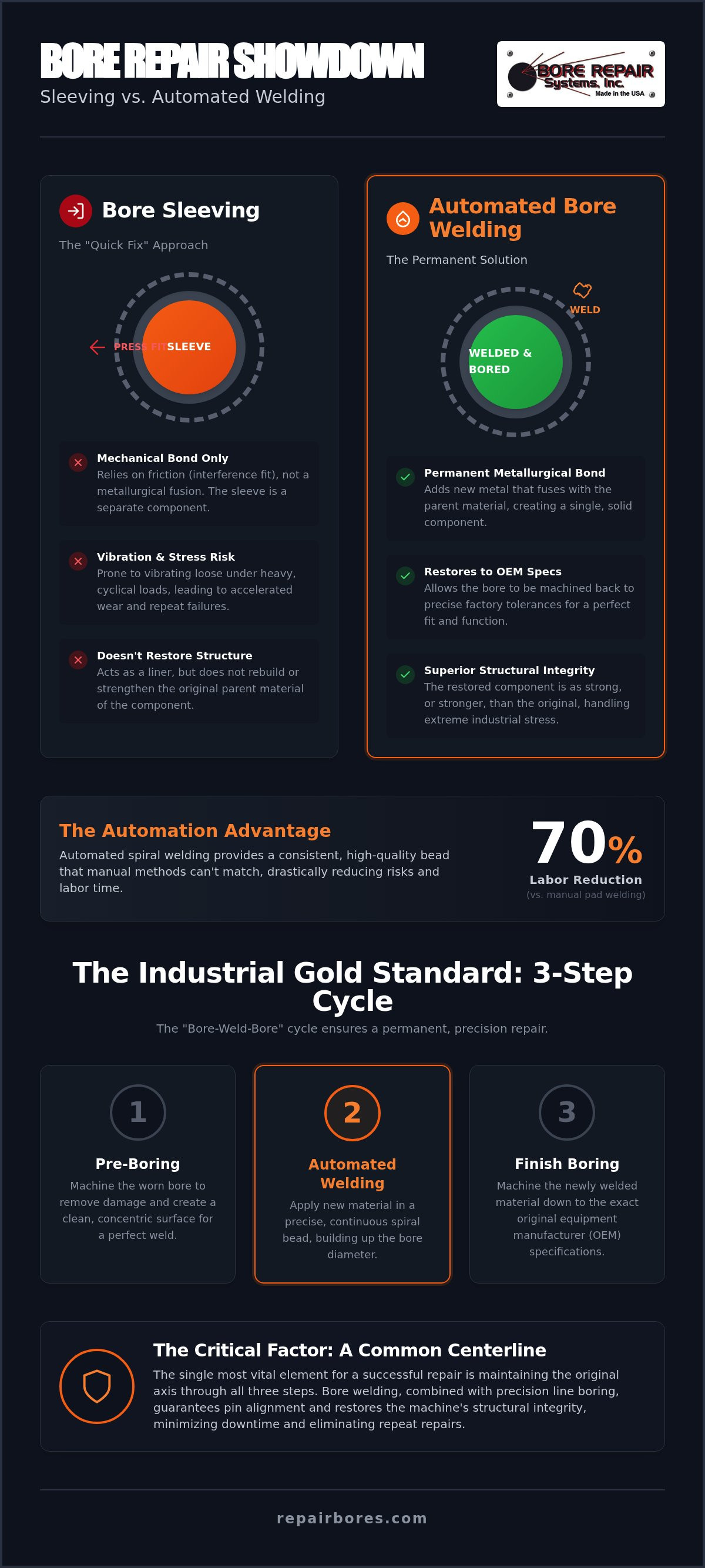
Bore Sleeving vs. Bore Welding: Direct Comparison
The core difference in the bore sleeving vs bore welding debate comes down to the nature of the bond. Welding creates a metallurgical fusion where the new material becomes an inseparable part of the parent metal. Sleeving relies on a mechanical interference fit, essentially using friction to hold a liner in place. While a sleeve might offer a faster initial turnaround, it doesn't restore the structural integrity of the component. Welding returns the part to a "like-new" condition by rebuilding the actual substrate to original factory specifications. This permanent restoration prevents the recurring re-work that often plagues mechanical repairs.
The Precision and Reliability Gap
Precision is where automated welding truly outperforms manual sleeving. When you finish bore a welded surface, the cutting tool moves through a continuous, solid material. This prevents the "tool jump" or broken carbide inserts that occur when a boring bar hits the tiny gaps or uneven hardness found in sleeved assemblies. Reliability also hinges on the accuracy of the initial setup. Using misaligned bore repair techniques when installing a sleeve significantly shortens the life of the repair. A slight misalignment causes the sleeve to experience uneven loading, which leads to it "walking" out of the housing or rotating under high vibration. Welding eliminates this risk entirely because there is no separate part to move; the rebuilt bore is part of the frame itself.
Total Cost of Ownership (TCO)
A pragmatic look at the Total Cost of Ownership (TCO) shows that welding is the more economical long-term choice. You must compare the cost of a single, permanent weld repair against the price of multiple sleeve replacements over the machine's life. Every time a sleeve fails, you lose money on labor, parts, and machine downtime. Furthermore, sleeving requires you to over-bore the original component to make room for the liner. This permanently weakens the casting or plate. Precision welding preserves the original component's dimensions and strength. This high level of accuracy also protects adjacent parts. By maintaining perfect concentricity, you reduce secondary wear on expensive pins, bushings, and seals. If you're ready to stop the cycle of temporary fixes, explore our professional bore welders to bring precision repair in-house.
Implementing In-House Bore Repair Solutions
Bringing bore repair capabilities in-house is a strategic shift that moves your operation from reactive maintenance to total control. Outsourcing a single repair can cost thousands in labor and travel fees for a contractor. In contrast, bringing this work in-house can reduce your costs by 50% or more. A portable line boring machine typically pays for itself in just 2 to 5 repairs. When you browse a bore welder for sale, you're looking at a tool that eliminates the need for expensive third-party service fees and shipping logistics. Owning the process allows your team to respond to equipment failure the moment it happens, keeping your fleet in the field.
The choice between bore sleeving vs bore welding often comes down to the equipment you have on hand. Portable line boring machines allow for in-situ repairs, which means you don't have to tear down the entire machine to fix a single pivot point. This "on-machine" approach saves days of disassembly time and prevents the logistical nightmare of transporting massive booms or frames to a machine shop. By rebuilding the bore with an automated welder, you restore the original structural integrity without the compromises of a mechanical sleeve.
The Role of Professional Training
Even the most advanced equipment requires a skilled hand to achieve factory tolerances. Precision is non-negotiable in heavy equipment repair; a few thousandths of an inch can be the difference between a smooth-running joint and a premature failure. Investing in a line boring operator training program ensures your team understands the nuances of alignment and material science. Proper instruction covers everything from initial setup to line boring machine maintenance. This knowledge protects your investment and ensures every repair meets OEM specifications, keeping your operators safe and your machines reliable.
Selecting Your Equipment Partner
Choosing the right bore welding machine manufacturer is about more than just the initial purchase. You need a partner that builds gear for the harsh realities of the workshop and the field. Look for systems designed for durability and ease of use in heavy-duty industrial environments. Ensure your partner provides a full range of line boring machine accessories to handle various bore diameters and depths. Versatility is key when your fleet includes everything from small loaders to massive excavators. Invest in the tools that eliminate downtime, restore precision, and put the power of professional repair back in your hands.
Take Control of Your Bore Restoration Strategy
Choosing between bore sleeving vs bore welding determines whether your machine returns to the field for a single shift or for the long haul. While sleeving offers a mechanical fix for specific metallurgical constraints, automated bore welding remains the industrial gold standard for permanent restoration. It rebuilds the parent material itself, ensuring your equipment maintains the precision and structural integrity required for heavy-duty operation. You've seen how the "Bore-Weld-Bore" cycle eliminates the risks of sleeve migration and the dangers of over-boring.
Bringing these capabilities in-house isn't just about saving on service fees; it's about owning your uptime. Bore Repair Systems, Inc. provides the specialized tools and expertise you need to achieve professional results every time. We support your operation with US-based manufacturing and technical support, patented automated bore welding technology, and comprehensive operator training and certification programs. Stop the cycle of temporary fixes and start rebuilding your components to original factory specs.
View Professional Bore Repair Systems, Inc. and Equipment to find the right solution for your shop and keep your fleet moving.
Frequently Asked Questions
Can I restore a bore that is severely egg-shaped using welding?
Yes, you can restore severely egg-shaped bores using the welding process. The "Bore-Weld-Bore" cycle is designed specifically for this challenge. First, you use a line boring machine to remove the irregular material and create a concentric surface. Then, an automated bore welder applies a uniform layer of new metal. Finally, you machine the bore back to factory specs. This creates a permanent, solid repair that a mechanical sleeve simply can't match.
Is bore sleeving or bore welding better for excavator boom repairs?
Bore welding is significantly better for excavator boom repairs because it restores the structural integrity of the parent metal. Booms face extreme directional loads and constant vibration. In the debate of bore sleeving vs bore welding, a sleeve is often a liability here. Sleeving requires you to remove more material, which weakens the casting. Welding creates a metallurgical bond that integrates with the frame, ensuring the repair won't "walk" out under stress.
How much material should I remove during the pre-boring stage?
You should remove only as much material as necessary to reach clean, sound base metal. This usually means machining the bore until the deepest "egg-shaped" wear point is gone and the hole is perfectly concentric. Welding over rust, grease, or work-hardened metal leads to porosity and poor fusion. Creating a consistent surface ensures the automated welder can apply an even bead, which results in a higher quality finished repair that meets OEM tolerances.
What are the risks of using a sleeve in high-impact joints?
The primary risks of using a sleeve in high-impact joints include sleeve migration and mechanical failure of the parent metal. Constant hammering causes the interference fit to loosen over time. Because the sleeve and the housing often have different thermal expansion rates, they expand and contract at different speeds during work cycles. This eventually leads to the sleeve "walking" out or rotating, which can block grease paths and cause catastrophic failure of the pin.
Do I need special training to operate an automated bore welder?
Professional training is essential for operators to achieve consistent, factory-spec results and maintain a safe worksite. While automated systems simplify the process, understanding proper alignment, heat control, and machining speeds is critical. Bore Repair Systems offers comprehensive training services that cover both line boring and bore welding operations. This education ensures your team can maximize the lifespan of the equipment while producing repairs that meet or exceed original equipment manufacturer standards.
Can bores be repaired in the field without dismantling the machine?
You can absolutely repair bores in the field using portable line boring and bore welding equipment. These systems are designed to mount directly onto the machine, which eliminates the need for total disassembly and transport to a machine shop. By performing the repair in-situ, you save significant time on teardown and reassembly. This approach is highly efficient for large equipment like excavators or loaders where transport logistics are both difficult and expensive.
What is the typical tolerance for a finished industrial pivot bore?
Typical industrial pivot bores require a tolerance within +/- 0.001 to 0.002 inches to ensure a proper fit for bushings and pins. While specific OEM requirements vary by machine type, maintaining these tight tolerances is vital for longevity. If a bore is too loose, the joint will experience impact loading that accelerates wear. Precision equipment and proper training allow operators to hit these specs consistently, ensuring the joint functions exactly as it did when new.
How does heat from welding affect the structural integrity of the component?
Controlled heat from an automated bore welder actually preserves structural integrity by minimizing the heat-affected zone (HAZ). Unlike manual "pad welding," which often applies excessive, uneven heat that can warp components, automated systems provide a consistent spiral bead. This managed heat input prevents distortion and ensures the metallurgical bond is sound. When performed correctly, the process restores the component's strength without compromising the chemical or physical properties of the original base metal.


Comments