

Bore Repair vs Replacement: A Guide to Heavy Equipment Maintenance ROI

Updated: 4 days ago
Replacing a worn housing isn't just a maintenance choice; it's often a massive financial gamble on a supply chain that isn't playing fair. When weighing the merits of bore repair vs replacement in 2026, you're fighting against a 12.5% annual increase in structural steel costs and lead times that can sideline a machine for months. You shouldn't have to choose between a budget-breaking OEM part and the fear of structural failure from a subpar patch job.
You know the frustration of watching a critical asset sit idle while your crew waits for shipping updates. It's an expensive bottleneck, especially with median labor rates for heavy-duty technicians reaching $149 per hour. This guide provides the technical and financial framework to help you decide whether to restore worn bores or invest in new components. We'll examine how using automated bore welders and portable line boring machines allows you to achieve factory-spec precision right in your shop. You'll discover how to minimize equipment downtime and reclaim control over your maintenance schedule while significantly reducing long-term overhead.
Table of Contents
Understanding the Bore Repair vs Replacement Dilemma
Bore wear is inevitable in heavy machinery. It represents the gradual loss of concentricity in critical pivot points, like excavator booms or loader frames. When a bore loses its circular profile, it creates a cascade of mechanical failures. The decision between bore repair vs replacement often comes down to a battle against the clock and the balance sheet. In-house repair is becoming the standard for shops that can't afford to let assets sit idle.
Many fleet managers fall into the "Replacement Trap." They assume a new housing is the only way to guarantee factory-spec performance. In 2026, this assumption is costly. With structural steel prices rising at 12.5% annually and OEM lead times stretching into months, waiting for a replacement part can paralyze a project. Tariffs and material shortages have turned procurement into a logistical nightmare, making the "buy new" strategy a liability for active job sites. High labor rates for technicians, which reached a median of $149 per hour in 2025, make every hour of downtime a significant financial hit. Relying on manual "patch" welding is equally dangerous. Hand-welding often results in uneven hardness and egg-shaped holes that accelerate wear on pins and bushings, leading to even more downtime later.
The Anatomy of a Worn Bore
Friction doesn't just stop at the sacrificial bushing. Once a bushing fails or spins, the friction erodes the base metal of the housing itself. This erosion typically isn't uniform. In excavator pin holes or loader pivots, the constant directional force creates "egg-shaping." This misalignment forces the entire linkage out of plane. Achieving a true circular profile again requires precision Boring (manufacturing) techniques to clear out the distortion before building the surface back up with an automated welder.
When Replacement Seems Necessary
Sometimes, repair isn't an option. If a housing suffers from catastrophic structural cracking, the integrity of the component is compromised beyond what welding can restore. Use Non-Destructive Testing (NDT) to check for these deep fractures. However, don't assume "new" is always better. Modern OEM parts sometimes lack the metallurgical hardness found in older, forged components. If the base structure is sound, restoring the existing bore often results in a pivot point that is more durable than a mass-produced replacement. You can explore specialized portable machine tools to handle these restorations in your own shop, effectively reclaiming your maintenance schedule from unpredictable supply chains.
The Mechanics of Restoration: How Automated Repair Works
Understanding the mechanical process of restoration is the first step in resolving the bore repair vs replacement debate. Many shops still rely on manual "patch" welding to fix worn holes. This approach is fundamentally flawed. It creates hard spots and uneven surfaces that make subsequent machining difficult and unreliable. Automated restoration uses a controlled, repeatable process to rebuild the surface to a state that often exceeds the original casting's durability. It's the difference between a temporary fix and a factory-spec overhaul.
Precision is the primary benefit of this method. When you perform an Equipment life-cycle cost analysis (LCCA), the longevity of these repairs becomes a key variable. A precision-aligned bore reduces the frequency of future teardowns. It protects pins and bushings from premature wear caused by misalignment or "egg-shaping." This mechanical integrity is the secret to maximizing machine ROI. If you want to improve your shop's efficiency, you can consult with our technical team to find the right equipment for your specific needs.
Automated Bore Welding vs Manual Buildup
Automated bore welding is a precision buildup process that applies a continuous, spiraling bead of weld metal to the interior of a worn bore. Manual buildup relies on a welder's steady hand and eyesight. This inevitably leads to inconsistencies in depth and bead placement. Automated systems maintain a constant travel speed and wire feed rate. This consistency ensures deep, uniform penetration and a superior molecular bond. By controlling the heat input, these systems also minimize the heat-affected zone (HAZ). A smaller HAZ preserves the structural integrity of the base metal, preventing the brittleness that often leads to stress cracks in heavy-duty components.
Line Boring for Professional Results
Once the bore is built up, it must be machined back to exact tolerances. This is where line boring becomes critical. It's not just about making a hole round. It's about ensuring perfect alignment across multiple pivot points. If you have a loader arm with two bores, they must be perfectly concentric to prevent the pin from binding. Line boring machines achieve this alignment, providing a foundation for long-lasting performance. You can see these tools in action by viewing our bore welder and portable boring videos. This two-step process of automated welding followed by precision boring ensures the repaired component meets or exceeds original equipment specifications.
ROI Analysis: Comparing the True Costs
Analyzing the financial impact of bore repair vs replacement requires a shift from looking at simple invoices to calculating total cost of ownership. Most fleet managers use the 50% rule as a baseline. If a repair costs more than half the price of a new component, they consider replacement. However, the economic climate of 2026 has pushed many organizations, including the U.S. Marine Corps, to raise that threshold to 65%. This shift is driven by a 6.2% increase in construction input prices in early 2026 alone. When you factor in the 12.5% annual rise in structural steel costs, the "buy new" option becomes a moving target that often outpaces maintenance budgets.
The true cost of a decision isn't just the price of the metal. You must account for the "Hidden Costs" that OEM dealers rarely mention. Total disassembly of a machine to remove a housing can take dozens of hours. With heavy-duty technician labor rates reaching a median of $149 per hour in 2025, those hours add up fast. A solid strategic framework for asset management requires looking beyond the immediate repair bill. You have to evaluate the lost production time, project penalties, and the cost of renting a replacement machine while yours sits in the shop. In many cases, the visible repair bill is only a fraction of the total economic hit.
The Cost of Replacement
Replacement often feels like the path of least resistance, but it's frequently a logistical nightmare. OEM markups on specialized housings and frames are at an all-time high. Beyond the purchase price, you're looking at massive freight costs for heavy industrial components. Shipping a multi-ton frame across the country isn't just expensive; it's slow. Procurement lead times in 2026 have lengthened considerably. A machine that stays down for six weeks waiting for a part is a machine that isn't earning revenue. This downtime often represents the single largest expense in the replacement column, far outweighing the cost of the part itself.
The Cost of In-House Repair
When replacement is the better strategic move, it helps to have expert guidance on the latest models; read more in this 2026 equipment guide from United Lift LLC.
If a complete machine replacement is more viable than component restoration, exploring used heavy lifting equipment for sale can help you avoid the high costs and long lead times of new OEM units.
In-house repair allows you to reclaim your maintenance schedule. By investing in portable machine tools, you can amortize the equipment cost over multiple fleet repairs. Instead of paying for a new housing every time a pivot point wears out, you're only paying for wire, gas, and a few hours of technician time. This approach significantly reduces your reliance on external machine shops and their unpredictable lead times. Portable bore welders and line boring machines allow you to perform repairs without fully stripping the machine. This labor efficiency is a game-changer. You can see how other professionals have optimized their budgets by reviewing our customer feedback. By keeping the work in-shop, you transform a six-week wait into a three-day turnaround.
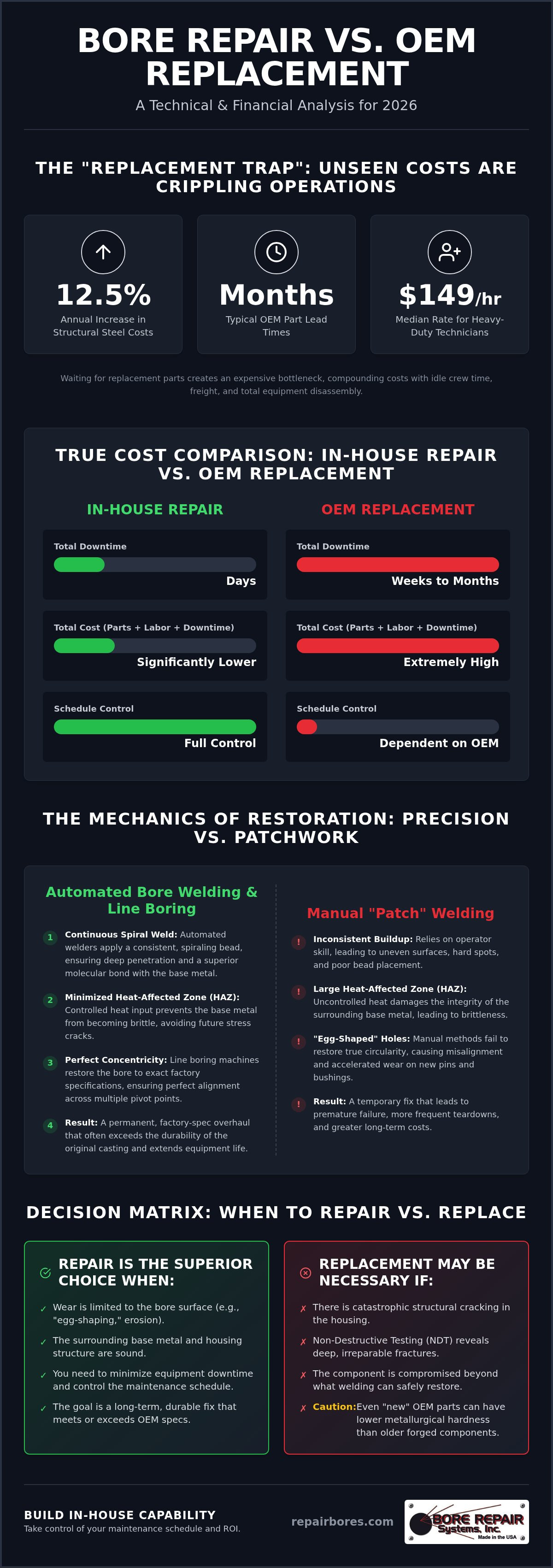
Decision Matrix: When to Repair and When to Replace
Deciding between bore repair vs replacement requires a methodical evaluation of technical risk and operational urgency. Don't make this call based on gut feeling alone. A systematic approach ensures you don't waste money on a non-repairable component or overspend on a new part that isn't actually needed. The decision hinges on four critical variables: wear depth, structural integrity, lead time, and the machine's remaining service life. If the equipment is scheduled for retirement in 12 months, an expensive replacement is rarely justifiable. Conversely, if you're managing a new fleet, a high-quality restoration is often the best way to maintain asset value.
Assess the availability of the replacement part immediately. In 2026, procurement lead times for heavy equipment housings have lengthened significantly. If an OEM housing is backordered for eight weeks, the cost of the machine sitting idle will likely dwarf the cost of an in-house repair. Even if a repair is technically complex, the ability to get the machine back into the dirt in three days often wins the ROI argument. Use the following steps to audit your worn components before pulling the trigger on a purchase order.
Step 1: Structural Integrity Audit
Before you fire up a bore welder, you must confirm the base metal is sound. Inspect the housing for stress fractures that extend beyond the bore surface. Use Non-Destructive Testing (NDT) methods like dye penetrant or magnetic particle inspection if you suspect deep cracks. If the structural webbing of the frame is cracked or the component is visibly twisted, welding the bore won't solve the problem. A new bore in a crooked frame will bind the pin and lead to immediate failure. If the frame is square, the component is a prime candidate for restoration.
Step 2: Technical Feasibility
Evaluate the volume of weld material required to restore the bore. While automated systems can handle significant buildup, there is a point where the time and material costs reach diminishing returns. Measure the distortion to calculate the required weld passes. You must also assess physical access. Portable line boring equipment is designed for tight spaces, but you still need enough clearance to mount the bar and the drive unit. If the bore is buried so deep in the chassis that the machine requires a total teardown anyway, the replacement option becomes more competitive. To help you select the right tools for these evaluations, review our Professional Bore Welder Systems: 2026 Buying Guide. If you're unsure about the feasibility of a specific job, contact our technical support team for a professional assessment.
Building In-House Capability with Bore Repair Systems
Moving your maintenance operations in-house is the ultimate resolution to the bore repair vs replacement dilemma. When you outsource, you're paying for another shop's overhead and sitting at the back of their queue. By the time you factor in their markup and the logistics of moving heavy components, the ROI of the repair drops. Owning your equipment changes that math. It allows you to reclaim your schedule and ensure that every pivot point on your fleet meets factory-spec tolerances without waiting for an open slot at a third-party shop.
The shift to in-house maintenance is a strategic response to the current industrial climate. In 2026, the shortage of skilled technicians remains a top concern, coupled with rising operating expenses. When you have the tools and the talent in your own bay, you aren't at the mercy of someone else's labor availability. You turn a potential weeks-long delay into a predictable, high-quality turnaround that keeps your machines in the dirt and earning revenue.
Why Training is the Critical Link
Training is the bridge between owning a machine and mastering a process. You can't expect a technician to achieve precision without a solid foundation in the mechanics of restoration. Professional training ensures your team understands the nuances of thermal expansion, material penetration, and alignment. It's about safety as much as it's about performance. A properly trained operator produces repeatable, factory-spec results that prevent the structural issues associated with manual welding. You can explore our portable machine tools and training services to see how we help your team bridge the skills gap and achieve professional-grade repairs every time.
Selecting Your Equipment
Building an effective toolkit requires an audit of your fleet's most frequent failures. Don't invest in a system that's overkill for your compact equipment, and don't under-equip for your heavy mining assets. You need to match bore welder specifications to your most common pin sizes and housing depths. Portable systems offer the greatest flexibility. They allow you to perform field repairs that save the massive labor costs of a total machine teardown. This mobility is essential when you're managing remote job sites where transporting a machine for a simple bore fix isn't feasible. To build a setup that fits your specific operational needs, Contact Bore Repair Systems for a tailored equipment consultation.
Reclaim Your Maintenance Schedule
Navigating the choice between bore repair vs replacement requires a clear-eyed look at your fleet’s long-term operational health. You've seen how automated restoration provides factory-spec precision that manual welding simply cannot match. By focusing on the true costs of downtime and logistical delays, you can move away from the replacement trap and start making data-driven decisions that protect your bottom line. Bringing these capabilities in-house isn't just about saving on parts; it's about taking full control of your shop's efficiency and asset lifespan.
Our systems offer a proven ROI for heavy equipment maintenance teams by eliminating the wait times associated with OEM supply chains. We don't just provide the tools; we ensure your success with expert technical training included with every equipment system. This ensures your technicians achieve professional, repeatable results from day one. Stop letting backordered parts dictate your project timelines.
Ready to optimize your shop’s repair capabilities? Browse professional bore repair systems and equipment today to find the right solution for your fleet. It’s time to get your machines back in the field faster and more reliably than ever before.
Frequently Asked Questions
Is a repaired bore as strong as a brand-new part?
A precision-repaired bore is often superior to a new part. Automated welding creates a molecular bond with the base metal, often resulting in a more durable surface than the original casting. Since many OEM parts in 2026 utilize mass-produced materials with lower hardness levels, a high-quality weld overlay can increase the component's resistance to future wear while restoring factory-spec concentricity.
How much downtime can I save by repairing a bore in-house?
You can save weeks of idle time by avoiding the current "Replacement Trap." Procurement lead times for new housings have lengthened considerably in 2026, often stretching to two months or more. An in-house repair typically takes one to three days. This speed helps you manage the bore repair vs replacement decision by eliminating freight shipping delays and the high costs of renting a backup machine.
Do I need special certifications to operate a bore welder?
No federal certifications are required, but technical training is essential for professional results. Operating automated systems involves specific setup procedures and machining tolerances that differ from standard shop welding. We provide comprehensive training for equipment bore repair to ensure your operators can achieve repeatable, high-precision results safely. This education allows your team to handle complex restorations without relying on third-party schedules.
What is the maximum amount of wear that can be repaired with welding?
Most bores are repairable regardless of wear depth as long as the base structure is sound. Automated bore welders can apply multiple passes to build up significant metal loss. The limit is usually economic rather than technical. If the wear extends into the structural webbing or compromises the frame's integrity, replacement is safer. For standard "egg-shaping," welding is almost always the more cost-effective choice.
Can I repair a bore without completely disassembling the machine?
Yes, this is a major advantage of using portable machine tools. These systems mount directly to the machine frame, allowing you to perform repairs in the shop or the field. By repairing the bore in place, you avoid the massive labor costs of a total machine teardown. This efficiency is critical for maintaining project timelines and reducing the total cost of ownership for your fleet.
How does automated bore welding prevent egg-shaped holes?
Automated systems eliminate the inconsistencies of manual hand-welding. They maintain a constant travel speed and wire feed rate, applying a uniform, spiraling bead of metal. This controlled process prevents the uneven heat and "hard spots" that lead to distortion. Because the weld is consistent, the line boring machine can easily machine the surface back to a perfectly round, factory-spec profile that resists future egg-shaping.
What industries benefit most from portable line boring machines?
Any industry using heavy-duty articulated joints sees an immediate ROI. The most common sectors include:
Construction and earthmoving for excavators and loaders.
Mining and quarrying for crushers and haul trucks.
Forestry for feller bunchers and forwarders.
Waste management for compactors and transfer equipment.
These industries face high downtime costs, making the ability to perform on-site repairs a significant competitive advantage.
How do I know if a bore is too worn to be safely repaired?
You must perform a structural audit before starting any repair. Use Non-Destructive Testing (NDT) to check for deep stress fractures that extend beyond the bore surface. If the housing is cracked through its structural webbing or the frame itself is twisted out of square, the part should be replaced. If the damage is limited to surface erosion and the frame is true, the component is a prime candidate for restoration.


Comments