

2026 Bore Repair Training: Maintenance Reference Guide

Updated: Sep 1
Every hour your heavy equipment sits idle waiting for a third-party contractor is a direct hit to your bottom line. You've likely seen the invoices from outside machining services and realized the cost of the repair often pales in comparison to the cost of lost productivity. It's frustrating to watch specialized work leave your shop because of a lack of internal expertise or the fear that a technician might damage an expensive machine frame. You want a team that can handle precision work without hesitation.
Investing in a structured bore repair training program is the only way to break this cycle of dependency. By mastering standardized technical requirements and curriculum standards, your crew can achieve factory-spec precision on every job. This guide provides a comprehensive reference for 2026 maintenance standards; it details the exact skills needed to bring professional machining in-house. We'll examine the specific setup protocols, automated welding techniques, and safety standards that ensure a repeatable, high-quality repair every time you fire up the equipment. It's time to stop outsourcing your profitability and start building a specialized team that keeps your fleet moving.
Table of Contents
Defining the Scope of a Professional Bore Repair Training Program
A professional bore repair training program is not a collection of equipment manuals or a "watch-one-do-one" apprenticeship. It is a structured technical curriculum designed to eliminate the guesswork from industrial maintenance. Many shops still rely on trial and error, which often leads to egg-shaped bores or compromised metallurgy. Professional instruction replaces these risks with a repeatable science. In 2026, the industry standard requires a seamless blend of automated bore welding and precision Boring (manufacturing) to restore equipment to factory specifications. This approach ensures that every repair is documented, standardized, and precise.
The primary objective of this training is restoring mechanical integrity to heavy equipment frames, pivots, and hinges. When a pivot point wears out, it creates a structural liability that can lead to catastrophic failure. A professional program teaches technicians how to build up worn material and machine it back to the exact diameter and alignment required for high-performance operation. It moves the shop away from temporary fixes and toward permanent, factory-grade resolutions.
The Shift from General Mechanic to Machining Specialist
General maintenance skills are valuable, but they don't translate directly to the high-stakes world of bore repair. A general mechanic might know how to swap a component, but a machining specialist understands how heat-affected zones (HAZ) impact the structural steel of a machine frame. If you apply too much heat during welding or use the wrong feed rate during boring, you risk material embrittlement or tool chatter. Precision bore repair is the restoration of factory-spec concentricity. This transition requires a deep respect for metallurgy and the physics of metal removal that goes beyond standard wrench-turning.
Who Should Enroll in a Bore Repair Program?
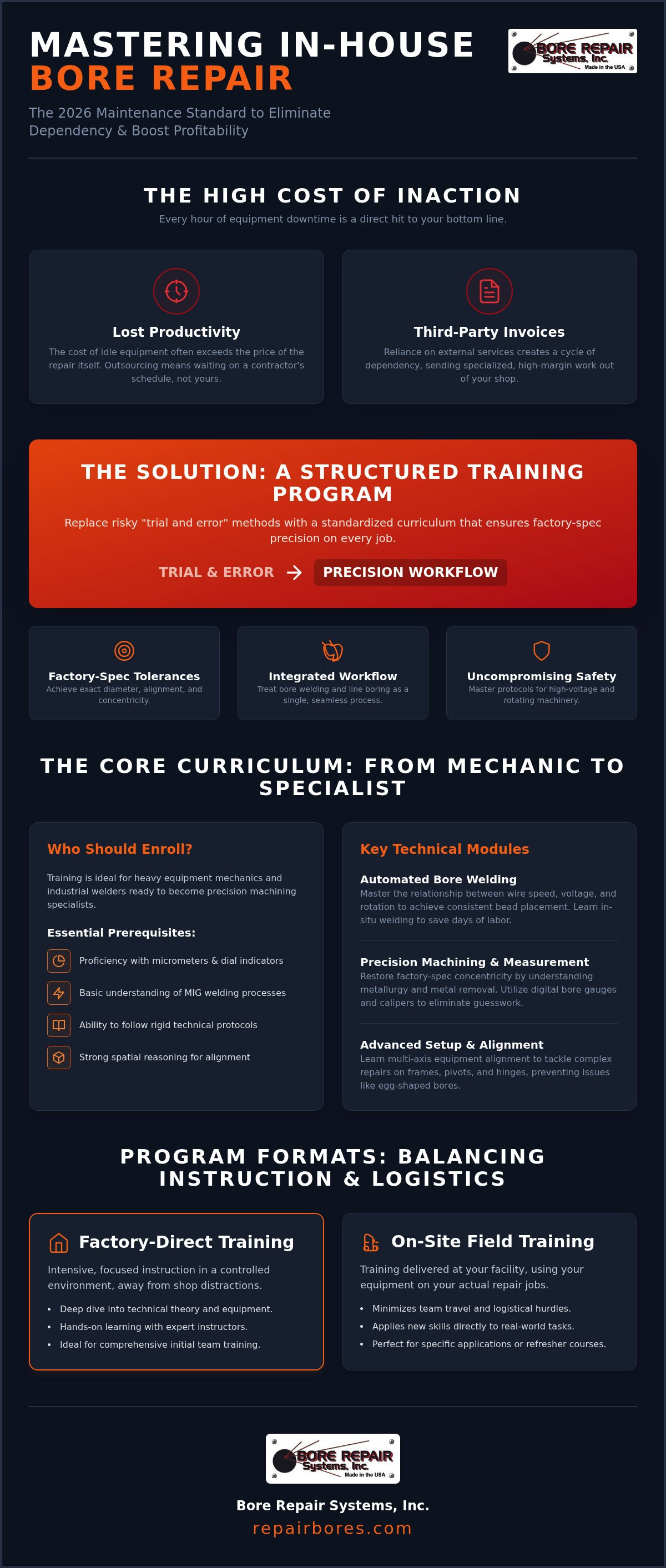
Ideal candidates for training include heavy equipment mechanics and industrial welders who possess a baseline understanding of mechanical systems. Before starting a professional program, technicians should have experience with basic shop tools and foundational welding techniques. They don't need to be master machinists, but they must be comfortable with precision measurement. Essential prerequisites usually include:
Proficiency with micrometers and dial indicators
Basic understanding of MIG welding processes
Ability to follow rigid technical protocols and safety standards
Strong spatial reasoning for aligning multi-axis equipment
Maintenance managers play a critical role in this process. They shouldn't just send the most available person; they should select team members who are detail-oriented and patient. Selecting the right personnel ensures the equipment investment pays off through reduced downtime and higher repair quality across the entire fleet.
The Core Curriculum: Technical Skills and Precision Standards
Successful bore repair relies on an integrated workflow where welding and machining aren't treated as separate events. A professional bore repair training program bridges the gap between these two disciplines, teaching technicians how to manage the entire restoration process from initial inspection to final verification. Modern training standards emphasize the use of automated systems to ensure consistency, reducing the physical strain on operators while increasing the accuracy of the finished product. Safety remains the highest priority. Technicians learn rigid protocols for handling high-voltage equipment and rotating machinery, ensuring the shop stays productive and accident-free.
Digital measuring tools have transformed how we approach these repairs in 2026. Training now includes the use of electronic bore gauges and digital calipers that feed data directly into repair logs. These tools eliminate the "feel" factor that often leads to inconsistent results in manual shops. By mastering these technologies, your team can guarantee factory-spec clearances on every pivot point they touch.
Automated Bore Welding Modules
Setting up a bore welder requires more than just hitting a start button. This module focuses on achieving consistent bead placement by mastering the relationship between wire speed, voltage, and rotation pace. Technicians learn to manage weld parameters for various materials, from standard mild steel to specialized alloys. A key advantage of this training is learning how to perform in-situ welding, which allows for repairs without removing massive components from the machine frame. This skill alone can save days of labor during a major overhaul.
Line Boring and Machining Modules
Maximum rigidity is the foundation of every successful cut. In this module, operators learn to set up line boring machines using heavy-duty mounting brackets and spherical bearings to prevent tool chatter. The curriculum covers the math behind the machining, teaching technicians how to calculate feed rates and spindle speeds for different steel hardness levels. The ultimate goal is achieving perfect concentricity. You want the new weld and the original bore center to align exactly, ensuring the pin fits perfectly without binding. If you're ready to upgrade your team's capabilities, consider exploring a professional bore repair training program to master these specialized skills.
Advanced Measurement and Verification
Verification is where a professional repair proves its value. This module teaches the precise use of micrometers and dial indicators to verify tolerances within thousandths of an inch. Understanding factory-spec clearances for pins and bushings is critical; a bore that's too tight will seize, while one that's too loose will fail prematurely. Finally, the curriculum covers documentation. Keeping detailed industrial repair logs ensures quality control and provides a technical history for every piece of equipment in your fleet. This level of detail is what separates a professional machining specialist from a general mechanic.
Evaluating Program Formats: Factory vs. Field Training
Choosing the delivery method for your bore repair training program is a strategic decision that affects both cost and long-term skill retention. You must weigh the benefits of an immersive factory environment against the practical advantages of training in your own shop. Both paths lead to technical proficiency, but the logistical requirements differ significantly. For a small shop with one or two lead technicians, a trip to the manufacturer might make sense. For a large fleet maintenance department, bringing the instructor to the facility is usually the more efficient path. It's about finding the balance between intensive education and operational uptime.
Manufacturer-Direct Factory Training
Sending technicians to a manufacturer's facility provides an immersive experience that's hard to beat. It removes them from the daily distractions of active shop operations, allowing for total focus on the curriculum. Instructors at these facilities are often the same experts who designed the bore welders and line boring machines your team will use. This direct access offers technical insights that are difficult to replicate in a busy field environment. Technicians also benefit from specialized shop environments optimized for teaching, complete with various mock-ups and testing stations. Additionally, these sessions allow your team to network with other industrial professionals, sharing field-tested solutions for common mechanical hurdles.
On-Site Field Training Programs
For larger maintenance departments, on-site training is often the most pragmatic choice. This format eliminates travel expenses and keeps your team close to the equipment they service. The primary advantage is context. Technicians learn on the specific machines and in the exact environmental conditions they face every day. This "real-world" approach allows the instructor to help solve actual repair challenges currently sitting in your shop. It turns a training session into a productive maintenance event, providing immediate ROI by completing a live job under expert supervision. It's a direct way to ensure that your specific workflow and shop layout are optimized for precision machining.
Large organizations should also consider a "train-the-trainer" model. By certifying a lead shop foreman or senior machinist, you create a sustainable internal knowledge base. This ensures that new hires are onboarded with the same high standards without requiring repeated external sessions. Regardless of the format you choose, your team must train on the actual equipment they'll operate daily. Mastery of a specific bore repair training program comes from muscle memory and familiarity with your specific tools' controls and feedback. Investing in the right format ensures those skills translate directly to your bottom line.
Implementation: Transitioning from Training to In-House Repair
Transitioning from a classroom environment to a live shop floor requires a deliberate strategy. Completion of a bore repair training program is only the first step. To see a return on your investment, you must integrate these new skills into your standard maintenance workflow immediately. The first 90 days are critical. Start with less complex repairs, such as smaller pivot points, to build operator confidence and refine your shop's setup procedures. Avoid the common pitfall of waiting for a "perfect" job; the longer the gap between training and application, the more technical nuances are lost.
Management must commit to this transition by scheduling dedicated time for the newly trained technicians to practice. It's often tempting to revert to old habits when a high-priority machine breaks down. However, bypassing your internal team in favor of a contractor only delays your shop's independence. Consistency is what builds the muscle memory required for factory-spec precision. For a deeper look at the financial benefits of this transition, review our guide on In-House Line Boring vs. Outsourcing.
Setting Up the In-House Machining Station
A dedicated area for bore repair ensures that precision tools remain calibrated and accessible. You'll need a clean, well-lit space with stable power for your bore welder and line boring machine. Beyond the primary equipment, success depends on having the right bore welding accessories on hand, such as specialized torches and centering cones. Safety is non-negotiable. Automated welding generates consistent fumes, so proper ventilation systems and high-quality welding screens are essential to protect the rest of the shop. Proper organization of this station reduces setup time and prevents tool damage.
Measuring Success and ROI
Management needs data to justify the investment in new capabilities. Track the reduction in equipment downtime hours religiously. When you repair a bore in-house, you eliminate the two-week lead time often required by contractors. Calculate the cost savings per bore by comparing your internal labor and consumable costs against previous third-party invoices. You'll likely find that the equipment pays for itself within the first few major repairs.
Long-term equipment life cycles also improve. Precision repairs performed by a trained team prevent the premature wear of pins and bushings. By investing in training, you're not just saving on a single job; you're extending the operational life of your entire fleet. If you're ready to stop relying on outside help, visit Bore Repair Systems to view our professional equipment and training options.
The Bore Repair Systems Advantage: Expert Technical Education
Choosing a bore repair training program shouldn't be about checking a box. It's about gaining a competitive edge through manufacturer-direct knowledge. At Bore Repair Systems, Inc., we don't just sell tools; we engineer the solutions that keep heavy equipment in the field. This unique perspective allows us to provide instruction that's grounded in the actual mechanics of the equipment, not just abstract machining theory. Graduates leave our programs with the confidence to handle high-stakes repairs because they've learned from the people who built the machines. We prioritize technical integrity over marketing fluff, ensuring your team has the skills to back up their work.
Our role doesn't end when the training session concludes. We provide ongoing technical support to program graduates, acting as a seasoned partner in your shop's success. If your technicians encounter a complex mechanical challenge or a unique frame geometry, they have direct access to our expertise. This level of support is what transforms a standard maintenance crew into a precision machining department. We're committed to your long-term independence from outside contractors.
Manufacturer-Led Instruction
Our training goes beyond basic operation. You'll learn from the same engineers who design our professional bore welder systems. This section of the curriculum provides a deep-dive into the BOA-408i and BOA-M1 systems, focusing on how to maximize efficiency and tool life. We cover the latest machining techniques and equipment updates that third-party trainers simply can't access. You get direct, no-nonsense education on how to set up, operate, and maintain your equipment for maximum ROI. It's about mastering the tools to unlock their full potential.
A Commitment to Field Success
We focus on education because a tool is only as good as the technician using it. Our goal is to ensure your team becomes a specialized machining department capable of factory-spec results every time. We understand the pressure of idle equipment and the high cost of contractor delays. That's why our approach is pragmatic and solution-oriented. We've seen every possible equipment failure, and we've designed our training to address those realities head-on. It's time to stop reacting to wear and start mastering the restoration process.
Professionalizing your maintenance department starts with a clear roadmap. Managers can schedule a consultation or a dedicated training session to evaluate their specific fleet needs. Contact us today to bring precision machining in-house and secure your fleet's operational future. We're ready to help you build a team that's as reliable and sturdy as the equipment they maintain.
Taking Control of Your Equipment Maintenance Future
Transitioning to in-house machining is a strategic move that pays immediate dividends. By moving away from third-party contractors, you eliminate weeks of downtime and keep your fleet operational. A professional bore repair training program provides your team with the technical foundation to restore pivot points with factory-spec precision. You've seen how a structured curriculum and automated equipment can transform a general mechanic into a machining specialist.
Bore Repair Systems offers manufacturer-direct expert instruction that focuses on automated machining and welding. This specialized education ensures a proven ROI for heavy equipment fleets by extending machine life and reducing repair costs. It's about more than just buying tools; it's about mastering a repeatable, high-quality process that secures your shop's independence. Ready to stop waiting on outside contractors? Contact Bore Repair Systems to Schedule Your Training Program. Your team has the potential to handle these complex repairs; they just need the right roadmap to get there.
Frequently Asked Questions
How long does a typical bore repair training program take to complete?
Most professional programs range from two to four days depending on the complexity of your equipment and the size of your team. This timeframe allows for a balance of theoretical classroom instruction and intensive hands-on practice. Technicians use this time to move past basic setup and into advanced troubleshooting. A three-day window is often the standard for mastering the foundational mechanics and automated software required for factory-spec results.
Do my technicians need prior welding certification before attending?
Formal welding certification is not a strict prerequisite, but a baseline proficiency in MIG welding is essential for success. Technicians should understand wire feed mechanics and gas shielding before starting a specialized bore repair training program. The curriculum focuses on the automated application of material rather than teaching basic beads. If your team has industrial welding experience, they can easily transition into mastering the automated systems used for precision restorations.
Can we get trained on our specific heavy equipment models?
Yes, training is frequently tailored to the specific machine frames and pivot geometries your team services daily. While the core principles of machining remain constant, the mounting and alignment challenges vary between excavator buckets, loader hitches, and articulated joints. Providing your specific model information beforehand allows instructors to prepare relevant mock-ups or focus on the exact tolerances required for your fleet. This ensures the skills translate directly to your shop floor.
Is the training valid for both bore welding and line boring?
Professional training covers both bore welding and line boring as a single, integrated workflow. You cannot achieve factory-spec results by mastering only one half of the process. The curriculum teaches technicians how to build up worn material with an automated welder and then machine it back to size with a line boring unit. This holistic approach ensures the finished bore is perfectly concentric and structurally sound, preventing premature pin and bushing failure.
What is the typical ROI for a team that completes professional training?
ROI is typically realized within the first three to five major repairs by eliminating expensive third-party machining invoices. Beyond direct cost savings, shops see a massive reduction in equipment downtime. Instead of waiting weeks for a contractor, your trained team can complete a repair in a matter of days. This increased fleet availability often pays for the initial training and equipment investment within the first year of shop implementation.
Does Bore Repair Systems offer on-site training for our national locations?
Bore Repair Systems provides on-site training across the United States to accommodate large maintenance departments and national fleets. We bring the expertise to your facility, allowing your team to learn in their own shop environment using their specific tools. This format is highly efficient for organizations that need to standardize repair protocols across multiple locations. It eliminates travel costs for your technicians while ensuring the training addresses your shop's unique logistical challenges.
What equipment is required to participate in the training program?
Participation requires a complete bore repair system, including a bore welder, a line boring machine, and the necessary mounting accessories. You'll also need standard shop utilities like a stable power supply and a clean shielding gas source for the welding modules. Instructors use your specific equipment during the sessions to ensure technicians are comfortable with the exact controls and feedback of the tools they'll use for every future repair job.
How do we verify that an operator has mastered the necessary precision?
Mastery is verified through precise measurement and documented test cuts that meet factory tolerances. Technicians must demonstrate proficiency with micrometers, dial indicators, and bore gauges to prove the finished bore is concentric and sized correctly. A successful operator won't just "feel" the fit; they will provide a technical log showing the final dimensions match the OEM specifications. This objective verification is the hallmark of a professional machining specialist.


Comments