

On-Site vs. In-House Bore Repair Training: Choosing the Right Path for Your Team
- slinger6
- 13 hours ago
- 11 min read

The most convenient training option for your team might actually be the one that costs you the most in the long run. Many shop managers assume that bringing an instructor to their facility is the only way to minimize downtime. However, if that choice leads to distracted operators or incomplete technical mastery, the "savings" vanish quickly. Choosing between on-site vs in-house bore repair training isn't just about travel costs; it's about whether your technicians can consistently hit factory-spec tolerances without a mentor standing over their shoulder.
You're likely feeling the pressure of a packed repair schedule and the legitimate fear of an operator making a costly mistake on a customer's heavy equipment. It's a difficult balance to maintain. This article evaluates the logistical, educational, and financial trade-offs of both training paths to ensure your team masters precision bore repair. We'll examine how to minimize disruptions to your shop while maximizing the ROI on your bore welders and boring machines. This guide provides the clarity you need to choose the right path for your specific operational needs and long-term success.
Table of Contents
Understanding the Impact of Training Location on Operator Proficiency
The Practical Advantages of On-Site Training for Field Teams
The Benefits of In-House Training at the Manufacturer Facility
Decision Framework: Comparing On-Site vs. In-House Learning Outcomes
Mastering Precision with Bore Repair Systems, Inc. Training Programs
Understanding the Impact of Training Location on Operator Proficiency
Bore repair training is the specialized education required to operate automated bore welders and line boring machines. It isn't just about knowing which buttons to press. It's about understanding the mechanics of material deposition and the physics of precision machining. At Bore Repair Systems, Inc., we focus on technical education to ensure that every operator can achieve professional results. This training covers the entire workflow; from initial alignment and mounting to the final finishing pass that meets factory tolerances.
The location where this learning happens significantly impacts technical retention. When evaluating on-site vs in-house bore repair training, shop managers must consider how the environment affects the mastery of complex concepts. While On-the-job training provides the benefit of familiarity with local equipment, a manufacturer's facility offers a level of focus that is difficult to replicate in a busy shop. Bore Repair Systems, Inc. emphasizes that in 2026, the link between operator skill and machine longevity is clearer than ever. A technician who understands the limits of their hardware prevents the forced errors that lead to premature wear and expensive component failures.
The Skill Gap: Bore Welding vs. Line Boring
These two processes require entirely different technical mindsets. Automated bore welding is a metallurgical challenge that involves managing heat and material flow. Line boring is a geometric challenge that demands surgical precision and a deep understanding of surface finishes. A "one-size-fits-all" approach to training often fails because it ignores these distinctions. The goal is always factory-spec repair. If an operator doesn't understand the specific requirements for both welding and machining, the quality of the final repair will inevitably suffer.
Why 2026 Technology Demands Specialized Instruction
Modern equipment has evolved beyond basic manual controls. Current systems feature digital interfaces and integrated alignment sensors that require a higher level of technical literacy. You can't rely on intuition alone to calibrate 2026-grade hardware. Precision bore repair is the intersection of automated material deposition and surgical machining. Without specialized instruction, technicians often underutilize their machines or fail to maintain the tight tolerances required by modern heavy equipment. Proper training ensures that your team can leverage every feature of their automated systems for maximum shop efficiency.
The Practical Advantages of On-Site Training for Field Teams
On-site training brings the expert directly to your facility. This approach allows your technicians to learn on the exact machines they'll use every day. When evaluating on-site vs in-house bore repair training, the biggest draw for many is the immediate application of skills. Your team doesn't have to translate what they learned on a factory floor back to their own workshop. They set up the bars, align the welders, and cut the bores in the same environment where they'll be expected to perform under pressure.
This method aligns with the broader Industrial Maintenance Career Pathway, which emphasizes the value of practical, hands-on experience. By keeping the team local, you eliminate the logistical headaches of booking flights, hotels, and managing per diems. It also allows for collective learning. Instead of sending one lead tech who might forget half the details by the time they return, the entire maintenance crew can observe and participate. This builds a shared technical vocabulary across your shop. Managers often weigh the cost of downtime against the benefits of on-site vs in-house bore repair training when deciding how to upskill their crew.
Training on Your Own Turf
Every shop has its quirks. Power supplies might fluctuate, or shop air systems might have specific pressure drops. On-site training identifies these site-specific hurdles before they cause a real-world failure. If you're repairing bores on a specific fleet of excavators or loaders, the instructor can tailor the curriculum to those specific frames. You learn exactly how to maneuver a line boring machine around the tight spaces of your most common equipment. This ensures your setup is optimized for your actual workflow, not a theoretical one.
The "Distraction Factor" of On-Site Learning
The convenience of on-site training comes with a significant risk: the emergency repair. It's tempting for a manager to pull a tech out of a session to fix a broken hydraulic line or swap a bucket. This kills the educational momentum. To get the most out of the session, you must treat the training area as a "no-fly zone." Mitigate shop noise and interruptions by scheduling the training during a lighter production window. Ensure the trainer has the full, undivided attention of the operators to prevent costly knowledge gaps. Mastery requires focus.
The Benefits of In-House Training at the Manufacturer Facility
While on-site training focuses on local convenience, in-house training at a manufacturer facility provides a total break from the daily grind. This path removes the "distraction factor" mentioned previously; there are no emergency repairs or shop floor interruptions to pull an operator away from their instruction. This total focus allows for a much steeper learning curve and better retention of complex machining principles. When weighing on-site vs in-house bore repair training, the primary advantage of the factory floor is the ability to learn in a controlled, optimized environment.
Training at the source also grants your team access to the full range of equipment and accessories. Most shops only own the specific models they need for current contracts. At a manufacturer's facility, technicians can test different bar sizes, specialized mounting jigs, and the latest automated bore welders. This exposure helps your team understand the full scope of what's possible. It makes them better prepared for future equipment upgrades or more complex repair jobs that might eventually come through your doors, ensuring they aren't limited by the hardware currently in your shop.
The Manufacturer-Direct Advantage
Learning at a dedicated facility like Bore Repair Systems, Inc. ensures your technicians learn from the source. They work directly with the engineers and senior technicians who designed and built the systems. This direct access allows for a deeper dive into machine mechanics that you just can't get in a field setting. The facility provides specialized testing bores and jigs designed to simulate various repair scenarios, from simple pivot points to badly wallowed-out housings. Additionally, your team can network with other professionals. Sharing tips and experiences with peers from different industries often leads to breakthroughs in how they approach their own shop efficiency.
Mastering the Fundamentals of Precision
In-house training focuses heavily on the "why" behind every setting. Operators don't just learn which buttons to push; they learn how feed rates, wire speed, and voltage interact to create a perfect weld bead. There is a clear psychological benefit to "going to school." It signals to the operator that mastering this equipment is a significant investment in their career. This mindset leads to a higher level of professional pride and care in their work. In-house training provides a controlled, standardized baseline for all future field repairs. It ensures every technician starts with the same high-level foundation before they ever have to adapt to messy, real-world conditions.
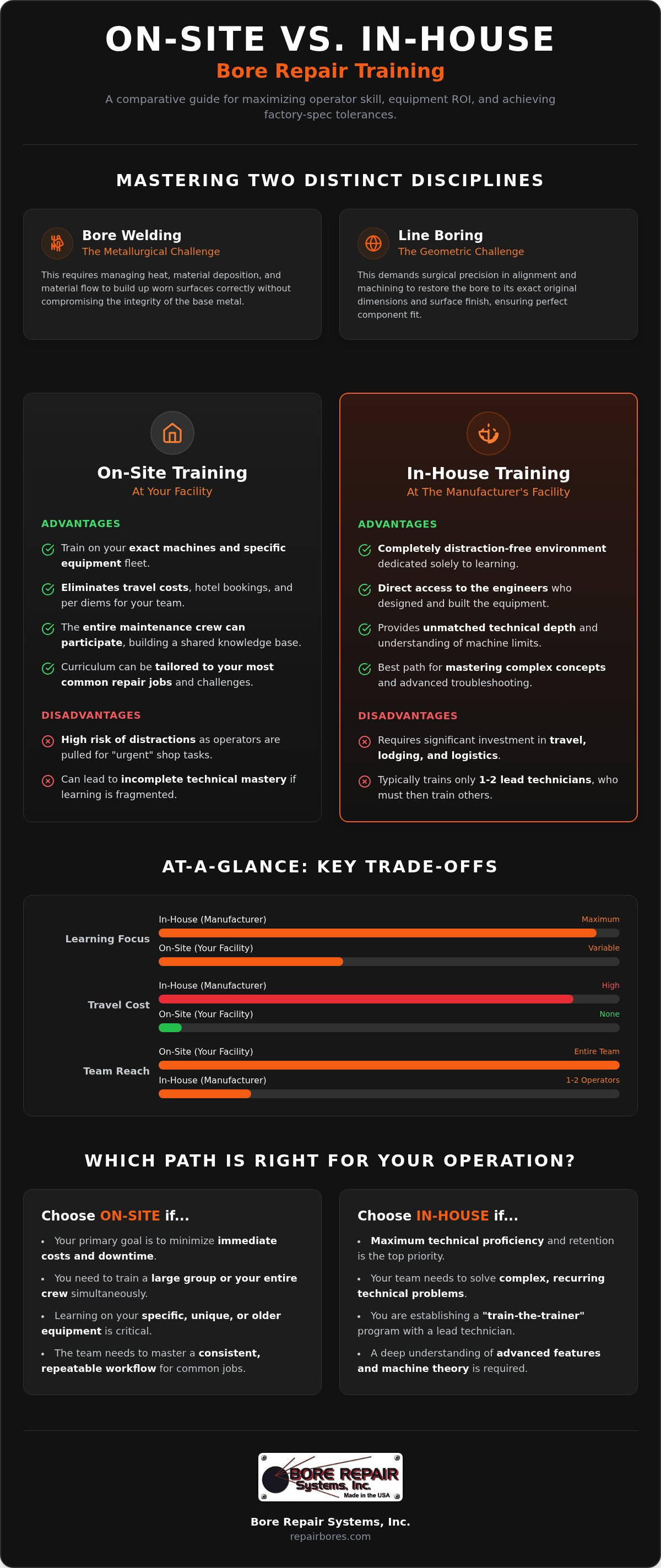
Decision Framework: Comparing On-Site vs. In-House Learning Outcomes
Selecting the right training format is a strategic decision that impacts your shop's bottom line and repair quality. The choice between on-site vs in-house bore repair training often hinges on your current team's workload and their existing technical baseline. In a 2026 maintenance schedule, where equipment uptime is non-negotiable, you must weigh the speed of proficiency against the cost of logistical disruption. While on-site training keeps your crew at the shop, in-house training often results in higher long-term retention because the learning environment is controlled and standardized.
ROI calculations shift based on the size of your team. For a single technician, the cost of travel to a manufacturer facility is usually offset by the depth of expertise they bring back. For a crew of six, the travel expenses multiply, making on-site instruction more financially attractive. However, "Time to Proficiency" is typically shorter for in-house graduates. They return ready to work, whereas on-site students often lose hours to shop distractions, extending the period before they can achieve factory-spec results independently.
When to Choose On-Site Training
Large Team Training: If you need to certify five or more operators simultaneously, on-site sessions are the most cost-effective path.
Custom Equipment Configurations: This is the best choice if your shop uses highly specialized or modified mounting hardware that isn't found in a standard training lab.
Live Project Integration: Choose this when you want to integrate line boring operator training directly into a current, high-priority repair job.
When to Choose In-House Training
Entry-Level Development: New hires with zero bore repair experience benefit most from the immersive, distraction-free environment of a factory facility.
Train the Trainer Programs: If you intend to have one lead technician develop an internal training curriculum, they need the deep technical "why" provided at the source.
New System Implementation: This is recommended when purchasing complex, multi-axis professional bore welder systems that require a fundamental shift in how your team approaches material deposition.
Ultimately, the goal is to eliminate costly mistakes on customer equipment. Whether you bring the expert to your floor or send your best hands to the factory, the investment in education is what secures your shop's reputation for precision. If you're ready to upgrade your team's capabilities, explore our current training schedules to find the best fit for your facility.
Mastering Precision with Bore Repair Systems, Inc. Training Programs
The training philosophy at Bore Repair Systems, Inc. is fundamentally pragmatic and solution-oriented. We prioritize functionality and dependability over marketing fluff, focusing on the industrial expertise required to keep your fleet operational. Our programs are designed for professionals who value precision and time-efficiency. Every module centers on hands-on application because we know that technical education is the only way to unlock the full potential of automated bore welders. Whether you are weighing the logistical trade-offs of on-site vs in-house bore repair training, our goal remains the same: ensuring your operators can achieve factory-spec results without hesitation.
Support from our team doesn't end when the formal session concludes. We act as a seasoned partner, providing the right tools and knowledge to resolve specific operational hurdles long after the training is complete. If your team encounters a particularly stubborn equipment failure or an unusual alignment challenge, our veteran engineers are available to guide you through the resolution. We also offer customization for both on-site and in-house sessions to match your fleet's specific mechanical challenges. This ensures that the instruction is rooted in practical application rather than abstract theory, respecting your intelligence and the urgency of your repair schedule.
What to Expect from a Professional Program
Our curriculum provides a methodical guide through the entire repair lifecycle. It moves from initial alignment and mounting to material deposition and final machining passes. We break down complex mechanical challenges into digestible segments, ensuring each technician masters the current setup before moving to the next. Safety protocols for automated welding and boring are integrated into every step to protect your crew and equipment. Utilizing specialized line boring training is the most effective way to justify a new equipment purchase by ensuring it delivers a high ROI from the first job. It turns a heavy technical process into a straightforward, repeatable workflow.
Getting Started: Scheduling Your Session
Evaluating your team's current skill level is the first step toward a successful session. We help you determine if your crew needs a fundamental refresh on alignment or advanced instruction on new digital controls for automated systems. Requesting a quote for on-site vs in-house bore repair training is straightforward and moves with purpose. We provide clear options that respect your shop's production needs and travel constraints. Ready to eliminate complications and master your equipment? Contact Bore Repair Systems, Inc. to schedule your training and ensure your team achieves professional, repeatable results that stand up to industrial demands.
Equip Your Team for Long-Term Technical Mastery
Choosing the right path for on-site vs in-house bore repair training is a strategic investment in your shop’s reputation. On-site training allows your crew to master equipment within your specific facility’s workflow, while in-house training at a manufacturer facility offers an immersive environment free from daily distractions. Both paths aim for the same result: operators who can achieve factory-spec tolerances with confidence and speed. It’s about ensuring that every repair meets the highest standards of precision without second-guessing.
Success in modern maintenance requires more than just owning the right tools; it requires the manufacturer-direct expertise to use them to their full potential. Our hands-on curriculum is designed for 2026 standards, providing a proven ROI for maintenance teams by minimizing downtime and eliminating costly repair errors. We act as your seasoned partner, ensuring your technicians have the fundamental knowledge to solve complex mechanical challenges correctly the first time.
Schedule Your Professional Bore Repair Training Today and take the first step toward a more efficient, high-precision workshop. Your team’s mastery is the key to unlocking your equipment’s true value.
Frequently Asked Questions
How long does a typical bore repair training program last?
A typical bore repair training program lasts approximately two days. This timeframe provides enough room for both technical theory and extensive hands-on practice. We focus on getting your team through the learning curve quickly so they can return to production. While shorter orientations exist, a full two-day session ensures operators can handle initial alignments and final machining passes with factory-spec precision. This duration balances depth with shop efficiency.
Do my operators need prior welding experience to attend bore welder training?
Prior welding experience is beneficial but not strictly required for attending bore welder training. Our automated systems are designed to simplify the material deposition process. We teach the fundamentals of how wire speed and voltage interact within the context of the machine's digital controls. An operator with a basic mechanical aptitude can master our welders through a structured, step-by-step instructional approach that prioritizes practical application over abstract theory.
Is certification provided upon completion of the training?
Yes, we provide a certificate of completion for all technicians who successfully finish the program. This serves as a formal record of their specialized education in operating automated bore welders and line boring machines. Having factory-certified operators helps your shop demonstrate a commitment to precision and quality control. This is especially useful when bidding on complex customer contracts or managing high-value internal fleet repairs that demand documented technical proficiency.
Can on-site training be performed during active repair jobs?
On-site training can be performed during active repair jobs, but we generally recommend using a dedicated test piece instead. Training on a live customer project can increase stress and introduce the distraction factor, where technicians are pulled away for other emergencies. To maximize the ROI of on-site vs in-house bore repair training, it's best to create a controlled environment where the instructor has the team's full, undivided attention.
What equipment do we need to provide for an on-site training session?
For an on-site session, you need to provide a stable power source, clean shop air, and the specific bore repair equipment your team will use. We also suggest having a representative work piece, such as an excavator bucket or a loader frame, available for practice. Ensuring these utilities are ready before the instructor arrives prevents wasted time and allows the training to move with a sense of purpose from the first hour.
What is the maximum number of students recommended per training session?
We recommend a maximum of four to six students per training session to ensure high-quality instruction. While larger groups are possible for classroom overviews, hands-on technical mastery requires direct supervision and enough machine time for every participant. Keeping the group small allows our experts to address the specific skill levels of each operator. This leads to better long-term retention of complex machining and welding concepts across the entire team.
Does Bore Repair Systems, Inc. offer follow-up support after the training is complete?
Yes, Bore Repair Systems, Inc. provides ongoing technical support long after the formal training ends. We act as a seasoned partner for your shop, helping your operators troubleshoot unusual equipment failures or difficult setups in the field. This post-training assistance is a core part of our philosophy. We ensure your team continues to achieve professional results and maintains the mechanical integrity of your equipment through every future repair challenge.
Can we combine line boring and bore welding training into a single session?
You can definitely combine line boring and bore welding training into a single, comprehensive session. These two skills are the intersection of precision repair. Learning them together helps operators understand how material deposition affects the final machining pass. Combining the modules provides a holistic view of the repair lifecycle. This helps your maintenance team reduce total downtime and improve the overall durability of the bores they fix in the shop.


Comments