

How to Fix Worn Pivot Pins on Excavators: A Professional Guide
- slinger6
- 23 hours ago
- 12 min read

Slapping a new bushing into an egg-shaped hole isn't a repair; it's a countdown to your next expensive breakdown. When you need to fix worn pivot pins excavator bores, manual "weld-and-grind" methods usually result in misaligned holes that eat through new hardware in a matter of weeks. You've likely seen the results: excessive vibration, rapid pin wear, and a machine that heads back to the shop far sooner than it should. With industry labor rates now averaging $149 per hour, your operation can't afford to do the same job twice.
You know that precision is the only way to stop the cycle of rapid wear and recurring downtime. This guide teaches you the exact process to restore worn excavator bores to factory specifications using automated repair systems. We'll walk through the transition from manual patches to a systematic approach involving automated bore welding and precision line boring. By following these professional steps, you'll ensure your bores are perfectly aligned. This allows you to extend the service life of your fleet and keep your long-term maintenance costs under control.
Table of Contents
Understanding Excavator Pivot Pin Wear and Egg-Shaped Bores
When you're operating a machine, you know the exact moment something goes wrong. The bucket doesn't quite land where you point it. You hear a heavy clunking sound every time the load shifts. These symptoms, along with increased vibration and a loss of precision, are clear signals that you need to fix worn pivot pins excavator bores before the damage becomes critical. Ignoring these signs leads to a "snowball effect" where a small amount of play creates a hammering action. This constant impact destroys the structural integrity of the arm and accelerates wear on every connected component.
Bore wear is rarely uniform. Because an excavator arm primarily pushes or pulls in specific directions, the load isn't distributed evenly around the hole. This directional stress creates "egg-shaped" wear, where the bore stretches into an oval. Once this happens, a standard replacement pin or bushing won't sit flush. It'll only contact the "high spots" of the worn bore, leading to immediate failure of the new parts. The goal of professional repair is to restore perfect concentricity and the original surface hardness of the metal.
The Mechanics of Bore Failure
Friction is the primary cause of deformation. When lubrication fails, metal-on-metal contact generates intense heat and abrasive wear. This is a common issue in heavy equipment maintenance where harsh environments quickly degrade grease. As the bore loses its shape, the entire geometry of the excavator arm shifts. This misalignment puts sideways pressure on hydraulic cylinders and seals, leading to leaks and premature failure. Egg-shaped wear is the result of concentrated stress cycles on the bore surface. Without a perfectly round foundation, the pin cannot distribute the machine's massive breakout forces safely.
When to Repair vs. When to Replace
Deciding whether to rebuild a bore or replace the entire component comes down to a simple cost-benefit analysis. Buying a new boom or bucket is a massive capital expense that most fleets want to avoid. In almost every case, rebuilding the bore is the smarter ROI booster. You should assess the depth of the wear; if the structural wall of the casting is still thick enough to support a weld and a fresh cut, it's a prime candidate for restoration. However, safety is the priority. If you find deep cracks that extend into the main structure, the component's integrity is compromised. For typical wear, using an automated system to fix worn pivot pins excavator bores restores the machine to OEM specifications for a fraction of the replacement cost.
Why Manual Welding and Grinding Fails to Fix Worn Bores
Many shops attempt to fix worn pivot pins excavator bores using a handheld welder and a die grinder. It seems like a cost-effective shortcut. In reality, it's a recipe for recurring failure. The human hand cannot maintain the steady speed or consistent distance required to build a perfectly circular layer of metal inside a hole. This lack of precision creates high and low spots throughout the bore. When you try to force a new pin into a hole that isn't truly round, you create localized pressure points. These points lead to rapid friction and accelerated wear that destroys your new parts in record time.
Heat management is another critical failure point. Manual welding dumps a massive, concentrated amount of heat into one area of the casting at a time. This thermal stress often warps the base metal, pulling the entire bore out of alignment. As the weld cools inconsistently, it creates "hard spots" in the material. These spots are significantly harder than the surrounding metal. They can cause a boring bar to deflect or chatter during the final machining phase, leading to a poor surface finish. Heavy vehicle and mobile equipment service technicians understand that improper thermal cycles compromise the structural integrity of the machine's arm.
The Problem with Manual "Slug" Welding
Achieving 100% weld penetration by hand inside a deep bore is nearly impossible. You often end up with "slug" welding, where the new metal sits on top of the old surface rather than fusing with it. This creates hidden air pockets and slag inclusions that weaken the joint. These voids act as stress concentrators. Under the massive breakout forces of a modern excavator, these weak joints can crack or delaminate entirely. This lack of fusion is the primary reason why manual fixes often result in the new pin failing within weeks of the machine returning to the field.
Manual Grinding vs. Precision Machining
Precision is the difference between a repair that lasts a month and one that lasts a decade. A die grinder cannot restore the original center point of a bore. It simply follows the existing wear pattern, which we've established is usually egg-shaped. If you don't restore concentricity, the load distribution across the pin will be uneven. This puts massive strain on the bushings and seals. To achieve professional results, you must use misaligned bore repair techniques that establish a true center line through both sides of the pivot point. Establishing this geometry is impossible with hand tools alone.
Don't settle for temporary patches that keep your machine in the shop. If you're tired of chasing the same wear problems, it's time to look into bore welder systems that take the guesswork out of the process and ensure a factory-spec finish every time.
The Professional Solution: Automated Bore Welding and Line Boring
The "Weld-and-Bore" cycle is the industry standard for permanent restoration. It replaces the metal lost to friction and then machines it back to a perfect circle. This process is the only reliable way to fix worn pivot pins excavator bores because it treats the root cause of the failure. First, an automated bore welder applies a uniform layer of new metal. Then, a line boring machine cuts that metal to the exact OEM specifications. This systematic approach ensures that the repair isn't just a patch, but a full restoration of the component's integrity.
Automated bore welders are the backbone of this process. Unlike manual welding, these systems lay down a continuous, spiral bead of metal. This ensures 100% coverage without the voids or inclusions common in hand-welding. Following OSHA qualification standards for repair personnel is vital here. Professional equipment requires trained hands to ensure the repair meets safety and performance requirements. Using these tools correctly prevents the "hard spots" and heat distortion discussed in previous sections.
One of the biggest advantages is the ability to perform bore welding without removing components. This "in-situ" approach saves dozens of hours in teardown and reassembly. You can keep the machine mostly intact while restoring the pivot points to like-new condition. It's a faster, cleaner, and more efficient way to manage fleet maintenance.
Advantages of Automated Bore Welding
Automated systems provide a level of control that is impossible to match by hand. The consistent heat input significantly reduces the risk of structural warping in the excavator arm. Because the weld beads are perfectly circular, the subsequent machining process is much faster and more predictable. Automated systems allow for a high-quality surface finish that extends pin life by providing a smooth, hard foundation for the bushing.
The Precision of Portable Line Boring
Once the welding is complete, the line boring machine takes over to restore alignment. This step is critical because it ensures that the center line remains true across multiple pivot points. You can achieve tolerances within thousandths of an inch, matching the original factory fit. To handle complex excavator geometries, you often need specialized line boring machine accessories like offset mounting plates or various boring bar lengths. This precision ensures that the load is distributed evenly across the entire pin surface, preventing future egg-shaped wear.
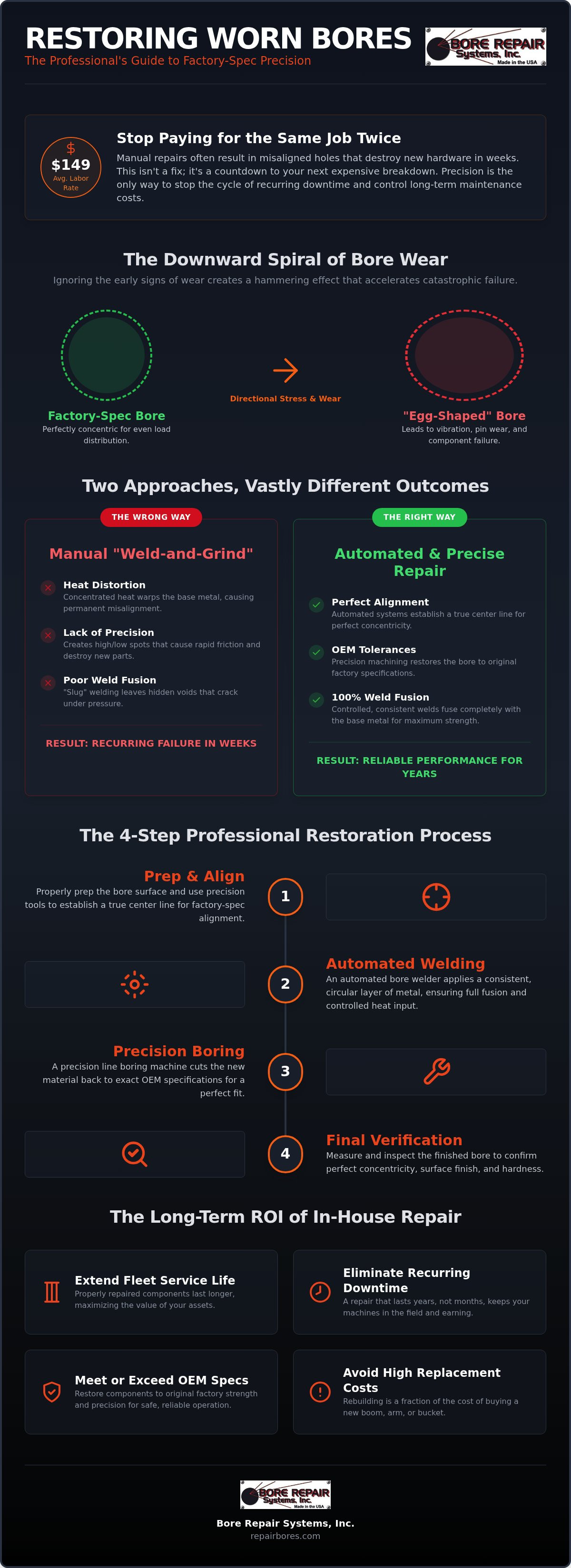
How to Fix Worn Pivot Pins: A Step-by-Step Restoration Guide
Many operators try to save time by hammering a sleeve or an oversized bushing into a loose joint. This is a temporary fix that fails because the parent material is already distorted. To properly fix worn pivot pins excavator bores, you must follow a rigid mechanical process that restores the base metal itself. This systematic approach ensures the machine returns to the field with factory-level precision and alignment.
Preparation and Alignment
The first step is a thorough cleaning. Strip the joint by removing the old pin and bushings. Use a heavy-duty degreaser and a wire wheel to remove every trace of grease, rust, and old paint. You can't achieve a quality weld over contamination. Once the metal is bare, assess the damage. Measure the bore with a telescopic gauge to identify the exact wear pattern and depth.
Next, set up your mounting brackets for the boring bar. You must ensure the bar is perfectly centered relative to the original bore axis. If your alignment is off by even a fraction of an inch, the entire arm geometry will be crooked. This puts lateral stress on the hydraulic cylinders. Take your time during this phase; precision here dictates the success of the entire repair.
Welding and Machining Operations
Once the bar is aligned, mount your automated bore welder. It's essential to select the right welding wire for heavy equipment applications. A standard 70S-6 wire is common, but some applications require specific hard-facing alloys for increased durability. Set the feed rate on the automated bore welder to create a tight, overlapping spiral bead. This builds up the worn surface uniformly without leaving voids or slag inclusions.
After the welding is complete and the metal has cooled, switch to the boring machine. Start with "roughing" cuts to remove the bulk of the new weld material. As you approach the final dimension, take a "finishing" cut with a sharp tool bit at a slower feed rate. This restores the hole to the required diameter with a surface finish that meets or exceeds OEM specifications.
Final Assembly
Before putting the machine back together, perform a final inspection. Check the fitment of the new pivot pin and bushing. They should slide in with the correct amount of resistance. Ensure all grease passages are clear and functional; if you welded over a grease port, you'll need to redrill it. Finally, install new seals to prevent dirt and water from entering the joint. This keeps your new pin protected from premature wear.
Precision tools make this entire process faster and more accurate. If you're ready to bring these capabilities into your shop, explore our professional bore welder and line boring packages to get the job done right.
Investing in In-House Bore Repair Capabilities
Outsourcing your bore repairs often means your machine sits idle for days while you wait for a contractor's schedule to clear. This "waiting game" is the most expensive part of the maintenance process. When you decide to fix worn pivot pins excavator bores in-house, you take total control of your production schedule. You no longer pay for a service provider's travel time or their significant overhead. Instead, your maintenance shop becomes a profit center that keeps the fleet moving. Investing in the right equipment is a strategic move that pays for itself through reduced labor costs and maximized machine availability.
The ROI becomes clear when you compare the cost of a professional bore welder for sale against just a few outsourced repair invoices. Most fleet owners find that the equipment pays for itself in a handful of jobs. Beyond the direct monetary savings, you gain the peace of mind that comes with knowing the repair was performed to your exact standards. You aren't just patching a hole; you're building a permanent capability for your maintenance department.
Reducing Machine Downtime
Downtime is the silent killer of project profitability. If an excavator is down for 48 hours waiting for an outside tech, that represents a massive loss in billable productivity. Compare that to a 4-hour in-house repair using portable systems. You can fix the equipment in the field or in the shop without a full teardown. This flexibility allows you to keep your fleet in the dirt and out of the shop. Faster turnarounds mean more hours on the meter for your equipment and less stress for your project managers.
Mastering the Equipment
Owning the tools is only half the battle. To achieve OEM-level results, your team must understand the nuances of the "Weld-and-Bore" cycle. This is why line boring operator training is a critical investment for any heavy equipment team. Professional training ensures your technicians can handle complex setups and meet tight tolerances every time. We provide specialized line boring training programs designed to build a culture of precision maintenance within your team. When your technicians master these tools, you ensure every repair is permanent and every machine is safe for the long haul.
Restore Your Fleet to OEM Standards
Egg-shaped bores and loose pins don't have to signal the end of your machine's productive life. You now understand why manual patches fail and how the systematic "Weld-and-Bore" cycle provides a permanent restoration. By choosing to fix worn pivot pins excavator bores with automated systems, you ensure every joint meets original factory specifications. This approach eliminates the guesswork and the recurring downtime that eats into your project profits. Precision machining is the only way to protect your equipment and your reputation for quality work.
Bringing these capabilities in-house transforms your maintenance operations into a strategic advantage. Our systems offer Made in the USA industrial quality and include comprehensive operator training to ensure your team achieves professional results immediately. We provide field-proven automated technology that simplifies even the most complex repairs. Take control of your fleet's maintenance schedule today. Explore Professional Bore Repair Systems and Training to start restoring your equipment with confidence. Your machines belong on the job site, not waiting in the shop.
Frequently Asked Questions
How do I know if my excavator pin holes are egg-shaped?
Identify egg-shaped wear by using a telescope gauge or inside micrometer to measure the bore at multiple points. If the vertical measurement is larger than the horizontal measurement, the hole has lost its roundness. Visually, you'll see uneven wear patterns and gaps where the bushing should sit flush. Excessive clunking during operation and visible movement in the joint under load are clear indicators that the bore has lost its concentricity.
Can I fix worn pivot pins without a line boring machine?
No, you cannot achieve a professional restoration without a line boring machine. While some try to use oversized bushings or hand grinding, these methods don't correct the alignment or restore the center point. Line boring is the only way to ensure the bore is perfectly round and concentric with the opposite side of the pivot. Without this precision, the new pins and bushings will experience rapid, uneven wear and fail again.
How long does a typical excavator bore repair take?
A standard repair usually takes between four to eight hours per bore depending on the extent of the wear. This includes the time for setup, automated welding, and precision machining. Using portable equipment allows you to perform these repairs without a full machine teardown, which saves dozens of hours of labor. In-house capabilities significantly reduce the total downtime compared to waiting for an outside contractor to reach your job site.
How do I determine the cost difference between repairing a bore and replacing the arm?
Repairing a bore typically costs a small fraction of the price of a new excavator arm or boom. Replacing major structural components is a massive capital expense that often involves long lead times for parts. By choosing to fix worn pivot pins excavator bores using the weld-and-bore method, you restore the original part to OEM specifications. This maximizes the ROI of your existing assets and avoids the high cost of new iron.
Is automated bore welding stronger than manual welding?
Automated bore welding is superior because it provides 100% fusion and a consistent grain structure. Manual welding often results in voids, slag inclusions, and inconsistent hardness that can lead to cracking under heavy loads. The automated process maintains a steady travel speed and heat input; this reduces the risk of structural warping. This creates a uniform, high-quality foundation that is much more durable than a hand-welded patch and easier to machine.
Can I perform bore repairs in the field or do I need a shop?
You can perform these repairs in the field using portable line boring and bore welding systems. These tools are designed to mount directly to the machine, eliminating the need to transport heavy components to a machine shop. Field repairs are highly efficient for large excavators that are difficult to move. As long as you have a stable power source and follow safety protocols, field restoration delivers the same precision as shop work.
What type of welding wire is best for excavator bore repair?
An ER70S-6 solid wire is the standard choice for most excavator bore repairs due to its high tensile strength and excellent wetting action. It provides a reliable bond with the parent casting or forging. In high-impact or extremely abrasive applications, some technicians prefer a hard-facing wire to increase the surface durability of the bore. Always ensure the wire chemistry is compatible with the base metal of your specific machine to prevent weld failure.
How often should I check pivot pins for wear?
Perform a detailed inspection of your pivot points every 500 to 1,000 operating hours. Check for grease retention, seal integrity, and any visible movement in the joints. Regular lubrication is the best defense, but you should still measure bores whenever you replace pins or bushings. Early detection of minor wear allows you to fix worn pivot pins excavator components before the damage requires extensive welding and machining that increases downtime.


Comments