

Bore Welding Without Removing Components: A Professional Guide to In-Situ Repair

Updated: Sep 3
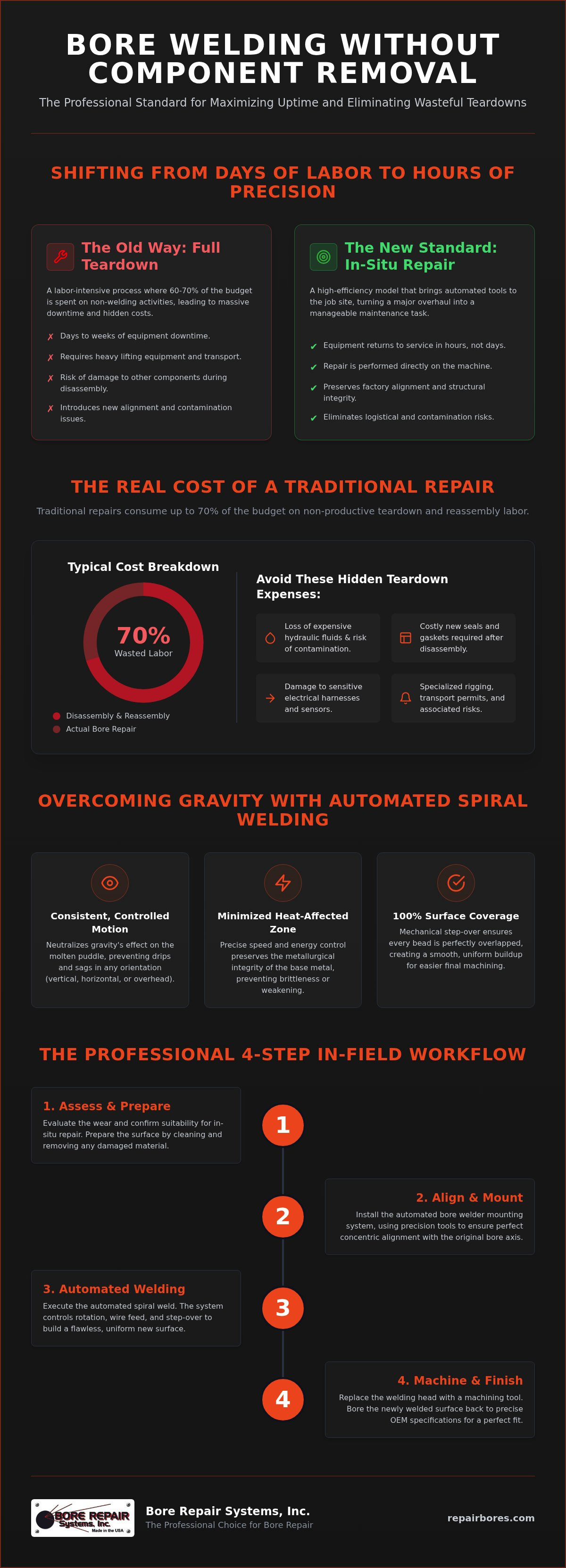
How much revenue did your operation lose the last time a critical machine sat idle for three days just to have a single pivot point repaired? You know the drill; the actual welding might only take an hour, but the labor-intensive teardown and reassembly eat up your entire week. It's a massive drain on resources that most shops simply accept as the cost of doing business. However, performing bore welding without removing component parts is the professional standard for cutting those costs and getting equipment back to work.
We agree that pulling a boom or dropping a frame just to fix a worn hole is a waste of skilled labor. In this guide, we'll show you how to leverage automated technology to restore bores to OEM specifications directly in the field. You'll learn the technical requirements for out-of-position welding and the steps needed to ensure a high-precision finish without the overhead of a full shop teardown. It's time to stop fighting the machine and start fixing it where it stands.
Table of Contents
The Economics of In-Situ Repair: Why Avoiding Component Removal Saves Thousands
Overcoming Gravity: How Automated Bore Welders Solve Out-of-Position Challenges
Decision Matrix: Evaluating In-Situ Bore Welding vs. Full Shop Disassembly
The In-Field Workflow: 4 Steps to Successful Bore Welding Without Teardown
Equipping Your Shop for Success: Why Bore Repair Systems is the Professional Choice
The Economics of In-Situ Repair: Why Avoiding Component Removal Saves Thousands
In-situ bore welding is the practice of rebuilding worn metal surfaces directly on the machine frame or assembly. Instead of hauling a 50-ton excavator to a specialized shop, you bring the tool to the iron. The traditional teardown model relies on days of labor just to access the bore. In contrast, the in-situ model focuses on hours of setup. This shift in strategy transforms a major overhaul into a manageable maintenance task, making bore welding without removing component assemblies the preferred choice for industrial managers. The primary goal is to return equipment to service with minimal mechanical disturbance, ensuring the machine stays on the job site.
The Real Cost of Equipment Downtime
When a production machine stops, the clock starts ticking on lost revenue. For a large excavator or mining truck, hourly downtime costs can be staggering. Traditional repairs often see 60-70% of the total budget consumed by labor that has nothing to do with the actual welding process. Consider the hidden expenses of a full teardown:
Costly seal and gasket replacements required after every disassembly.
Loss of expensive hydraulic fluids and the risk of contamination.
Potential damage to electrical harnesses and sensor arrays during removal.
Rigging risks and the need for specialized transport permits.
You're paying for the time it takes to disconnect lines and rig massive components. These hidden costs often exceed the price of the actual bore repair. Even a small hydraulic spill can lead to expensive environmental cleanup and high refill costs. These variables vanish when you repair the bore in place.
Operational Benefits of Field-Based Bore Repair
Choosing bore welding without removing component parts eliminates the logistical nightmare of heavy-lift transport. You don't need a lowboy trailer or a 20-ton overhead crane to fix a pivot point. By keeping the main assemblies intact, you maintain the structural integrity and factory alignment of the machine. Disassembly often introduces new play or alignment issues during re-installation. In-situ repair avoids these variables entirely. The entire repair footprint shrinks to the size of a single service truck. This efficiency allows your team to focus on the precision work of the bore itself rather than the brute force of disassembly. It's a pragmatic approach that prioritizes uptime and mechanical dependability. You're not just fixing a hole; you're protecting the machine's overall health. For specialized technical support in the maritime industry, you can visit Panama Ship Service to see how these principles are applied to shipping operations at the Panama Canal.
Manual welding inside a bore is a constant fight against physics. Gravity pulls on the molten puddle, leading to drips, slag inclusions, and inconsistent penetration. When you're attempting bore welding without removing component assemblies, the bore is rarely in a convenient flat position. It's often vertical or overhead. Manual "paddling" or weaving can't maintain the concentricity required for a high-quality repair. It results in a lumpy, uneven surface that makes the subsequent machining process much harder than it needs to be. You need a system that neutralizes these environmental variables.The Advantage of Automated Spiral Welding
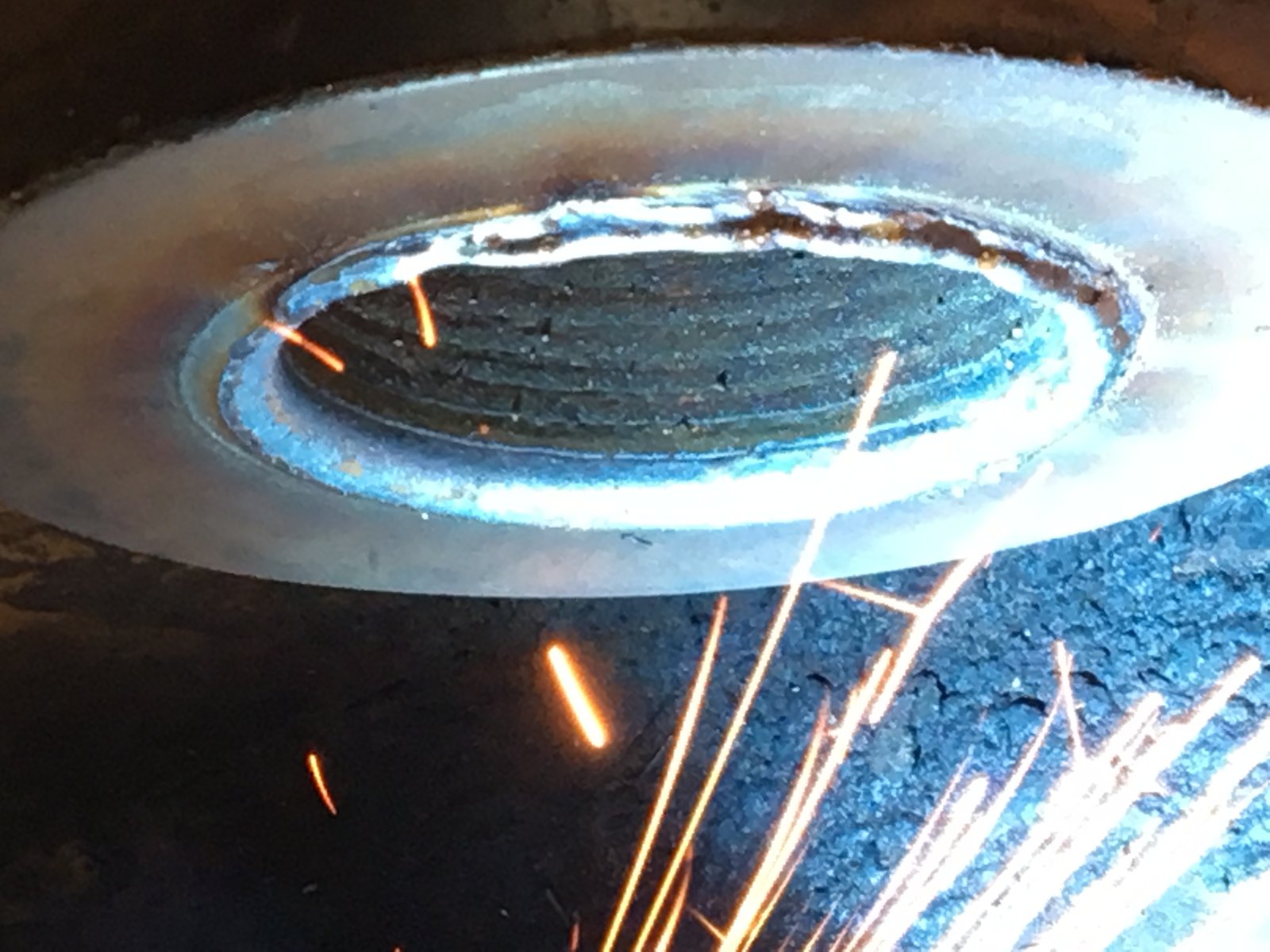
Automated bore welders neutralize gravity through constant, controlled motion. The machine maintains a perfect arc gap throughout 360 degrees of rotation, which prevents the puddle from sagging or running. By using precise speed control, you minimize the heat-affected zone (HAZ) and preserve the metallurgical integrity of the base metal. Automated step-over ensures 100% surface coverage by mechanically overlapping every bead for a smooth, uniform build-up. This level of control is impossible to achieve by hand, especially in cramped field environments where visibility is limited.
Managing Out-of-Position Weld Puddles
Controlling the weld puddle in vertical-up or overhead positions requires more than just a steady hand. It requires the right parameters. You must select the proper wire diameter and shielding gas to ensure the puddle freezes quickly enough to stay in place. Automated systems allow you to fine-tune rotation speed and wire feed to match the specific orientation of the bore. This is a critical part of a professional In-Field Workflow. Unlike manual welding, where slag can get trapped in the weave, spiral welding creates a continuous bead that pushes slag to the surface. This ensures a dense, void-free deposit that meets OEM standards.
The metallurgical bond is the foundation of any repair. Without the luxury of a flat-position bench, manual welders struggle to get deep, even penetration. Automated systems solve this by keeping the torch at a consistent angle and distance. This ensures that the heat is distributed evenly, creating a strong bond without distorting the housing. You aren't just adding metal; you're restoring the component's original strength. High-precision automation makes bore welding without removing component parts a reliable engineering solution rather than a desperate field fix. If you want to achieve these results in your own shop, investing in the right bore welders is the first step toward professional-grade repairs.
Decision Matrix: Evaluating In-Situ Bore Welding vs. Full Shop Disassembly
Deciding to perform bore welding without removing component parts is a technical evaluation, not just a matter of convenience. You must assess the physical space and the metallurgical condition of the machine before committing to an in-situ repair. While field work is highly efficient, it requires specific conditions to ensure the final result meets OEM standards. If the environment or the damage exceeds certain thresholds, shop disassembly becomes the safer, more reliable route. It's about knowing the limits of your equipment and the realities of the job site.
Accessibility and Clearance Requirements
The first hurdle is always the physical footprint. You need enough "swing radius" for the boring bar and the automated welding head to rotate freely. Measure the distance between the bore and any adjacent obstructions like hydraulic tanks or frame rails. If you can't fit the standard mounting brackets, you might need to utilize specialized line boring machine accessories to bridge gaps or provide stable mounting points in tight quarters. Blind holes present an additional challenge, as they lack a secondary support point for the bar. These require specialized end-mount bearings and shorter, more rigid bars to prevent chatter during the machining phase.
Structural vs. Cosmetic Wear
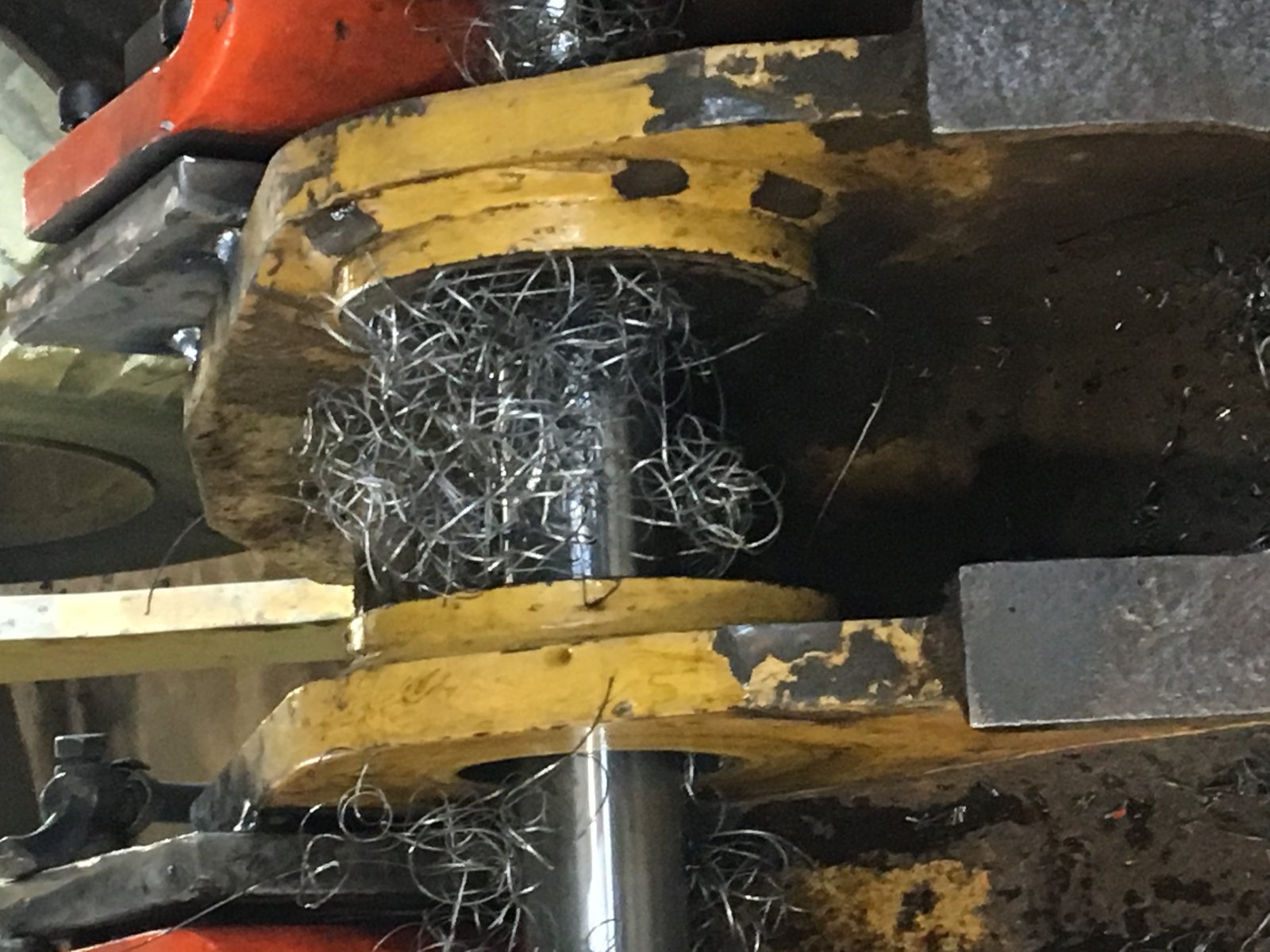
You must distinguish between surface wear and structural failure. If a bore is simply oversized or egg-shaped from years of use, it's a perfect candidate for in-situ welding. However, if you discover catastrophic structural cracks radiating from the bore into the main frame, the component's integrity is compromised. Welding over a structural crack without proper gouging and deep-penetration repair is a safety risk. Stop the job and reassess if the base metal itself is failing. Additionally, evaluate the remaining wall thickness of the housing. If the wear is so severe that the housing has become dangerously thin, the heat from the bore welding without removing component process could cause warping or further cracking. In these cases, the component should be removed for a full shop-based reconstruction or replacement. Safety and mechanical integrity must always outweigh the desire to save time on teardown.
Finally, consider the environmental factors. High winds can strip away your shielding gas, leading to porosity in the weld. Extreme cold requires pre-heating the base metal to prevent hydrogen embrittlement and cracking. If you can't control the temperature or protect the work area from rain and debris, you won't achieve a professional-grade bond. A successful in-situ repair is the result of matching the right technology with the right environment. For teams working in hazardous areas where environmental control and fire safety are critical, you can visit PetroHab LLC to learn about their modular hot work safety enclosures.
Successful bore welding without removing component parts requires a disciplined, methodical approach. You aren't just filling a hole; you're rebuilding a precision interface in a non-stationary environment. This four-step workflow ensures that your field repair matches the quality of a shop-based overhaul. By following a structured process, you eliminate the guesswork and ensure the machine returns to service with OEM-level accuracy.
Preparation: Cleaning and Pre-Heating in the Field
Step 1 begins with the metal itself. Use a grinder or a preliminary machining pass to remove the "work-hardened" layer. This glazed, brittle surface is created by years of friction; welding directly over it invites delamination and cracks. Once the base metal is clean, address thermal stabilization. Use induction or torch heating to bring large castings to a uniform temperature. This prevents the rapid cooling that causes hydrogen embrittlement. Always protect sensitive electronics and hydraulic lines with fire blankets to prevent spatter damage during the process. Removing grease and moisture now prevents porosity in the final weld bead.
Alignment and Machining to OEM Specs
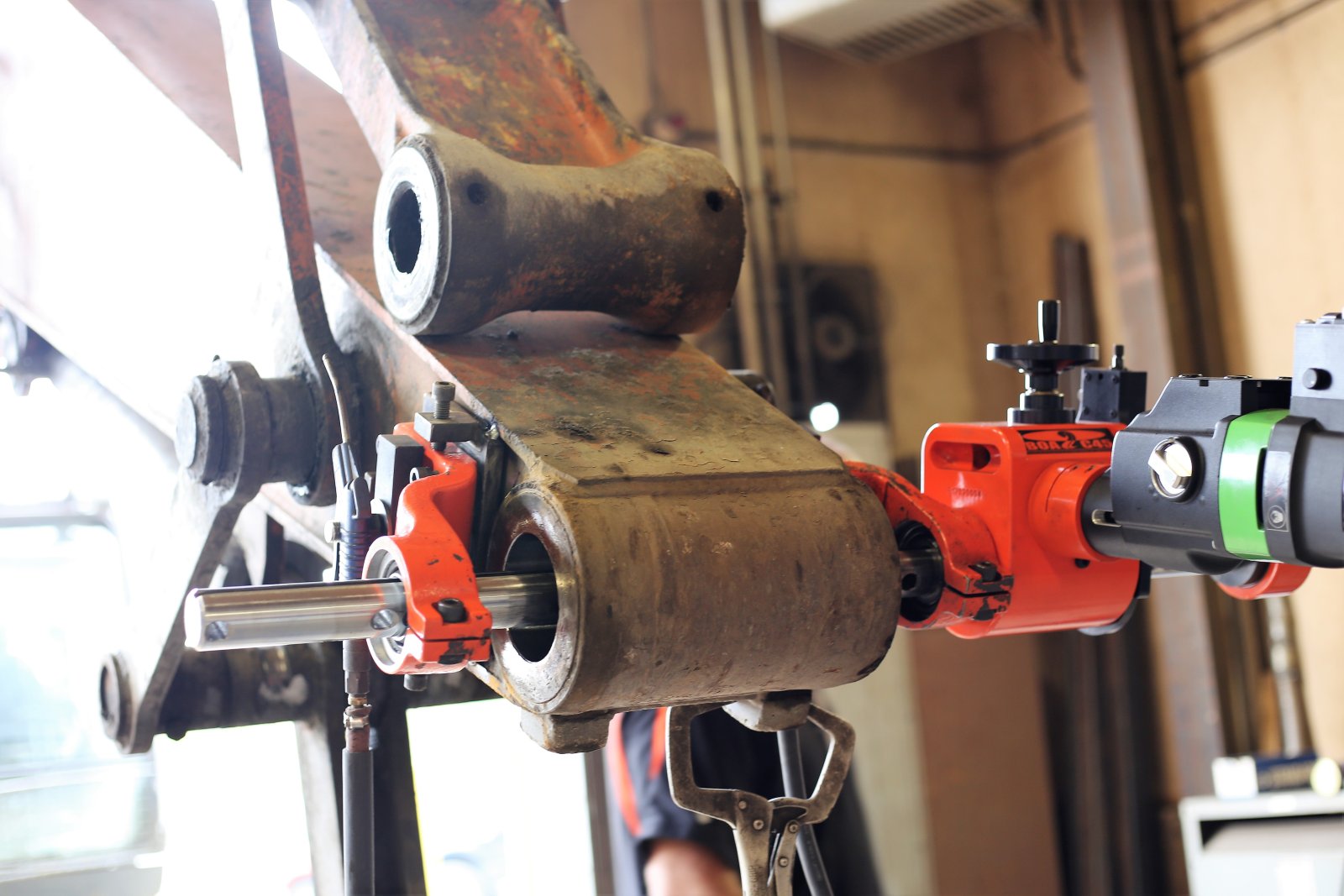
Step 2 focuses on precision alignment. Mount your brackets and set the centerline by referencing the original, unworn sections of the bore. If you lose the axis here, the machine will never track correctly. This stage highlights the value of line boring operator training. A trained eye knows how to compensate for gravity and machine flex before the first bead is laid. Proper setup is 90% of the battle in field repair.
Step 3 is the welding cycle. Once aligned, engage the automated bore welder and monitor the spiral path. You're looking for a consistent bead overlap that provides enough material for the final cut without excessive waste. The automation handles the rotation and step-over, allowing you to focus on maintaining proper gas coverage and wire feed speed. Consistency here means less time spent machining later.
Step 4 is the transition to final machining. After the weld cools to an ambient temperature, swap the welding head for the boring bar. This is where the in-situ model proves its worth. Because the mounting brackets haven't moved, you don't have to re-align the assembly. Simply machine the new metal back to the exact OEM diameter. You've restored the fit and the function without ever pulling a pin or dropping a frame. If you're ready to bring this capability to your own fleet, explore our bore repair systems and training packages today.
Equipping Your Shop for Success: Why Bore Repair Systems is the Professional Choice
Choosing a bore welding machine manufacturer is a long-term business decision. You need equipment designed by engineers who have spent time in the mud, not just in a clean lab. When your team performs bore welding without removing component parts, they rely on the tool's durability and the manufacturer's technical support. American-made equipment provides a clear advantage in industrial environments; it offers superior mechanical integrity and immediate parts availability. You don't want your repair stalled because a critical component is stuck in international customs. It's the difference between a tool that works in the shop and one that survives the field.
By investing in professional bore welder systems, you shift from a reactive maintenance model to a proactive one. This transition turns your shop from a cost center into an in-house profit center. Instead of paying a third-party service provider to bring their tools to your site, your own technicians can handle the work. This keeps the technical expertise and the revenue inside your organization, allowing you to control your own repair schedule.
The Value of Manufacturer-Direct Training
Owning the hardware is only half the battle. Your technicians need to understand the physics of the repair to achieve consistent results. Comprehensive line boring training reduces the risk of equipment damage and costly rework. It ensures your team is certified to handle complex, out-of-position repairs where gravity and heat management are critical. When a unique challenge arises in the field, having a direct line to the engineers who designed your machine is invaluable. Expert guidance prevents small errors from becoming catastrophic failures and ensures every repair meets OEM specifications.
Selecting the Right Portable Equipment
Not every job requires the same footprint. You must select equipment that matches your specific fleet and environment. Consider these factors when building your repair kit:
Compact Welders: Best for tight spaces like loader linkages or small pivot points where clearance is limited.
Heavy-Duty Units: Designed for the high-duty cycles and larger diameters found in mining and heavy construction.
Modularity: Ensure your welder interfaces seamlessly with your boring bar to maintain alignment without resetting your mounts.
Using a unified system ensures that the transition from welding to machining is fast and accurate. If you're ready to stop the cycle of expensive teardowns and lost uptime, Contact Bore Repair Systems today for a customized equipment quote. We provide the tools and the training to ensure you can perform bore welding without removing component assemblies with total confidence.
Take Control of Your Equipment Maintenance
Adopting an in-situ repair strategy isn't just about saving time; it's about reclaiming your shop's profitability and efficiency. You've seen how the traditional teardown model wastes thousands in labor and fluids. By mastering bore welding without removing component assemblies, you eliminate those hidden costs and return your heavy machinery to service in hours rather than days. This transition requires the right combination of field-hardened hardware and technical expertise to ensure every repair meets OEM specifications.
It's time to stop outsourcing your most critical repairs and start building an in-house center of excellence. Our systems are Made in the USA and feature patented automated technology designed to handle the toughest out-of-position challenges. We don't just sell you a machine; we provide the expert training your team needs to succeed in the field. Precision is now within your reach and under your control.
View our Professional Bore Welder and Line Boring Systems and see how easy it is to modernize your maintenance workflow. Your equipment belongs on the job site, not sitting idle in the shop. Take the first step toward faster, more reliable field repairs today.
Frequently Asked Questions
Is it safe to weld a bore while it is still attached to the hydraulic system?
Yes, provided you take specific precautions to protect sensitive parts. You must isolate hydraulic lines and shield them from spatter and radiant heat. Always ground the welder directly to the component being repaired rather than through the machine's frame or cylinders. This prevents electrical arcing from damaging internal seals or electronic sensors. Proper cleaning and thermal blankets are essential to ensure the safety of the surrounding systems during the process.
What is the maximum diameter bore that can be welded without removing the component?
Most portable systems can handle diameters ranging from 1 inch to over 60 inches. The specific limit depends on the reach of your automated welding head and the clearance of the machine frame. For massive bores in mining or power generation, specialized extensions are often used to maintain precision across the entire surface. Always check the mounting footprint to ensure the machine has enough room to rotate through the full 360-degree cycle.
Do I need special welding wire for in-situ bore repairs on heavy machinery?
You should use high-quality flux-cored or solid wire that matches the base metal's metallurgical properties. For field work, a wire with good out-of-position characteristics is vital to prevent sagging or dripping. Using the correct wire ensures a strong bond and reduces the risk of porosity in the finished bead. Many professionals prefer a wire that creates a dense deposit, which makes the final machining phase much smoother and more predictable.
How do I prevent the heat from the bore welder from warping the main component?
Manage heat through controlled travel speeds and proper pre-heating techniques. Automated systems use a consistent spiral path to distribute thermal energy evenly across the bore surface. This prevents localized hotspots that lead to distortion or warping. For large castings, induction heating or torch pre-heating helps maintain a uniform temperature. This balance is critical for bore welding without removing component parts while keeping the housing within original structural tolerances.
Can automated bore welders be used on vertical or overhead holes?
Yes, automated spiral welders are specifically designed to handle out-of-position welding challenges. The machine maintains a constant arc gap and rotation speed, which allows the weld puddle to freeze before gravity can pull it away. This automation creates a uniform bead that is impossible to achieve with manual welding in vertical or overhead orientations. It ensures a high-density, void-free deposit regardless of how the machine is positioned on the job site.
How much time can I expect to save by not removing the component?
You can typically reduce total repair time from several days down to just a few hours. The majority of traditional repair time is spent on teardown, transport, and reassembly. By performing the bore welding without removing component assemblies, you bypass these labor-intensive steps entirely. This efficiency allows you to get your equipment back into production much faster, significantly reducing the total cost of downtime for your operation.
What kind of training is required to operate a portable bore welder in the field?
Operators should complete manufacturer-direct training that covers setup, alignment, and parameter adjustment. While basic welding knowledge is a helpful foundation, mastering the automated spiral process requires specific instruction on managing out-of-position variables. Training ensures your team can achieve high-precision results and avoid common mistakes like improper centering or poor bead overlap. Professional certification provides the technical knowledge needed to return worn bores to original factory specifications.
Can I use my existing MIG welder with an automated bore welding system?
Most automated bore welders are compatible with standard constant voltage (CV) power sources. You simply connect the bore welder's control box to your existing MIG power supply to provide the welding current. This modularity allows you to leverage your current shop equipment while adding specialized automation. Ensure your power source has a high enough duty cycle to handle the continuous welding required for large bore reconstructions without overheating or cutting out.
Comments