

How to Use a Line Boring Machine: A Professional Step-by-Step Guide
- slinger6
- Aug 7
- 12 min read

A perfect bore isn't created during the cutting phase. It's won or lost during the setup. If you've spent hours wrestling with manual repairs only to end up with a sloppy fit, you know that guesswork has no place in heavy equipment maintenance. Learning how to use line boring machine equipment correctly eliminates the need to wait for expensive external services that keep your machines idle. You need a way to bring that precision back in-house without the headache of complex alignment procedures.
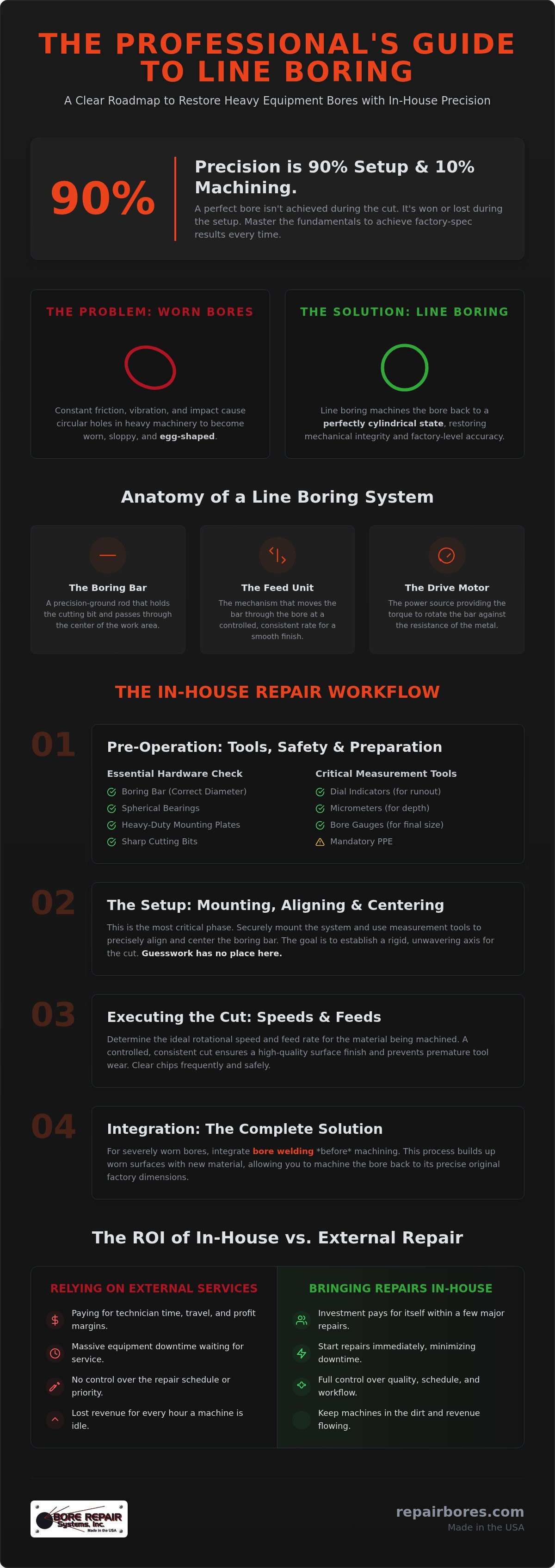
Achieving tight tolerances shouldn't feel like a gamble. We understand that precision is 90% setup and 10% machining. This guide shows you how to restore bores to factory precision every single time. You'll master the fundamentals of the industrial workflow and identify the specific tools required for a complete repair. We've laid out a clear roadmap to handle everything from initial bar alignment to the final pass with total confidence.
Table of Contents
Understanding Line Boring and Its Industrial Applications
Line boring is the industrial process of enlarging or restoring a hole to precise tolerances. Over thousands of operational hours, the circular holes in heavy machinery often become egg-shaped due to constant friction and impact. Line boring corrects this by machining the bore back to a perfectly cylindrical state. This is not just about making a hole bigger; it is about restoring mechanical integrity so that pins and bearings fit with factory-level accuracy. Portable systems have changed the game for field repairs. Instead of dismantling a machine and hauling it to a machine shop, you bring the tool to the iron.
A standard system consists of several critical parts that must work in perfect harmony. Understanding how to use line boring machine equipment effectively means mastering these components:
The Boring Bar: A precision-ground rod that holds the cutting bit and passes through the center of the work area.
The Feed Unit: The mechanism that moves the bar through the bore at a controlled, consistent rate.
The Drive Motor: The power source that provides the necessary torque to rotate the bar against the resistance of the metal.
When is Line Boring Necessary?
Wear is inevitable in heavy equipment. Excavator pivot pins and loader bucket hinges are common failure points. These areas face extreme vibration and heavy loads that eventually degrade the bore integrity. When you notice play in a joint or hear metal-on-metal grinding, the bore has likely lost its roundness. Incorporating line boring into your preventative maintenance schedule prevents small amounts of wear from turning into catastrophic structural failure. Catching the issue early saves the component from being scrapped. Vibration is the silent enemy of bore alignment. Every time a bucket hits the ground, that force is transferred through the pins. Eventually, the metal yields and the hole stretches.
The ROI of In-House Line Boring
Relying on external repair services creates a massive bottleneck. You aren't just paying for the technician's time; you're paying for their travel and the profit margin of another business. Buying your own equipment shifts that control back to your shop. The initial investment often pays for itself within a few major repairs. Downtime is the most expensive part of any failure. When your own staff knows how to use line boring machine tools, you can start the repair the moment the machine enters the shop. Integrating bore welding accessories into your workflow allows you to build up worn surfaces before machining, ensuring the final bore is exactly the size you need. Waiting three days for a service truck can cost thousands in lost productivity. Doing it yourself keeps the machine in the dirt and the revenue flowing.
Pre-Operation: Tools, Safety, and Preparation
Precision starts long before the motor turns. Skipping the preparation phase is the fastest way to ruin a workpiece or damage your equipment. To understand how to use line boring machine systems effectively, you must first organize your hardware. Essential components include the boring bar, spherical bearings, and heavy-duty mounting plates. These parts form the backbone of your setup. Without them, you cannot maintain the rigid alignment necessary for tight tolerances.
Measurement tools are equally critical. You cannot guess at accuracy in this field. Keep dial indicators, micrometers, and bore gauges within reach at all times. Use the dial indicator to check for runout and the micrometers to verify your cutting bit depth. Before you begin, inspect the boring bar for any signs of bowing or surface damage. Even a slight bend in the bar will translate into a tapered or oversized hole. Sharpness matters too. A dull cutting bit generates excessive heat and leads to poor surface finishes. Ensure your power supply is properly grounded and establish a clear safety perimeter around the work area.
Selecting the Right Boring Bar
Choosing the correct bar diameter depends entirely on the bore size you are repairing. A bar that is too thin will flex under load, while one that is too thick won't leave enough clearance for the cutting tool. Rigidity is your primary goal. Long spans require thicker bars to prevent chatter and deflection. If you are unsure about the best setup for your specific job, consult our portable line boring machine guide for detailed configuration tips. Matching the bar to the job is the first step toward a factory finish.
Operator Safety Protocols
Safety is non-negotiable when working with high-torque motors. Wear mandatory PPE: eye protection, heavy-duty gloves, and steel-toed boots. Managing metal chips is a constant task during operation. Use a brush or specialized tool to clear debris. Never use your hands while the bar is in motion. Familiarize yourself with the emergency stop procedures and keep the motor torque within recommended limits to avoid binding. This protects both the operator and the mechanical integrity of the machine. If you want to refine these skills and reduce risks, consider our professional training services to ensure your team operates with maximum efficiency.
The Setup: Mounting, Aligning, and Centering
Precision is not a happy accident. It is the result of a methodical setup. Before you even think about cutting metal, you must prepare the surface. Clean the work area thoroughly. Remove any burrs, slag, or rust from the existing bore surface using a grinder or hand file. Any obstruction on the surface will prevent your mounting plates from sitting flush. If your plates aren't flat, your alignment will be off before you even start the motor.
Once the surface is clean, tack-weld your mounting plates to the workpiece. These plates support the spherical bearings that hold the boring bar in place. Slide the bar through the bearings and the bore. At this stage, the bar should move freely. If it binds or requires force to slide, your plates are out of alignment. Stop and adjust them now. Mastering how to use line boring machine setups means recognizing that every minute spent here saves an hour of rework later. Secure the bearings only after you are certain the bar rotates without resistance.
Centering Techniques for Maximum Accuracy
Centering cones are the fastest way to get your bar in the ballpark. They slide onto the bar and wedge into the bore to provide a quick mechanical center. This is often sufficient for roughing passes. However, for professional results, you should verify the center with a dial indicator. Rotate the bar and measure the distance to the bore wall at four points. If the readings aren't identical, adjust your bearing carriers. An independent four-jaw chuck alignment offers even more control for complex jobs where the original bore is heavily distorted. Remember, the setup is where the job is won or lost. If your bar isn't centered on the original axis, the new hole won't align with the rest of the machine components.
Rigidity and Vibration Control
Chatter is the primary enemy of a clean surface finish. It occurs when the boring bar lacks sufficient support and begins to vibrate during the cut. Bearing spacing is critical. Keep your bearings as close to the work area as possible to minimize bar deflection. For exceptionally long boring bars, you must add intermediate supports. These extra bearings prevent the bar from whipping or vibrating under load. The thickness of your mounting plates also matters. Use heavy-duty plates to ensure the entire system remains stable under the torque of the drive motor. A rigid setup allows you to take deeper cuts and achieve a smoother final pass without the wavy patterns caused by vibration.
Executing the Cut: Speeds, Feeds, and Machining
Once you've locked in your alignment, it's time to set the tool. Use a micrometer or a specialized tool setter to establish your cutting bit depth. Precision here prevents over-boring and ensures you don't remove more material than necessary. If you're learning how to use line boring machine tools for the first time, start with a light roughing pass. This clears remaining irregularities and confirms your alignment is true. Engage the mechanical feed unit to maintain a constant rate. Manual feeding leads to uneven surface textures and premature tool wear. A consistent feed is the only way to achieve a professional finish.
Monitoring the cut is a sensory task. Listen for changes in the pitch of the motor. A high-pitched squeal often indicates the RPM is too high, while a low-frequency vibration suggests the bar is struggling with a depth of cut that's too aggressive. Watch the chips. They should be consistent in size and color. Blue or burnt chips mean you're generating too much heat. This heat can warp the bar or ruin the tempering of the cutting bit. Stop the machine immediately if you notice the bar jumping or chatter marks appearing on the surface.
Calculating Speeds and Feeds
Getting the RPM right is a matter of calculation, not guesswork. Use the formula: RPM = (SFM x 3.82) / Bar Diameter. For mild steel, you might target a Surface Feet Per Minute (SFM) of 80 to 100. Cast iron requires a slower approach to prevent tool dulling. The feed rate directly dictates the final surface texture. A slower feed produces a smoother finish but increases the time on the job. Chip load is the thickness of material removed per revolution. Balancing these factors ensures you remove material efficiently without stressing the drive motor or the boring bar.
Measuring the Final Pass
Your final pass must bring the bore to its target dimension within thousandths of an inch. Use a dial bore gauge to verify the diameter at multiple points along the bore. This allows you to check for tapering or out-of-roundness. If the bore is wider at one end, your bar might be flexing or your bearings could be loose. Maintaining your equipment is the only way to ensure these measurements stay consistent. Check our guide on line boring machine maintenance to keep your system in peak condition. To achieve these results in your own shop, explore our range of professional line boring machines designed for maximum rigidity and field durability.
Achieving Professional Results with Training and Integration
Machining a perfect hole is only one part of the restoration process. In many industrial scenarios, the bore is so badly worn or oversized that simply cutting more material away is not an option. You must restore the structural integrity of the component by adding metal back to the surface. This is where the synergy between welding and machining becomes vital. Understanding how to use line boring machine equipment effectively requires you to master the transition from the welding arc to the cutting bit. Without a high-quality weld build-up, your final machining pass will lack the base material needed to reach factory tolerances.
Relying on trial and error is a strategy that leads to high scrap rates and wasted shop hours. While the mechanical steps of the repair are logical, the thermal dynamics of welding and the precision required for final alignment demand a deeper level of expertise. Professional results are the product of consistent processes and well-maintained hardware. Performing regular equipment audits and staying current with accessory upgrades, such as high-torque drive motors or improved centering kits, ensures that your shop remains capable of handling the most demanding heavy equipment repairs.
The Bore Welding/Line Boring Workflow
The most efficient path to a finished repair is the "Weld-Bore-Finish" cycle. By using an automated bore welder, you create a uniform layer of new metal that is much easier to machine than the irregular beads produced by manual welding. Once the welding is complete, you re-install the boring bar and use the same centers to machine the hole back to its original dimension. This integrated approach ensures that the new surface is perfectly concentric with the machine's pivot point. For more information on selecting the right hardware for this cycle, see our professional bore welder systems guide. Combining these two technologies allows your team to handle complex repairs that would otherwise require expensive part replacements.
Advancing Your Skills
Technical proficiency is the best defense against downtime. While this guide provides the procedural foundation, professional training is what truly reduces operator error and improves safety. When a technician understands how to use line boring machine tools in a variety of field conditions, they can troubleshoot alignment issues on the fly and deliver better surface finishes. Certified training programs provide hands-on experience with complex setups, such as blind bores or multi-span alignments. This specialized knowledge turns a standard repair into a precision rebuild that extends the life of the machine.
Don't let mechanical failures stall your operations. If you are ready to bring your repairs in-house and achieve factory-level precision, we have the resources to help your team succeed. Contact Bore Repair Systems, Inc. today for the professional equipment and technical training required to master the craft of bore restoration.
Take Control of Your Equipment Repairs
Bringing bore repairs in-house is a strategic move for any operation managing heavy equipment. By mastering the sequence from initial alignment to the final pass, you eliminate the delays and high costs associated with outside vendors. You've seen that precision isn't just about the machine; it's about a methodical approach to setup and the seamless integration of welding when bores are oversized. Understanding how to use line boring machine systems gives your team the autonomy to restore equipment to factory specifications on your own schedule.
Success in this field depends on the reliability of your tools and the depth of your technical knowledge. Bore Repair Systems, Inc. provides the American-made precision equipment and expert-led training programs needed to tackle the toughest industrial repairs. Our decades of expertise are built into every machine we manufacture and every training session we lead. Master your maintenance with professional line boring equipment and training from Bore Repair Systems, Inc. and ensure your fleet stays productive. With the right foundation, you can handle any bore repair challenge with total confidence.
Frequently Asked Questions
How long does it typically take to set up a line boring machine?
Setup typically takes between one and three hours depending on the complexity of the alignment. Simple single-span bores are faster, while multiple bores requiring intermediate supports take longer. Precision is the priority here. If you rush the mounting and centering phase, the machining will be inaccurate. Most of your time should be spent verifying the bar is perfectly concentric with the original axis.
Can I use a line boring machine on hardened steel components?
Yes, you can machine hardened steel by using specialized carbide or ceramic cutting bits. You must adjust your speeds and feeds to account for the material's hardness to prevent tool breakage. Slowing down the RPM and using a consistent mechanical feed prevents the tool from overheating. Understanding how to use line boring machine equipment on various alloys is a core skill for any professional technician.
What is the difference between a portable line boring machine and a stationary mill?
The primary difference is mobility and the reference point for the cut. A stationary mill requires the workpiece to be brought to the machine and secured to a table. A portable line boring machine is mounted directly onto the workpiece, such as an excavator arm or a large industrial housing. This allows for in-field repairs of massive components that are too heavy or expensive to transport to a shop.
Do I need to weld the bore every time I use a boring machine?
You only need to weld the bore if the existing hole is oversized or has deep gouges that a cleanup pass cannot remove. If the bore is simply out-of-round but still within a machinable range for the next pin size, you can proceed directly to cutting. However, most restoration jobs require an automated bore welder to add material before machining the hole back to factory specifications.
How do I prevent "chatter" or vibration during the cutting process?
Prevent chatter by ensuring the boring bar has maximum rigidity and the bearings are spaced correctly. Keep the bearings as close to the cut as possible and use intermediate supports for bars exceeding certain lengths. Using a sharp cutting bit and the correct feed rate also reduces vibration. If chatter persists, check the mounting plate welds and ensure the motor torque isn't causing the bar to whip.
What is the maximum bore diameter a portable machine can handle?
Maximum bore diameter depends on the specific machine model and the diameter of the boring bar used. Some heavy-duty portable systems can handle bores up to 24 inches or more with specialized accessories. Always match the bar diameter to the hole size to maintain rigidity. Using a bar that is too small for a large bore leads to deflection and inaccuracy during the machining process.
How often should I sharpen or replace the cutting bits?
You should inspect the cutting bit before every pass and replace or sharpen it at the first sign of dulling. Indicators of a dull bit include a ragged surface finish, increased motor noise, or the production of fine dust instead of clean metal chips. Harder materials like cast iron or hardened steel will dull bits much faster than mild steel. Keeping a sharp edge is essential for maintaining tight tolerances.
Is specialized training required to operate a line boring system safely?
Yes, professional training is highly recommended to ensure operator safety and job accuracy. While the mechanical operation is straightforward, mastering the alignment math and motor torque management takes expert guidance. Proper training reduces the risk of equipment damage and helps technicians learn how to use line boring machine tools to achieve professional results. It also covers essential safety protocols for managing high-torque industrial motors.


Comments