

Best Bore Welder for Field Repair: 2026 Selection Guide
- slinger6
- Aug 4
- 12 min read

Every hour your heavy equipment sits idle for a bore repair is a direct hit to your bottom line. You already know that hauling a 20-ton machine back to the shop just to fix a worn pivot point is a logistical nightmare. It's expensive and slow, and finding the best bore welder for field repair is often the only way to avoid these massive overhead costs. Manual welding usually leaves you with inconsistent results that don't hold up; it's a drain on your project's timeline and your budget.
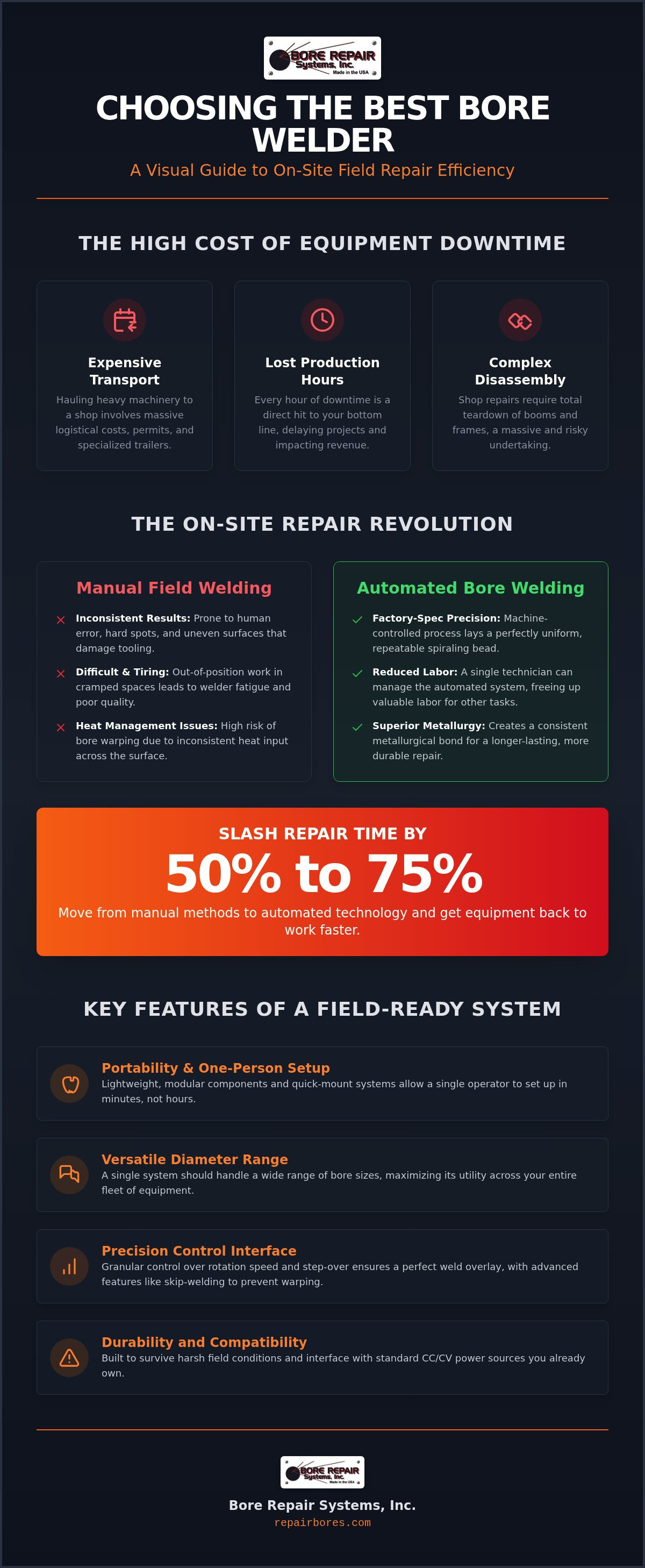
This selection guide shows you how to choose a portable system that restores bores to original factory specs right on the job site. By moving from manual methods to automated technology, you can reduce your repair time by 50% to 75% while ensuring high-quality, repeatable weld beads. We'll examine the critical factors for the 2026 market, including setup speed, diameter range, and the automation features that turn a complex field fix into a straightforward task. Precision doesn't have to stay in the shop; it's time to bring that same reliability to the field.
Table of Contents
The Critical Role of Bore Welders in Field Repair Efficiency
The cost of heavy equipment failure isn't just the price of the replacement part. It's the logistics. Moving a massive excavator or a mining loader to a specialized shop requires heavy haul permits, specialized trailers, and days of lost production. Using the best bore welder for field repair changes this equation entirely. It allows technicians to perform "in-situ" repairs, fixing the machine exactly where it stands. This approach eliminates the need for total teardown, keeping the assembly intact while restoring the mechanical integrity of the pivot points. Modern systems make it possible to handle these repairs on excavators, loaders, and large mining gear without the overhead of a full-service facility.
Reducing Equipment Downtime with On-Site Welding
Removing a boom or a frame for shop repair is a massive undertaking. It involves disconnecting hydraulic lines, removing pins that are likely already seized, and managing the safety risks of moving heavy, unbalanced components. When you choose to repair on-site, you bypass these hurdles. Automated systems maintain high levels of accuracy, often exceeding what's possible with traditional hand-welding. Understanding the differences between bore welding vs manual repair is essential here. The "repair instead of replace" philosophy isn't just about saving money on parts; it's about reclaiming the hundreds of hours typically lost to transportation and reassembly. By keeping the repair local to the machine, you ensure that the equipment returns to service in a fraction of the time.
Why Automation Beats Manual Rebuilding
Manual welding in the field is notoriously difficult. Welders often struggle with out-of-position work, heat management, and maintaining a consistent bead profile inside a dark, cramped bore. This inconsistency leads to hard spots and uneven surfaces that wreak havoc on line boring tools later. Automated bore welders solve this by providing a perfectly uniform weld overlay. The machine doesn't get tired or distracted. It lays down a repeatable, spiraling bead that creates a consistent metallurgical bond across the entire surface. This precision significantly reduces labor hours. Instead of a technician spending all day manually building up a large-diameter bore, the machine handles the multi-pass work with surgical efficiency. You get a better base for machining and a longer-lasting repair for the end-user. This automation is exactly what defines the best bore welder for field repair, as it turns a variable process into a predictable result.
Key Features of the Best Portable Bore Welders
Field repair isn't just about the weld; it's about getting to the weld. If a machine requires a crane or a three-man crew just to position it on an excavator boom, it isn't truly portable. The best bore welder for field repair must be lightweight and modular. It needs to survive the back of a service truck and work reliably in rain, dust, or extreme temperatures. Beyond durability, the equipment must interface with the power sources you already have on-site. Most technicians rely on standard CC/CV field welding power supplies, so your bore welder should be a "plug and play" addition to your existing fleet rather than requiring a dedicated generator.
Portability and One-Person Setup
In the field, labor is your most expensive asset. A machine that requires multiple technicians to mount is a drain on your margins. Modern systems use modular components that allow a single operator to carry the drive unit, the torch, and the mounting hardware separately to the work area. Quick-mount systems are essential here. They allow you to go from arrival to the first arc in minutes, not hours. These automated bore welding benefits are especially clear when working in awkward positions where holding heavy equipment is impossible. By using tack-weld or bolt-on mounting plates, you can secure the unit to almost any equipment geometry, from flat bucket ears to recessed pivot points.
Interface and Control Precision
Precision in the field shouldn't be a guessing game. The best bore welder for field repair provides granular control over rotation speed and step-over distance. This ensures the weld bead is placed exactly where it needs to be, preventing the "valleys" that lead to tool chatter during the boring process. Control interfaces must be simple enough to operate with gloves on but sophisticated enough to handle "skip-welding." This feature is vital for maintaining thermal balance. By welding only specific segments and then skipping to the opposite side, you prevent the bore from warping or developing excessive heat-affected zones. This level of control prevents operator fatigue during long repair cycles and ensures a shop-quality finish every time. If you're looking to upgrade your field capabilities, consider exploring professional-grade bore welders that prioritize these automated features.
Mounting flexibility is another non-negotiable trait. Every machine you encounter has different clearances and obstructions. A truly portable welder offers adjustable reach and various torch lengths to navigate tight spaces. Whether you are rebuilding a small pivot pin hole or a large main bore on a rock crusher, the machine must adapt without requiring custom-fabricated brackets for every job. This versatility is what allows a single investment to cover your entire fleet's repair needs.
Comparing Automated Bore Welding Systems for On-Site Success
Selecting the best bore welder for field repair requires more than just checking a power rating. You need a system that fits the specific geometry of your project. For most heavy equipment technicians, the choice comes down to the scale of the bore and the clearance around the work area. A machine that handles a 24-inch mining hub might be too bulky for a compact loader's pivot pin. These systems are built with rugged materials to withstand the dust, moisture, and intense heat of the job site. They don't just work in the shop; they're built to survive the reality of the field.
The BOA-408i Series: Versatility Across Sizes
The BOA-408i is the industry standard for a reason. It covers a massive range, from 0.8 inches up to 48 inches in diameter. This series is available in several variants to match your specific workload. The S1 through S4 models are optimized for standard diameter needs, while the BOA-408i S5 offers a "long stroke" advantage. This extra reach is critical for deep bore applications where standard torches can't maintain the necessary extension. For a complete breakdown of technical specifications and stroke lengths, consult our Professional Bore Welder Systems: 2026 Buying Guide. It's a reliable workhorse that adapts to almost any standard field repair scenario.
Specialized Solutions for Restricted Access
Sometimes the challenge isn't the size of the bore, but the lack of space around it. The BOA-M1 was engineered specifically for these ultra-tight environments. With a range of 1.25 to 8 inches, it's the ideal tool for compact construction equipment and recessed pivot points. It allows you to perform high-precision repairs where standard machines simply won't fit. Knowing how to rebuild worn bores in confined spaces is often the difference between a quick field fix and a total machine teardown. The BOA-M1 ensures you don't have to compromise on weld quality just because the workspace is cramped.
The real value of these systems lies in their integration with line boring machines. You shouldn't have to reinvent your setup between the welding and machining phases. These welders are designed to interface directly with existing line boring bars, allowing you to use the same mounting fixtures for both operations. This "single setup" workflow ensures that your weld overlay is perfectly concentric with the final bored surface. It's a pragmatic approach that saves hours of calibration time. By maintaining this continuity, you eliminate the alignment errors that often occur when switching between disparate tools in the field.
Maximizing ROI: Field Setup and Operation Best Practices
Owning the best bore welder for field repair is only half the battle. To maximize your return on investment, you must execute a disciplined preparation and operation strategy. In the field, environmental variables like wind, moisture, and ambient temperature can ruin a weld that would be perfect in a shop. ROI isn't just about speed; it's about avoiding rework. If you have to machine out a porous weld and start over, your field efficiency vanishes. High-quality results depend on a systematic approach that starts long before you strike the first arc.
Start with a rigorous inspection of the work area. Look for egg-shaped wear patterns. If one side of the bore is significantly more worn than the other, you'll need to plan your weld passes to compensate for the offset. Check for cracks in the base metal using dye penetrant or magnetic particle inspection. Welding over a structural crack only hides the problem until the machine is back under load. Clean the bore thoroughly to remove all grease, rust, and that shiny, work-hardened layer that develops from years of pin movement. This layer is often harder than the base metal and can lead to poor fusion if not removed.
Pre-Welding Preparation Checklist
A successful weld depends entirely on the surface quality. Follow these steps to ensure a high-integrity bond:
Mechanical Cleaning: Use a grinder or flapper wheel to reach bright metal across the entire repair surface.
Degreasing: Clean the bore and the surrounding faces with a residue-free solvent to prevent contaminants from entering the weld pool.
Concentricity Mapping: Measure the bore at multiple points to determine exactly how much buildup is required to restore original specs.
Accessory Selection: Choose the right bore welding accessories, such as specialized nozzles or extensions, to handle deep or recessed bores effectively.
Optimizing Weld Parameters in the Field
Outdoor conditions require specific adjustments. Even a light breeze can blow away your shielding gas, leading to porosity and brittle welds. Use windbreaks or increase your gas flow slightly to maintain a stable arc environment. Selecting the right wire and gas combination is critical for outdoor success. Additionally, proper grounding is non-negotiable. Always place your ground clamp as close to the repair area as possible. This prevents stray current from traveling through the machine's bearings or damaging sensitive electronics. If you're ready to upgrade your field capabilities with professional-grade tools, browse our full range of automated bore welders.
Thermal management is the final piece of the ROI puzzle. Heavy industrial components act as massive heat sinks. Pre-heating the bore to a specific interpass temperature prevents the weld from cooling too quickly, which reduces the risk of cracking in high-stress areas. Once the welding is complete, let the part cool naturally before starting the line boring process. This patience ensures the metal has stabilized, allowing your boring tool to achieve a clean, accurate finish without the tool chatter caused by uneven cooling zones.
Choosing Your Bore Repair Solution: The BOA Series Advantage
Reliability in the field isn't a luxury; it's a requirement. When you invest in the best bore welder for field repair, you need to know that the manufacturer stands behind the equipment. American-made engineering at Bore Repair Systems, Inc. ensures that your tools are built for the long haul. This translates to superior parts support and technical assistance that understands the urgency of a machine-down situation. You aren't just buying a welder; you're securing a partnership that keeps your fleet moving. Choosing a proven system eliminates the guesswork that comes with unbranded or generic equipment. If a component fails on a remote job site, you need a replacement on your doorstep the next day, not next month.
Evaluating your fleet's specific needs is the first step toward modernization. Just as professional stables utilize BovEquine for specialized health monitoring, industrial operations must select tools tailored to their unique environments. Consider the range of diameters you service most frequently and the typical clearance constraints of your machinery. A mining operation with massive haul trucks has different requirements than a municipal shop maintaining backhoes. Our BOA series is designed to scale with those needs, providing a modular approach that grows with your business. This adaptability ensures you don't overspend on capacity you don't need, while still having the power to handle your toughest repairs. Precision engineering should simplify your work, not complicate your inventory.
The Importance of Operator Training
These programs significantly reduce the learning curve for new maintenance departments. By training your operators, you minimize the risk of equipment damage and ensure every repair meets original factory specifications. In the same way that A1 Crane Academy helps professionals master specialized lifting and material handling equipment, expert knowledge in bore welding turns a high-performance tool into a long-term asset. It's about building confidence in your crew so they can tackle complex field repairs without hesitation or costly errors.
Investing in a Complete Bore Repair System
The fastest path to a full return on investment comes from using a matched set of tools. There is a powerful synergy between our BOA welders and the C-45 line boring machines. When you use a complete system, you ensure that the mounting fixtures, bars, and torches are designed to work together. This integration guarantees perfect alignment between the weld overlay and the final bore. You don't have to waste time fabricating custom adapters or struggling with mismatched tolerances. It's a streamlined workflow that delivers shop-quality results in the most challenging field conditions. This unified approach is what allows operators to cut repair times significantly compared to manual methods. To get started, consult with an expert to configure your field repair kit and evaluate your fleet's specific needs today.
Modernize Your On-Site Repair Capabilities
Field repair efficiency is no longer about how fast you can weld by hand. It's about how quickly you can set up an automated system that delivers shop-quality results. By choosing the best bore welder for field repair, you eliminate the logistical bottlenecks of equipment transport and the inconsistencies of manual rebuilding. Whether you're navigating the tight clearances of the BOA-M1 or the broad range of the BOA-408i series, the goal remains the same. You need to restore your bores to factory specs with minimal downtime.
Investing in patented automated welding technology ensures that your repairs are repeatable and durable. Every machine we build is Made in the USA and backed by national support to keep your operations running. We also offer expert-led operator training programs to ensure your team has the skills needed to maximize equipment lifespan. It's time to stop losing hours to teardowns and start fixing equipment where it stands. Get a Quote on the Industry-Leading BOA Bore Welder Series today and take control of your maintenance schedule. Your next repair is just one setup away from perfection.
Frequently Asked Questions
What is the best bore welder for small diameter field repairs?
The BOA-M1 is the ideal solution for small diameter repairs, specifically engineered for bores ranging from 1.25 to 8 inches. Its compact design allows it to fit into recessed pivot points and tight engine compartments where standard machines simply cannot operate. It provides the same automated precision as larger models but in a footprint optimized for compact construction equipment. This makes it a vital tool for technicians who frequently service smaller loaders and excavators.
Can I use my existing MIG welder with an automated bore welding system?
Yes, you can typically use your existing MIG welder with an automated bore welding system. Most portable units are designed to be "plug and play" with standard CC/CV field welding power supplies. The bore welder controls the rotation and step-over, while your existing wire feeder and power source provide the welding current. This compatibility ensures you don't have to invest in redundant power equipment for your service truck.
How much time does an automated bore welder save compared to manual welding?
Automated bore welders typically reduce repair time by 50% to 75% compared to manual welding. While a manual repair requires constant operator attention and multiple pauses for cooling or inspection, an automated system runs continuously with high precision. This efficiency isn't just about the welding phase; the uniform bead profile also slashes the time required for subsequent line boring by reducing tool chatter and uneven material removal.
Do I need a separate power source for the bore welder in the field?
You'll need a standard 110V or 220V power source to run the drive motor and control box of the bore welder. In the field, this is usually provided by a small portable generator or an inverter on your service truck. Remember that the welding arc itself is still powered by your primary field welder. The bore welder's own power requirement is relatively low and easy to manage on-site.
What is the maximum bore diameter a portable welder can handle?
A high-performance portable welder like the BOA-408i series can handle maximum bore diameters of up to 48 inches. This wide range makes it versatile enough for everything from small pivot pins to massive main bores on mining frames or rock crushers. For very deep bores, specialized variants like the BOA-408i S5 provide the necessary stroke length to maintain weld quality throughout the entire depth of the component.
How difficult is it to set up a bore welder on-site?
Setting up a bore welder on-site is a fast process designed for a single technician. Most systems use modular components that are easy to carry and position. You can secure the machine using simple tack-weld mounting plates or bolt-on fixtures, allowing you to go from arrival to striking an arc in under 30 minutes. This quick setup is a primary reason why these units are considered the best bore welder for field repair applications.
What maintenance does a portable bore welding machine require?
Maintenance for a portable bore welder is minimal but essential for long-term reliability. You should regularly clean the drive rollers to prevent wire slippage and inspect the torch liner for any kinks or debris buildup. Keeping the control box and electrical connections free from excessive dust and moisture will prevent electronic failures in harsh field environments. A quick post-job inspection ensures the machine is ready for the next urgent repair.


Comments