

The Cost of Equipment Failure from Worn Bores: What to Measure and Prevent

What if the repair invoice is the smallest part of a worn-bore failure? The cost of equipment failure from worn bores can extend well beyond replacement parts and machining. As pins and bushings move in an oval or misaligned bore, wear can spread to connected components, turning a repair that could have been planned into unplanned downtime.
That makes the real cost difficult to pin down. Repair expenses may be tracked in one place, while lost production, idle labor, rental equipment, and project delays appear in separate records. If damage progresses between inspections, it can also be harder to compare early repair with waiting for failure.
This article offers a practical way to assess that exposure using your own maintenance and operating data. You’ll learn which direct and indirect costs to include, what warning signs to monitor, and how to compare planned repair with failure response. It also explains how in-house bore repair equipment and operator training can support a more controlled workflow when repair needs arise.
Table of Contents
How worn bores turn into equipment failure and operational cost
A worn bore is an opening whose wear or deformation changes how a pin, shaft, or other connected part fits and moves. The change may begin as increased clearance. With more room to move, a joint can develop play, load may no longer be shared as intended, and repeated movement can accelerate wear in the bore or neighboring parts. That progression is possible, not automatic. Machine design, load, operating conditions, detection timing, and repair scope all affect what happens next.
What changes mechanically when a bore wears?
Consider an excavator linkage. If a bore and its pin-and-bushing connection wear, the joint may move more than intended under load. Depending on the arrangement, that movement can contribute to looseness, affect alignment, or increase stress on connected parts. Ovality describes a bore that has become out of round. Looseness describes excess movement or play in a connection. Misalignment means connected features or axes are no longer correctly aligned. These conditions can occur together, but they are not interchangeable diagnoses.
The general principle that misaligned components can contribute to mechanical failure appears in other equipment contexts too. Turbine engine failure discusses failure causes such as fatigue fractures and misaligned components. It offers context, not proof that a worn bore will cause the same outcome in a different machine.
Which costs appear beyond the repair invoice?
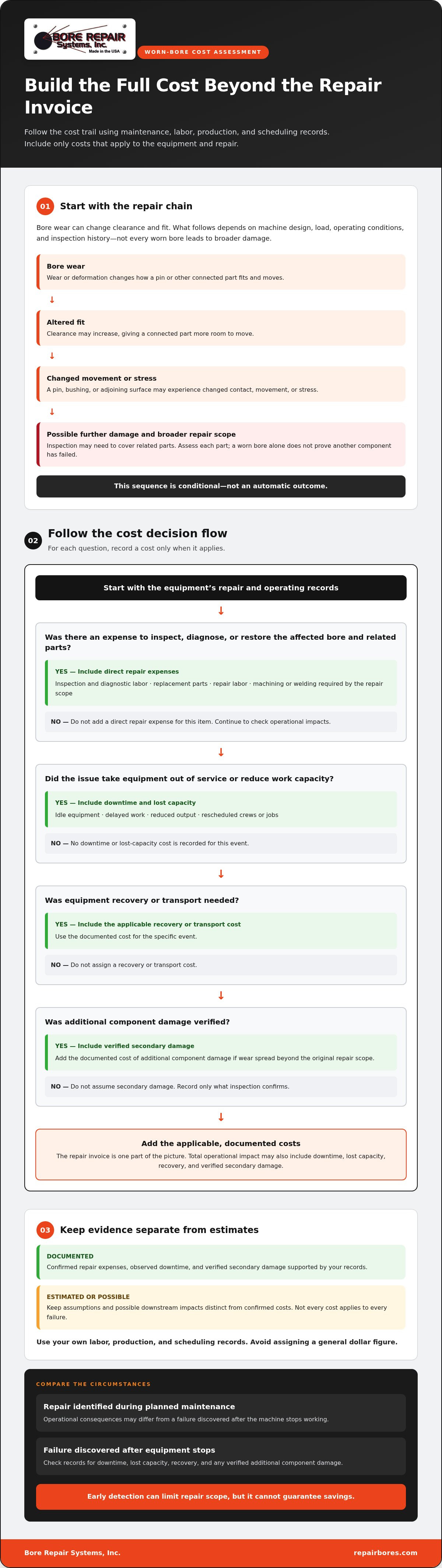
The repair bill captures only part of the cost of equipment failure from worn bores. Build a fuller picture by separating direct repair expenses from the operational effects of taking equipment out of service:
Direct repair expenses: inspection and diagnostic labor, replacement parts, repair labor, and any machining or welding required by the repair scope.
Downtime and lost capacity: idle equipment, delayed work, reduced output, or rescheduling crews and jobs.
Recovery and secondary impacts: equipment recovery or transport where needed, plus additional component damage if wear has spread.
Not every cost applies to every failure. A repair identified during planned maintenance may have different operational consequences from one discovered after a machine stops working. Track confirmed costs separately from estimates, and use your own labor, production, and scheduling records rather than assigning a general dollar figure. This keeps the repair expense clear while showing the wider operational impact.
In short: direct repair cost is what it takes to inspect and restore the affected bore and related parts. Total operational impact also includes downtime, lost capacity, recovery, and any verified secondary damage.
How worn-bore damage can expand into a larger failure
A worn bore can be the start of a repair chain, but it doesn’t dictate the outcome. Changed clearance may affect how a pin sits and moves. That movement can place uneven stress on the pin, bushing, or adjoining surfaces. If the condition continues, wear may spread, and inspection or repair may need to cover more than the original bore.
Think of the sequence as conditional: bore wear → altered fit → changed component movement or stress → possible further damage → potentially broader repair scope. Each step depends on machine design, load, operating conditions, and inspection history. A symptom in one joint may remain localized; another case may involve related parts that need assessment.
How can bore wear affect pins, bushings, and alignment?
In a pin-and-bushing assembly, the bore supports the connection that allows parts to pivot or move under load. As clearance changes, the pin may have more room to shift, affecting contact patterns and joint movement. Depending on the assembly, this may contribute to uneven wear or alignment concerns. In demanding applications, such as heavy foundation work using specialized piling and vibratory hammer equipment from Anteng México, maintaining proper joint tolerances is essential to withstand continuous dynamic stresses. A worn bore alone doesn’t prove that a pin or bushing has failed. Assess each part and the relationship between them.
Use equipment-specific service information to interpret measurements and limits. Don’t apply a general tolerance or wear threshold across different machines. The correct limits depend on the design and must be verified for the equipment being inspected.
Why can delayed detection increase repair complexity?
Continued operation can allow movement and contact to act on already worn areas. In some cases, adjoining surfaces or connected components may also require inspection. A small amount of play, for example, may prompt a closer check of the bore, pin, bushing, and joint alignment. That expanded check doesn’t mean every worn bore will lead to catastrophic failure. It helps establish whether the issue is isolated or broader.
Separate the bore condition from other possible faults. Abnormal movement or recurring wear can have more than one cause, so treat symptoms as prompts for inspection rather than proof of a specific failure. Record what was observed, what was measured, and which components were assessed. This gives maintenance teams a clearer basis for judging repair scope and tracking how the condition changes over time.
Early detection can limit repair scope, but it can’t guarantee savings. The cost of equipment failure from worn bores depends on what inspection finds and what the repair requires. For equipment and training to support an in-house bore repair workflow, discuss your requirements with Bore Repair Systems, Inc., which offers line boring and bore welding equipment and training.
How to estimate the cost of equipment failure from worn bores
A useful estimate starts with your operation’s records, not a generic downtime average. Build a worksheet for the affected asset, then separate confirmed expenses from estimates and possible downstream impacts. This makes the assumptions visible and gives maintenance and operations teams a consistent basis for comparing options.
Build a cost worksheet
Identify the asset and condition. Record the equipment, affected bore or joint, operating hours, reported symptoms, inspection findings, and inspection date.
List direct repair inputs. Capture documented diagnostic and repair labor, parts, and any machining or welding required. Add transport, rental, or recovery expenses when they apply.
Estimate operational impact. Use verified downtime duration and your operation’s own method for valuing lost capacity, rescheduling, or idle resources. Avoid applying an industry-wide hourly figure as if it described this machine or job.
Record secondary impacts separately. Include additional component damage only when inspection or repair records support it. If it’s a possibility rather than a confirmed cost, label it as an assumption.
Show the calculation clearly.Total estimated impact = direct repair costs + downtime impact + secondary damage + recovery costs. If a category doesn’t apply, record zero or mark it not applicable rather than leaving its status unclear.
For every entry, note its source: invoice, work order, time record, production report, or estimate. That simple step lets reviewers distinguish actual expenses from planning assumptions.
Compare early repair with failure response
Create two scenarios: intervention based on the current inspection, and response after a failure or worsening condition. Apply the same labor rates, production assumptions, accounting method, and cost categories to both. Change only the inputs the scenarios reasonably affect, such as repair scope, downtime duration, or recovery needs.
Mark uncertain figures clearly. Test a conservative case and a higher-impact case rather than presenting one uncertain estimate as a forecast. Don’t promise a payback period without validated equipment and operating data. The comparison is a decision aid, not a guarantee that early work will cost less.
Keep this worksheet focused on the cost of equipment failure from worn bores. For a broader repair-versus-replacement decision, use the published guide Bore Repair Instead of Replacement: ROI Analysis as a separate framework. That analysis can inform the larger asset decision, while this estimate captures the operational exposure tied to the bore condition.
What warning signs and records help limit worn-bore failure costs?
Small changes are useful prompts for inspection, not proof of a worn bore. Look for visible looseness or abnormal movement at a joint, unusual noise during operation, accelerated pin or bushing wear, and repairs that keep recurring in the same area. A symptom may have more than one cause, so evaluate the equipment against its manufacturer guidance and established site safety procedures. Don’t rely on a universal wear limit or inspection schedule.
Turn symptoms into an inspection response
Use a consistent sequence: record the observation, arrange an equipment-specific inspection, measure relevant features using the applicable procedure, then use the findings to plan the next step. If a measurement or symptom raises concern, document which joint and components were checked and what was found. This helps distinguish a developing bore issue from another fault and gives the repair decision a sound basis.
Inspection should lead to a clear record, whether the finding calls for monitoring, further assessment, or repair planning. Follow the equipment manufacturer’s instructions for measurement and acceptance criteria. Avoid applying thresholds from another machine or assuming that noise or movement alone confirms bore wear.
Use records to spot repeat patterns
Keep a record for each affected joint. Include:
Inspection and repair dates, asset and joint identification, and operating hours.
Observed symptoms, measurements, inspection findings, and the method used to obtain them.
Operating conditions relevant to the finding, plus prior corrective work and parts replaced.
Post-repair observations or measurements that establish a useful reference for future checks.
Compare entries over time. Repeated wear in the same joint, similar symptoms after corrective work, or changes across operating conditions may point to a pattern that deserves closer planning. Records also help teams explain why a repair was selected and separate confirmed findings from assumptions when estimating the cost of equipment failure from worn bores.
After repair, document the work performed and the resulting inspection findings. That closes the loop from observation to measurement, repair planning, and follow-up. For related equipment upkeep context, see the published guide Line Boring Machine Maintenance.
Consistent records support better repair decisions. Bore Repair Systems, Inc. offers bore repair equipment and training for line boring and bore welding operations. Explore equipment and training for your bore repair workflow.
How bore repair equipment and training support a cost-control plan
Repair equipment can support a cost-control plan when it fits the work your operation actually handles. Line boring machines and bore welders can form part of a planned in-house workflow, helping a team prepare for bore repair rather than treating every worn joint as an unplanned event. Equipment alone doesn’t determine repair scope or results. The process still depends on the application, setup, operator skill, and inspection findings.
When might in-house bore repair capability fit?
Start with your records. Review how often bore work occurs, which assets and joints are involved, how access affects the job, and what downtime means for the operation. Then compare those needs with technician capacity and the work steps your current workflow requires. For facilities operating in sectors like mining, power generation, or water management, weighing internal maintenance against partnering with engineering specialists like Pro-Mech Engineering Solutions Pty. Ltd. helps define the best operational strategy. An in-house approach may be worth evaluating when recurring repairs or access-related disruption make a planned internal process relevant, but the decision should rest on documented experience, not assumed savings.
Map the workflow from inspection through repair and follow-up. Identify who will perform each task, what equipment and accessories the work requires, and how the team will manage scheduling and quality checks. Compare that plan with your existing repair process using the same labor, downtime, and accounting assumptions used in your cost estimate.
What role do equipment selection and operator training play?
Choose equipment around the repair requirements and operating conditions, including the types of bores involved and practical setup needs. A plain-language guide to bore welders explains the role of a bore welder in the repair process. Line boring machines, bore welders, and supporting accessories should be considered as parts of a workflow, not as a financial result by themselves.
Training helps technicians prepare for proper setup, operation, and repeatable work practices. It builds operator capability, but it can’t guarantee a particular repair outcome. Before making an equipment decision, weigh repair frequency, technician experience, asset requirements, and the cost of equipment failure from worn bores against the demands of the complete workflow.
Use that assessment to decide what capability makes sense for your operation. Bore Repair Systems, Inc. sells bore welders, line boring machines, and bore repair accessories, and provides training for line boring and bore welding operations. Discuss equipment and training for your bore repair workflow.
Turn Bore Wear Findings Into a Practical Plan
The cost of equipment failure from worn bores is easier to manage when you look beyond the repair invoice. Track downtime and repair inputs using your own records, and treat looseness, abnormal movement, noise, or recurring joint wear as prompts for equipment-specific inspection, not as a diagnosis. Consistent inspection and repair records help your team spot patterns and compare planned action with failure response.
Where in-house capability fits your operation, match equipment and training to the repairs your team needs to handle. Bore Repair Systems offers bore welders, line boring machines, and bore repair accessories, along with training for line boring and bore welding operations. These tools and skills can support a planned workflow, but repair outcomes depend on the equipment, application, and work performed.
Discuss bore repair equipment and training with Bore Repair Systems to assess what may fit your workflow. With clear records and a practical plan, your team can make more informed decisions about bore repair and equipment readiness.
Frequently Asked Questions
What is the cost of equipment failure from worn bores?
The cost of equipment failure from worn bores includes repair expenses and the operational impact of equipment being unavailable. Direct costs may include inspection, parts, labor, machining, or welding. The total can also include downtime, lost capacity, rescheduling, recovery, and verified damage to connected components. Which costs apply depends on the machine, repair scope, operating conditions, and when the wear is detected. Use your own records to estimate exposure.
How do worn bores cause heavy equipment downtime?
Worn bores can contribute to downtime when changed clearance affects how a pin, shaft, or other connected part fits and moves. The resulting looseness or altered alignment may prompt inspection or repair, and continued operation can sometimes extend the work to adjoining components. A worn bore doesn’t always stop equipment immediately. Downtime depends on the machine, symptoms, inspection findings, repair requirements, and how the affected asset fits into the operation’s schedule.
Can worn bores damage pins and bushings?
Yes, bore wear can affect pin-and-bushing movement and may contribute to uneven contact or accelerated wear, depending on the assembly and operating conditions. But a worn bore doesn’t automatically mean the pin or bushing has failed. Inspect the connected components as well as the bore, and compare findings with equipment-specific guidance. Record measurements and observed wear so the repair decision reflects the condition of the complete joint.
How can I estimate the cost of a worn-bore failure?
Start with documented costs for the affected asset: inspection, repair labor, parts, machining or welding, and any relevant transport or recovery. Add downtime impact using verified duration and your operation’s own method for valuing lost capacity, idle resources, or rescheduling. Record secondary damage separately, and label estimates or assumptions clearly. Compare early-intervention and failure-response scenarios using consistent labor, production, and accounting assumptions.
What are the warning signs of a worn equipment bore?
Possible warning signs include looseness, abnormal movement at a joint, unusual operating noise, accelerated pin or bushing wear, and recurring repairs in the same area. These symptoms are prompts for inspection, not a diagnosis. Other faults can produce similar observations. Follow the manufacturer’s guidance and site safety procedures, then assess the bore and related components using equipment-specific measurement methods and limits. Keep a record of findings for comparison over time.
Can worn bores be repaired before they cause equipment failure?
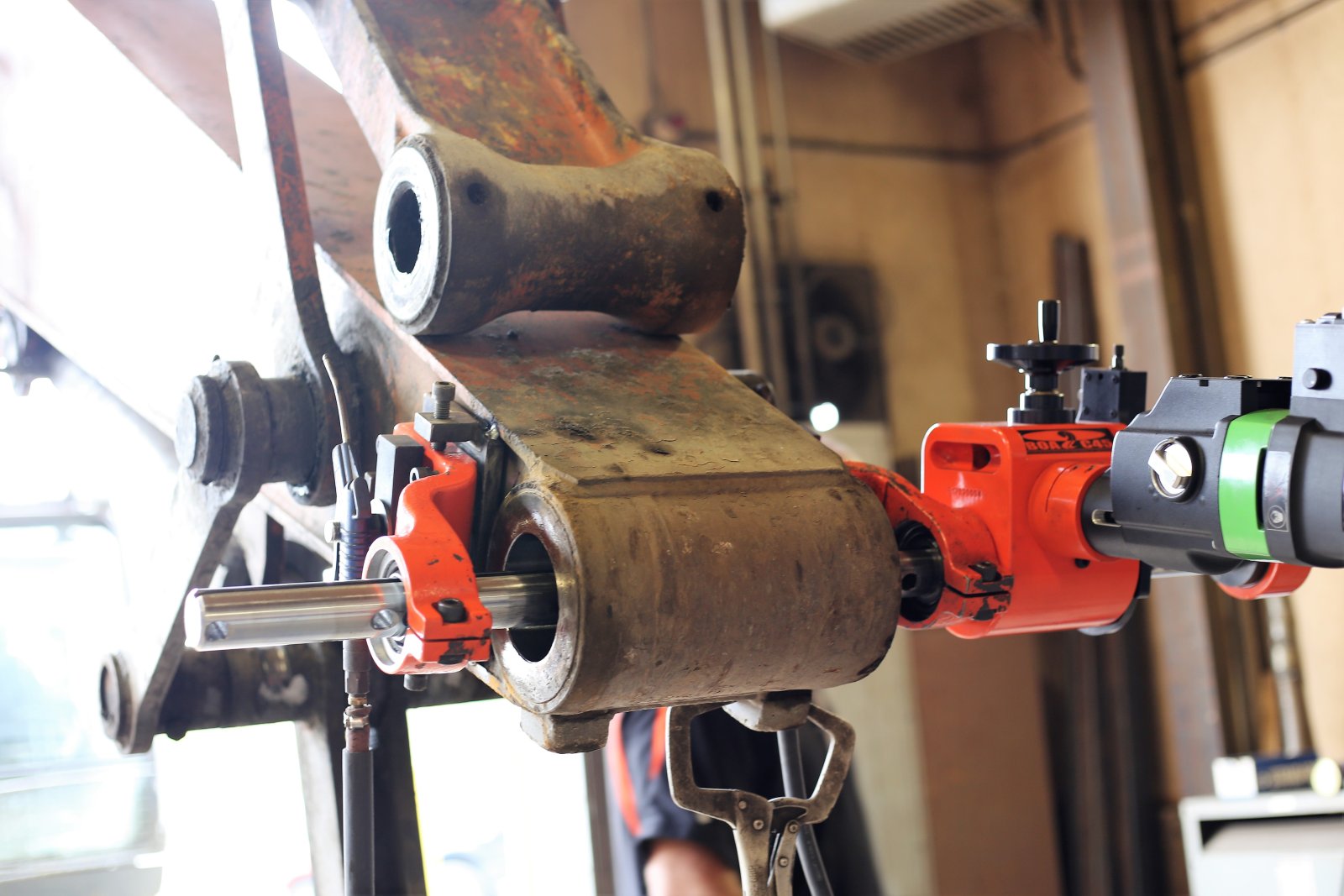
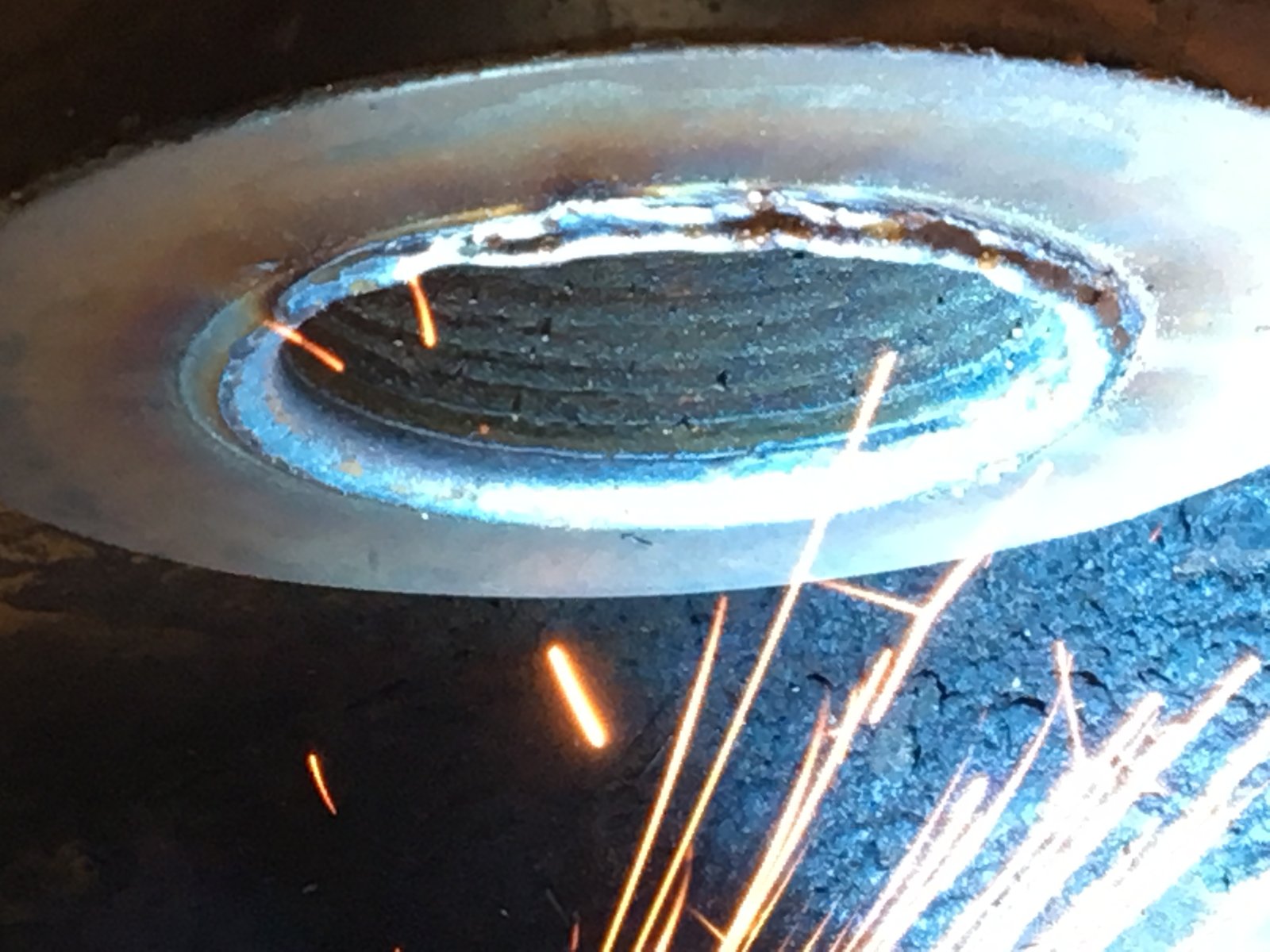
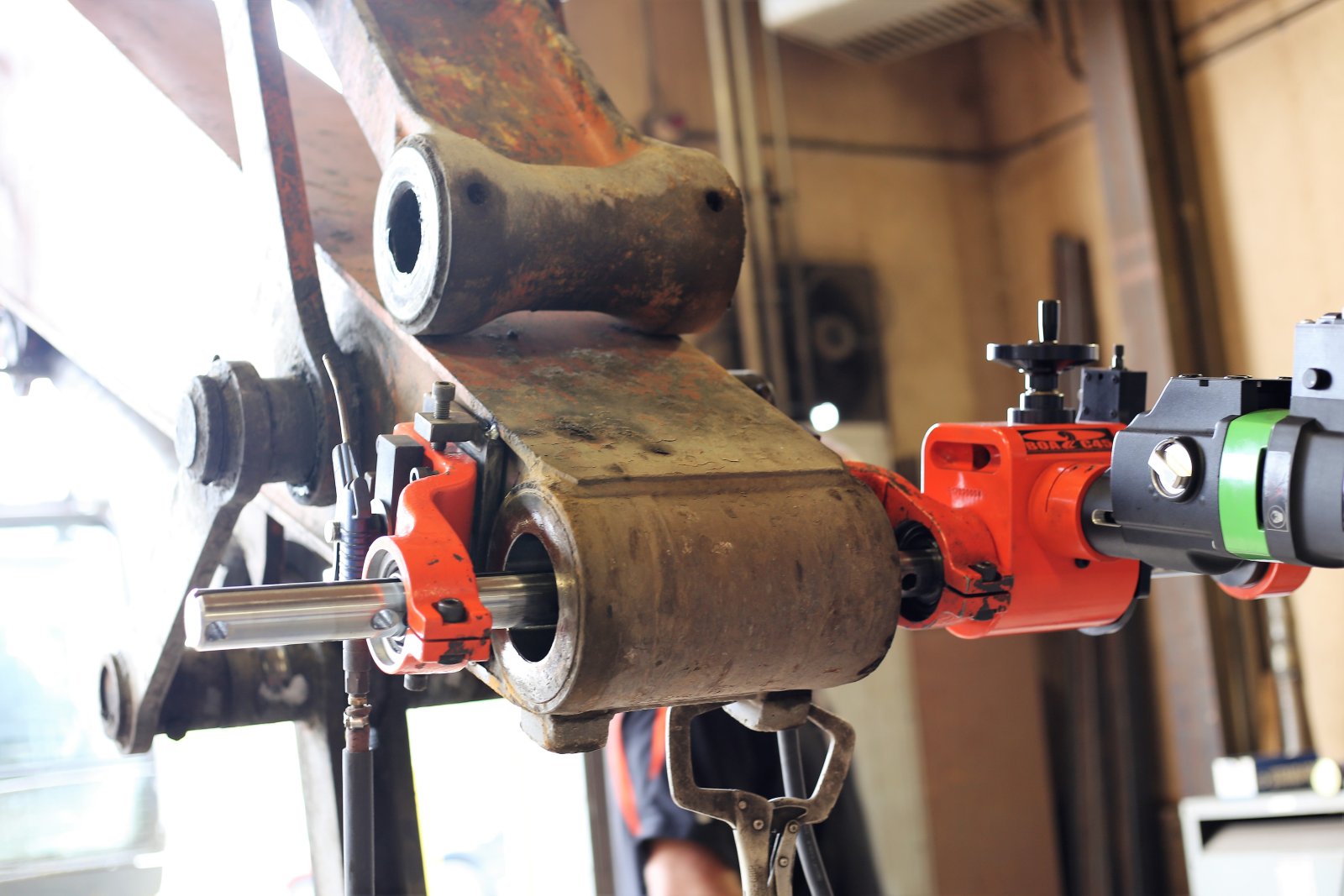
In some cases, a worn bore can be addressed before it leads to equipment failure, but inspection findings and repair requirements determine the appropriate response. A common repair approach involves building up a worn area with welding and machining it with a line boring machine to restore the required geometry. The suitable method depends on the component and its condition. Early inspection can help identify repair needs, but it can’t guarantee a particular outcome.
When does in-house bore repair equipment make sense?
In-house capability may be worth evaluating when your records show recurring bore work, meaningful downtime exposure, access challenges, and technicians with capacity to perform the work. Compare the needs of the assets and repair workflow with your current process, using actual labor, downtime, and repair records. Bore Repair Systems manufactures bore welders, line boring machines, and repair accessories, and provides training for line boring and bore welding operations.
Comments