

In-Sourcing vs Outsourcing Equipment Maintenance: Compare Costs

The lowest-cost choice isn’t always to keep every repair in-house or outsource them all. For many operations, the practical answer to in-sourcing vs outsourcing equipment maintenance is a hybrid: handle routine, repeatable work internally and bring in outside expertise for complex or infrequent repairs. The right balance depends on total costs, facility complexity, work quality, and equipment reliability.
Labor rates alone can make one option look cheaper while hiding the cost of tools, training, staff time, travel, and downtime. At the same time, keeping maintenance knowledge close to the equipment can improve control over priorities and scheduling. The challenge is weighing those trade-offs against the specialized skills and flexibility outsourcing can provide.
This article explains how to compare the full cost of each approach, decide which tasks fit your facility, and assess quality and reliability. You’ll also learn how preventive maintenance can reduce disruption under either model and how to choose a sensible mix of in-house work and outside support.
Table of Contents
Can you insource some repairs and outsource others?
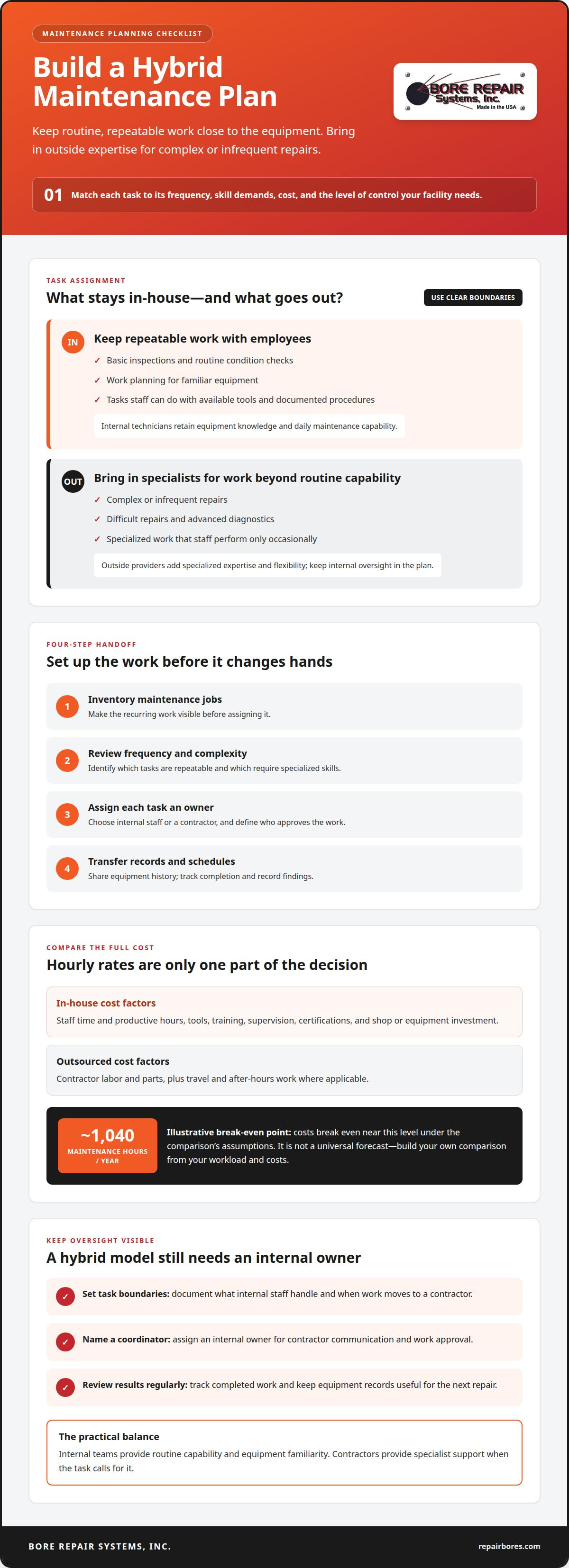
Yes. In-house maintenance uses your employees, tools, and procedures; outsourced maintenance assigns selected work to an external provider. To transition, list recurring jobs, classify each by skill and frequency, assign ownership, then transfer work records and review results.
In-House and Contractor Costs
Compare effective costs, not just hourly rates. Under that comparison’s assumptions, costs break even near 1,040 maintenance hours annually.
Those figures come from different illustrative calculations, so don’t combine them into a single forecast. Include productive hours, parts, and after-hours work in your organization’s own comparison.
Hybrid Maintenance Models
A hybrid model keeps routine work with employees and assigns complex or infrequent repairs to a contractor. Internal technicians retain equipment knowledge and handle basic tasks; outside specialists bring expertise for difficult repairs and advanced diagnostics. Unlike full outsourcing, this approach retains daily maintenance capability and oversight within the organization.
A fitness-center example illustrates that management can be divided by function: its eligible population is 2,500 people, with an active membership rate of 66 percent. For equipment, apply the same principle by assigning clear ownership for routine checks and specialist repairs.
Tasks for In-House Teams
In-house teams suit repeatable tasks that staff can perform with available tools and documented procedures. Examples include basic inspections, routine condition checks, and work planning for familiar equipment. These jobs are easier to schedule internally than specialized repairs performed only occasionally, which may be better outsourced.
Keep task boundaries clear. Record findings and completed work so a contractor receives useful equipment history when a repair moves beyond the team’s capability.
Managing a Maintenance Transition
Transition in steps: inventory maintenance jobs, review their frequency and complexity, assign each task to internal staff or a contractor, then transfer equipment records and schedules. Define who approves work and who tracks completion. This approach establishes accountability for the handoff, not just a cost model.
For a hybrid arrangement, name an internal owner for contractor coordination and review performance regularly. Choose the model that fits your workload, skill requirements, and the level of control your facility needs.
Choose by matching each task’s frequency and skill demands to the cost and control your operation requires.
What is the biggest hidden cost in outsourcing?
In the United States, equipment-maintenance safety requirements depend on hazards, work procedures, worker training, and applicable rules; licensing requirements depend on the equipment and task. Insourcing gives an organization more direct control and preserves internal knowledge, but requires staffing and shop investment. Outsourcing can reduce internal workload, while creating dependence on the provider and reducing direct oversight of how repairs are performed.
In-House Labor and Shop Costs
One hidden cost in outsourcing decisions is the internal capability an organization still needs to maintain.
Those figures show why wages alone don’t represent the cost of an in-house function. Include supervision, tools, training, certifications, and equipment, then divide annual expenses by productive hours. A useful in-sourcing vs outsourcing equipment maintenance comparison also accounts for the investment needed to develop employees’ skills.
Insourcing can preserve equipment knowledge and support familiar repair routines. However, lower productivity or idle shop capacity spreads fixed costs across fewer completed repairs. Track actual workload and productive time to see whether the internal team is using its capacity effectively.
Turnover and Replacement Costs
Employee turnover adds recruiting, onboarding, and lost-productivity costs to an in-house maintenance program. Replacing an employee can cost a U.S. organization from one-half to two times that employee’s annual salary.
Turnover can also interrupt work continuity. When an experienced technician leaves, the organization may lose practical knowledge about recurring faults, repair histories, and equipment-specific procedures. Record that knowledge in maintenance documentation, and include recruiting and training expenses when calculating the cost of retaining internal capability.
Skill development takes time as well as budget. Include training, certification, and the tools employees need for assigned repairs. Compare these commitments with the external expertise and capacity available from a contractor. A sound in-sourcing vs outsourcing equipment maintenance comparison includes the cost of maintaining skills, not just the cost of completing individual jobs.
Outsourcing Risks
Outsourcing shifts some labor and operating demands to a provider, but it doesn’t remove the need for quality oversight. Define each job’s scope, document completed repairs, and review performance regularly. These steps help managers track workmanship and identify gaps between the assigned task and the work delivered.
Vendor dependence is another risk. A provider may change its offerings or pricing, or go out of business, disrupting access to support. Keep equipment records and maintenance knowledge accessible internally so the operation can manage a provider change without losing critical repair history.
For teams developing bore-repair skills, discuss equipment bore-repair training as one way to build internal capability.
Evaluating facility complexity, cost, technology, and long-term plans
Choose the maintenance model by matching your facility’s equipment, staffing, and future workload. A useful assessment considers five factors: repair complexity, internal skills, technician utilization, technology needs, and hiring capacity.
Start with equipment complexity. A facility with familiar machines and repeatable repairs can build internal routines around its operating demands. Proprietary systems or specialized assets may require expertise that an internal team doesn’t use often. In those cases, outsourcing can provide access to specialist skills without requiring permanent hiring or extensive equipment investment.
Next, test the full cost against expected productive time. At 70% technician utilization, one technician delivers 1,456 productive hours a year. If actual work falls below that level, fixed costs are spread across fewer repairs; if workload grows, internal capacity may become more economical.
Staffing is part of that calculation. U.S. maintenance trades are projected to grow 13% from 2024 to 2034, with about 54,200 job openings annually over that decade. Hiring and retaining skilled employees can limit how quickly an in-house program grows. Compare the skills already available internally with the training needed for your most specialized work, then identify gaps that contractors could cover.
Technology needs also shape the choice. A maintenance team may need a computerized maintenance management system (CMMS), predictive analytics, or smart sensors to track equipment condition and schedule preventive work. Outsourcing can provide access to specialized tools and expertise without the same internal investment. An in-house team, however, can tailor maintenance routines and priorities closely to facility workflows.
Consider a fitness center with connected cardio machines and digital consoles. Its equipment mix may require both mechanical repair skills and familiarity with software or sensor-based alerts. An internal technician can handle familiar inspections and routine work, while a specialist can address advanced diagnostics. The same principle applies to industrial facilities using condition-monitoring technology.
Plan for future demand, not just today’s repair list. Map expected production changes, equipment upgrades, and staff development needs. Then compare three paths: build internal expertise, outsource specialized work, or combine both. Choose the path that keeps critical knowledge available while matching staffing and technology costs to the facility’s long-term workload.
How Can Outsourcing Improve Quality?
Outsourcing can improve maintenance quality when a service provider brings skills, tools, and work standards that the internal team lacks. It can also make spending easier to plan, but only when the contract defines the work and clearly measures results.
Start with the maintenance outcome, not the lowest bid. For a production line, define which equipment is covered, what work is included, how completion is recorded, and how reliability will be assessed. A clear scope helps prevent gaps between the facility’s needs and the provider’s responsibilities. It also gives managers a practical basis for reviewing service quality and cost.
Outsourcing can scale support as production demand changes. A facility facing seasonal peaks can bring in specialist capacity without permanently expanding its staff. External providers may also use machine-health monitoring and predictive maintenance tools to identify developing problems before they cause failures. These capabilities can improve consistency, especially when internal technicians don’t routinely handle complex diagnostics.
Budget predictability depends on contract structure. Defined-scope contracts and monthly service agreements can make planned expenses easier to forecast. But a fixed payment alone doesn’t guarantee good work. Specify the maintenance tasks, reporting expectations, and quality measures, then review actual work against them. Consolidating vendors with one trusted partner can also simplify coordination and reduce administrative effort—for instance, facilities operating complex packaging systems often partner with specialists like Phoenix Handling Solutions Limited to manage machinery servicing and scheduled maintenance.
Cost-focused agreements need a longer view. Under a reliability-based outsourcing contract, maintenance costs are very likely to rise in the first year or two before declining in the second or third year. A contract focused too heavily on cost reduction should last no less than five years. Treat reliability as the primary measure when balancing savings against equipment performance.
Use a practical contract review before selecting a provider:
Define scope: identify covered equipment, routine tasks, and specialist repairs.
Set measures: track work completion, recurring failures, and equipment availability.
Review costs: separate planned services from additional work and parts.
Check alignment: confirm the provider’s reporting and communication support facility goals.
These steps connect service quality to the facility’s actual operating needs. For example, a manufacturer can assess whether fewer repeat failures offset higher initial maintenance spending. Review performance over the contract term rather than judging a reliability program only by its first-year cost.
Outsourcing is not automatically the right choice for every repair. Keep internal responsibility for priorities and performance reviews, while using outside specialists where advanced expertise or technology adds value. This division lets the organization pursue savings without treating low cost as the only measure of quality.
Preventive maintenance and equipment reliability
Preventive maintenance supports reliability under either model. In manufacturing, inspections, condition monitoring, scheduled work, and repair records help identify developing faults before they interrupt production. The key is consistent execution, whether internal technicians, outside specialists, or both perform the work.
In-house maintenance gives facility managers direct control over scheduling, priorities, and response times. Outsourcing can provide specialist skills, but response depends on the support arrangement and how clearly responsibilities are defined. A hybrid model can keep routine inspections internal while assigning complex diagnostics to outside specialists.
Use a repeatable maintenance cycle to connect daily work with equipment performance:
Inspect: record visible wear, leaks, unusual noise, and operating changes.
Monitor: track equipment condition and identify components nearing the end of their lifecycle.
Plan: schedule maintenance around production needs and prioritize high-impact equipment.
Record: document work completed, findings, and recurring faults.
Investigate: use root-cause analysis to address repeat failures rather than treating each symptom separately.
These steps make reliability measurable through quality, time, and speed performance. For example, a manufacturing team can review whether scheduled inspections find developing wear, whether planned work finishes on time, and how quickly equipment returns to operation. Compare those records across maintenance periods to spot recurring delays or defects.
Predictive analytics and smart sensors can add condition data to the process. They can flag components nearing the end of their lifecycle, allowing teams to plan replacement instead of waiting for an emergency repair. A computerized maintenance management system can organize work orders, schedules, and service records so internal staff and contractors work from consistent equipment information.
Keep the program balanced. Maintenance costs can fall for two to three years before deferred work begins driving them up. Cutting inspections or postponing corrective tasks may lower short-term spending while increasing failure risk later. Review overdue work, repeat repairs, equipment condition, and downtime together. That keeps cost decisions tied to operating evidence, not just the maintenance budget.
Choose the model that maintains the discipline, skills, and response your equipment requires. If internal technicians need practical capability for bore-repair work, discuss equipment bore-repair training as part of your reliability plan.
Bore Repair Systems, Inc. - Bore Repair Made Easy with our USA made Lineboring and Boreweld solutions: Training for equipment bore repair
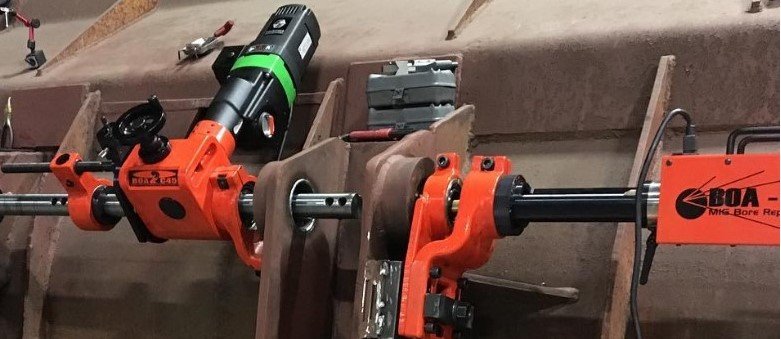
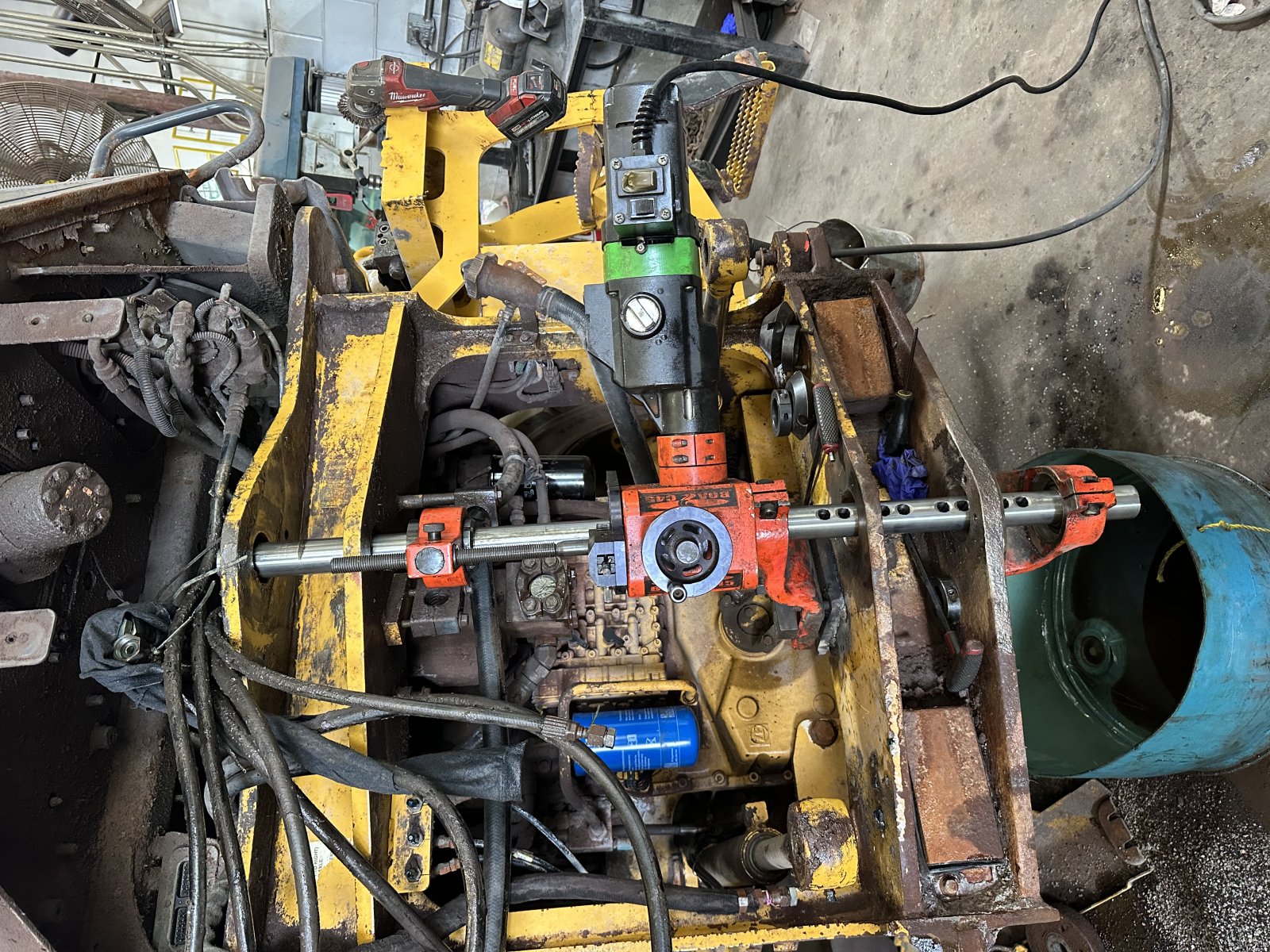
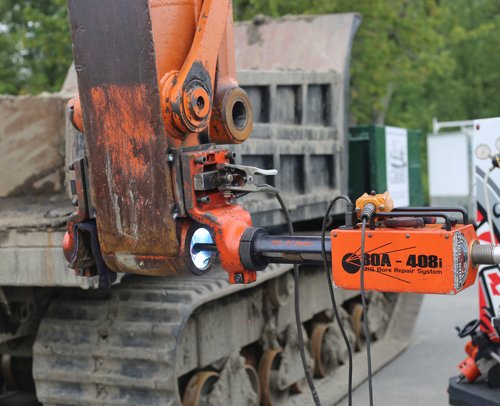
Bore Repair Systems, Inc. - Bore Repair Made Easy with our USA made Lineboring and Boreweld solutions offers training for equipment bore repair, giving maintenance teams a path to build internal skills for bore repair work. This can suit operations that want to handle selected repairs in-house while keeping other specialized work outside their team.
Training in line boring and bore welding helps technicians develop practical capability for these tasks. Bore welders, line boring machines, and bore repair accessories support equipment bore repair workflows. Together, training and purpose-built equipment can help a team decide which repairs fit its capabilities and where outside expertise remains useful.
If you’re considering training or equipment for your maintenance setup, contact Bore Repair Systems to discuss your needs.
Put Your Maintenance Plan Into Practice
Turn your maintenance decision into a working plan by choosing a defined group of repairs and assigning clear ownership. Record the current process, including who identifies the fault, who approves work, and how completion is documented. This gives your team a practical starting point and makes handoffs easier to manage.
Then review how the plan fits your equipment and workforce. The right balance in an in-sourcing vs outsourcing equipment maintenance strategy can change as internal skills develop, equipment needs shift, or production priorities evolve. Keep responsibility clear, preserve useful repair records, and adjust task ownership when the work demands it.
If bore repair is part of your plan, Bore Repair Systems can help you consider equipment and training options for building that capability. Contact Bore Repair Systems to discuss your bore-repair maintenance needs and identify a practical next step for your operation.
A clear plan gives your maintenance team a sound basis for moving forward.
Frequently Asked Questions
Why Consider Outsourcing Maintenance?
Outsource maintenance when specialist skills, technology, or flexible capacity are more practical than developing them internally. For example, a facility with seasonal production peaks can use outside support for extra work without permanently increasing its staff. This approach can also free managers to focus on production rather than coordinating every repair. Keep internal oversight so priorities, equipment records, and completed work remain visible.
At what fleet size does insourcing repairs make sense?
There’s no universal fleet-size cutoff; workload density and travel distance matter as much as the number of assets. One illustrative model found that about 107 vehicles within a sensible radius could generate enough work for an in-house bay. That’s a planning example, not a rule for every fleet. Count suitable maintenance hours, account for where vehicles operate, and assess whether steady work can support internal capacity.
What is insourcing?
Insourcing means assigning a function to your own employees and managing it within your organization. For equipment maintenance, that can mean scheduling inspections, recording faults, and completing selected repairs with internal staff. A company might insource routine work on familiar machines while using outside specialists for less frequent tasks. The defining point is who performs and manages the work, not where the equipment is located.
What are the pros and cons of outsourcing equipment maintenance?
Outsourcing can give an organization access to specialized skills and technology without developing every capability internally. It can also provide flexibility when production demand changes. The trade-offs are less direct control over work methods and possible dependence on a provider’s availability or business decisions. For example, if a contractor changes its services, maintenance plans may need adjustment. Retain equipment records and review completed work to preserve oversight.
How much does in-house equipment maintenance cost compared with outsourcing?
The comparison depends on productive hours, staffing, training, tools, facility overhead, contractor labor, parts, and travel. An in-house program carries fixed costs even when repair demand dips; outsourced spending generally follows the assigned work and contract terms. Build an annual comparison using the same task list and expected workload for both options. Include downtime and administrative effort, since a labor-only comparison can miss substantial cost categories.
How do labor, parts, overhead, and service-contract costs compare?
In-house labor includes wages and employment costs, while outsourced labor follows the provider’s rates and billing terms. Internal overhead can include supervision, facilities, tools, and training. Contractor invoices may include travel or parts markups, so review how each item is charged. For a fair comparison, map these categories separately against the same repairs and include recurring contract charges alongside work billed individually.
What factors should businesses consider when choosing a maintenance model?
Assess repair frequency, equipment complexity, internal skills, staffing capacity, technology needs, and the importance of direct scheduling control. A facility with frequent, familiar tasks may benefit from keeping more work in-house. A site with specialized equipment or fluctuating demand may need outside expertise. Also consider whether maintenance records, work priorities, and quality reviews will remain clear across internal staff and contractors.
How do you calculate the break-even point for in-house versus outsourced maintenance?
Divide annual fixed in-house costs by the difference between the contractor’s hourly cost and any variable in-house cost per productive hour. The result estimates how many annual hours make internal capacity financially competitive, assuming comparable work. One illustrative calculation placed break-even near 1,069 productive hours, using its own cost assumptions. Recalculate with your facility’s labor, overhead, parts, travel, and workload rather than treating that example as a universal threshold.
Comments