

How to Repair Worn Bores in Heavy Equipment: A Professional Guide for 2026

Updated: Sep 1
Every hour your excavator or loader sits idle while you wait for an outside machine shop to return a pivot pin housing is money bleeding from your bottom line. You already know that "good enough" repairs made with a hand welder and a grinder simply don't last. These makeshift fixes lead to egg-shaped holes, accelerated bushing wear, and eventually, a catastrophic failure that costs ten times more than the initial restoration. Learning how to repair worn bores in heavy equipment with precision is the only way to ensure your fleet stays in the dirt where it belongs.
We're going to help you master the technical process of restoring heavy machinery pivot points to factory specifications using modern automated welding and line boring techniques. By the end of this guide, you'll understand how to achieve perfect concentricity and mechanical integrity every time. We'll cover everything from initial measurement to the final pass, showing you how to extend the life of your most expensive assets while reducing your reliance on external service providers. It's time to bring that expertise back into your own shop and reclaim control over your maintenance schedule.
Table of Contents
Understanding Bore Wear and the Risks of Elongated Pin Holes
Bore wear isn't just a maintenance nuisance; it's a structural threat. In heavy machinery, this wear manifests as the loss of concentricity in critical pivot points. Constant pin-to-bushing friction eventually erodes the base metal. While bushings are designed to be sacrificial, they can only protect the housing if the fit remains tight. Once the bore begins to enlarge, the damage accelerates. Learning how to repair worn bores in heavy equipment requires a deep understanding of the physics of the damage.
Most operators notice "egg-shaping" before anything else. This occurs because vertical or lateral loads rarely apply pressure evenly. On an excavator boom, for instance, the force concentrates at the top and bottom of the hole during lifting. This directional pressure creates an oval shape that no standard bushing can fill. If you ignore these elongated holes, you trigger a destructive cascade effect. A loose pin allows for vibration that shreds hydraulic seals. This leads to persistent leaks and, eventually, structural cracking in the surrounding steel. High-wear zones like bucket hinges, loader articulation joints, and main boom pivots are the most frequent points of failure in mining and construction equipment.
The Anatomy of a Worn Bore
It's vital to distinguish between an oversized bore and an elongated one. Oversized bores show relatively even wear across the diameter. Elongated bores suffer from directional displacement. Don't make the mistake of pressing a new bushing into an oval hole. The lack of full surface contact means the bushing will spin or shatter under load. Concentricity is the state of having a common center, and restoring it is the primary objective of any professional repair.
Why Traditional "Patch" Repairs Often Fail
Many shops attempt to fix these issues with a hand welder and a die grinder. It doesn't work. Manual welding creates uneven heat distribution that can warp the base metal, making the final machining process even harder. You can't achieve a true circle by eye. Professional excavator pin hole repair requires a systematic approach. The process often starts with Boring (manufacturing) to clean up the damaged material before applying a consistent, automated weld bead. This ensures the repair is monolithic and built to last. Relying on "good enough" fixes only leads to repeated failures and more downtime.
The Mechanics of Restoration: Automated Bore Welding vs. Manual Buildup
To repair worn bores in heavy equipment effectively, you must first prepare the surface. You don't just weld over rust, grease, or work-hardened metal. The process begins by "boring out" the damaged area to create a clean, concentric surface. This removes the "egg-shaped" profile and exposes virgin metal that's ready for a high-strength bond. Manual buildup, often called "slugging," is a common but flawed alternative. It relies on the steady hand of a welder who must maintain a consistent arc length and travel speed while working inside a cramped housing. Even the best welders struggle with the variability of hand-welding in these conditions.
Automated systems eliminate this human error. By using a machine to control the torch, you achieve a level of consistency that's impossible to match manually. This precision doesn't just improve the look of the weld; it ensures metallurgical integrity. A machine applies heat evenly, which reduces the risk of warping the parent metal. It also cuts down on subsequent machining time. When the weld is applied at the correct diameter and with a uniform thickness, the boring bar only needs to take light finishing cuts to reach factory specifications.
How Automated Bore Welders Work
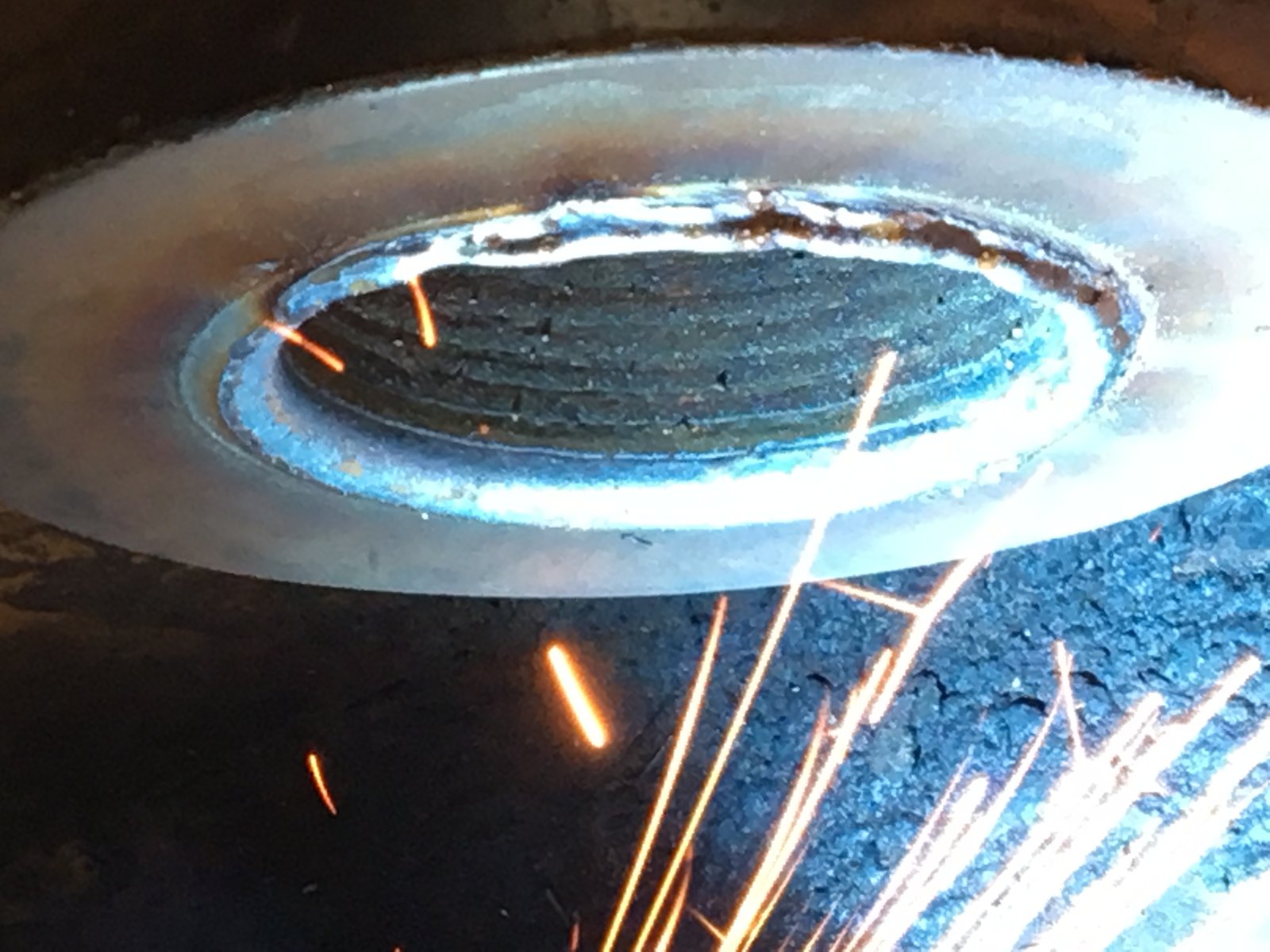
These machines utilize a spiral welding pattern to lay down a continuous bead of metal. The torch rotates and advances simultaneously, creating a uniform layer across the entire internal surface. This synchronization between rotation speed and wire feed is critical. If the speed fluctuates, you get voids or "cold laps" where the new metal fails to fuse with the old. This is why professional bore welder systems are now standard in the industry. They offer the versatility to work in the shop or directly on the machine in the field. This automation ensures that the buildup is thick enough to machine back to size without leaving low spots that require a second welding pass.
Metallurgical Benefits of Precision Buildup
The science of the repair is just as important as the mechanics. Every welding pass creates a Heat Affected Zone (HAZ) in the base metal. Manual welding often concentrates excessive heat in specific areas, which can lead to brittle spots or stress fractures. Technical research on Field Welding Repair of Heavy Equipment emphasizes that controlled heat input is vital for preserving the structural properties of high-strength steels. Automated systems distribute this thermal load evenly. You also gain the ability to use specialized hard-facing alloys that are difficult to apply smoothly by hand. These materials significantly increase the wear resistance of the bore, extending the time between repairs. If you want to stop the cycle of repeated failures, investing in precision bore welding equipment is the most pragmatic step you can take.
Line Boring Precision: Achieving Factory Specs in the Field
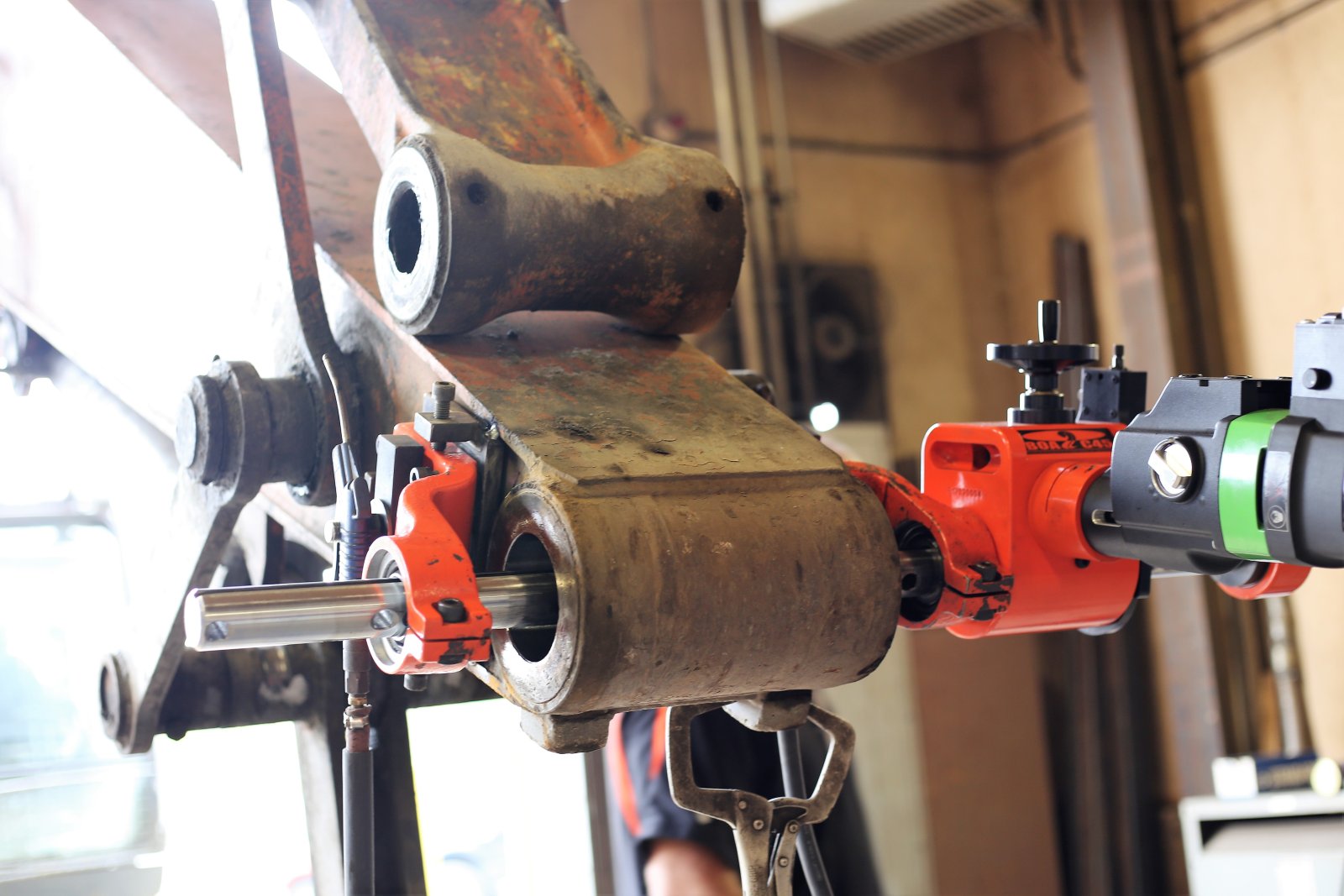
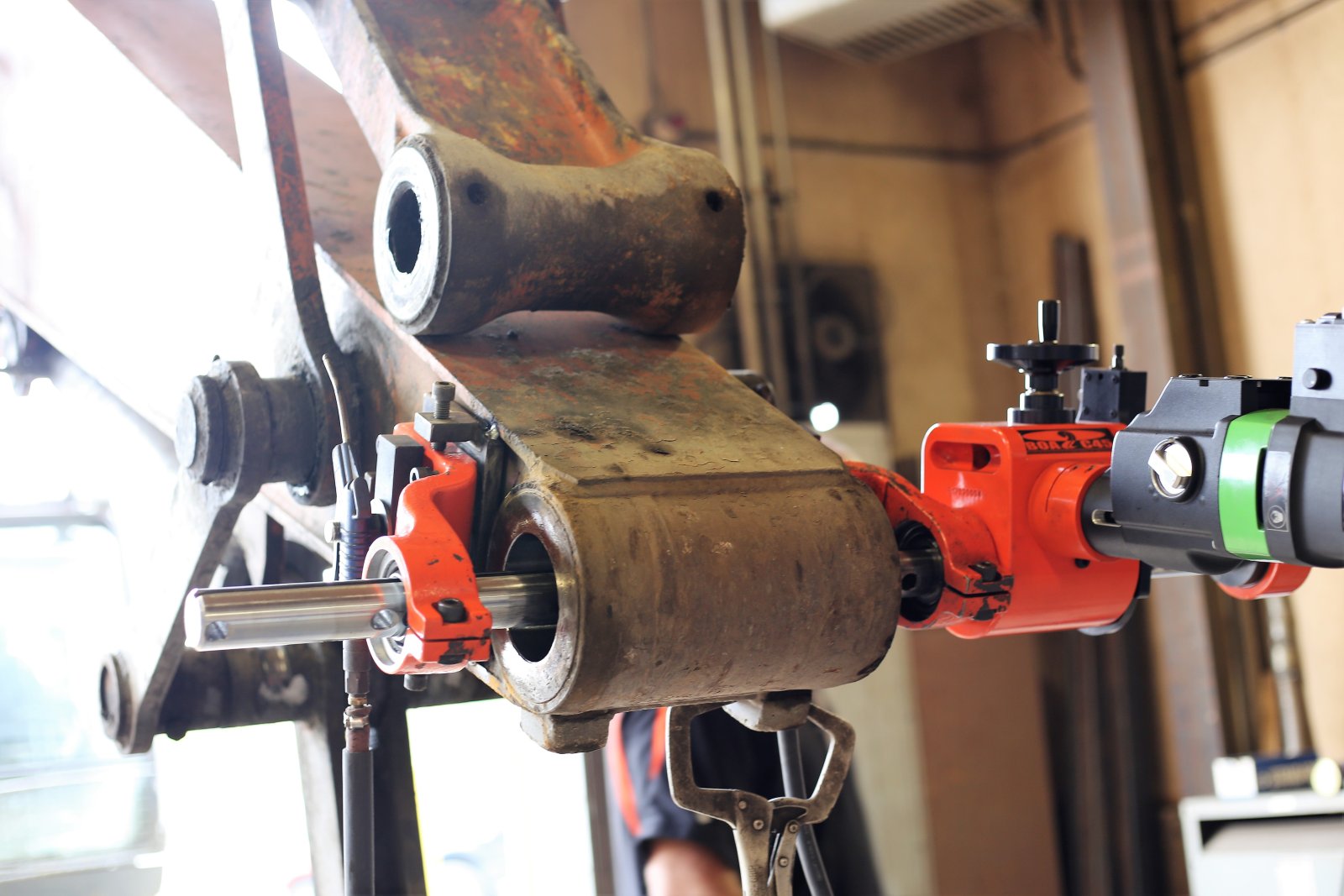
Line boring is the machining process that restores a welded buildup to its exact original diameter. While welding adds the necessary material, boring provides the final geometry. This is where the repair moves from a rough metallurgical bond to a high-precision mechanical component. To repair worn bores in heavy equipment with factory-level accuracy, you must utilize single-point machining. This method ensures that even when you're working on multiple bores in a single line, they remain perfectly co-axial. This alignment is what prevents pins from binding and stops premature wear on your new bushings.
The success of the cut depends on the rigidity of the boring bar and the quality of the cutting tool. Any flex in the bar during the machining process will result in a tapered or out-of-round hole. Stability is everything, and vibration is the primary enemy of a smooth finish. Utilizing professional line boring machine accessories like heavy-duty mounting brackets and steady rests keeps the bar from deflection. Without these stabilizers, you'll likely encounter chatter marks that compromise the seat of the bushing.
Setup and Alignment: The Secret to Success
Don't rush the setup. It's the most time-consuming part of the job, but it determines the final outcome. You use centering cones to find the original axis of the bore before the bar is locked into place. Spherical bearings are essential here; they allow for the minor adjustments needed to ensure the bar is dead center. You must measure the bore before you start, during the roughing passes, and right before the final finishing cut. If the bar isn't aligned with the original geometry of the machine, the pin simply won't fit, or the entire linkage will be crooked.
Machining for Durability and Fit
Precision is measured in thousandths of an inch. A standard press-fit bushing typically requires a tolerance within 0.001 to 0.003 inches. Achieving this level of accuracy requires total control over feed rates and spindle speeds. If you push the tool too fast, the surface finish will be too rough for a proper fit. If you go too slow, the tool may rub rather than cut, leading to work-hardening. Remember that line boring machine maintenance is vital. A well-maintained machine eliminates the mechanical play that causes vibration, delivering a mirror-like finish that ensures the repair lasts for thousands of operational hours.
Strategic Repair Decisions: When to Sleeve vs. When to Weld
Technicians often face a critical choice when they need to repair worn bores in heavy equipment: do they install a sleeve or perform a full weld restoration? Sleeving involves boring the damaged hole to an even larger diameter and pressing in a sacrificial steel insert. While this is a common "field fix," it fundamentally changes the component's structural geometry. You're effectively removing more of the original parent metal to make room for a separate part. This might be acceptable for light-duty machinery, but for high-stress pivot points, it introduces a potential point of failure that didn't exist before.
Weld-and-machine restoration is the superior alternative for most structural steel components. By using an automated welder to build up the surface, you return the part to a monolithic state. You aren't just filling a gap; you're rebuilding the housing to its original metallurgical specifications. The decision usually comes down to the base material and the load requirements. Cast iron housings are notoriously difficult to weld without cracking, making sleeves a pragmatic choice there. However, for the high-strength steel found in excavator booms and loader frames, welding is the only way to ensure the repair handles the same tonnage as the day it left the factory.
The Limitations of Sleeving in Heavy Equipment
Sleeves often fail in high-vibration or high-impact environments. Under heavy loads, a pressed sleeve can "walk" or spin inside the housing. Once that interference fit is lost, the sleeve starts to act as a grinding agent, destroying the bore from the inside out. There's also the risk of crevice corrosion. Moisture can migrate between the sleeve and the bore, leading to hidden oxidation that you won't see until the component fails. Use sleeves only as a last resort, such as in thin-walled castings where the heat of welding might cause unacceptable distortion.
The Long-Term ROI of Weld Restoration
Welding preserves the structural integrity of your machinery for the long haul. Because you're adding metal back to the component rather than cutting it away, you maintain the wall thickness required for heavy lifting. This approach also allows for infinite future repairs. A sleeved bore can only be enlarged so many times before the housing becomes too thin to be safe. When you look at the in-house line boring vs outsourcing cost analysis, the value of a permanent, monolithic repair is undeniable. It eliminates the need for custom-machined sleeves and ensures your equipment remains at factory specs. If you're ready to stop relying on temporary inserts, view our automated bore repair packages to bring professional-grade restoration to your shop.
Building an In-House Bore Repair Capability with Professional Equipment
Bringing your maintenance needs under your own roof is the most effective way to reclaim control over your operational schedule. To repair worn bores in heavy equipment with consistent success, you need a dedicated station equipped with an automated bore welder and a high-precision line boring machine. Relying on outside vendors often means working around their backlog rather than your own project deadlines. By investing in the right tools, you eliminate the middleman and ensure that every repair meets your specific standards for mechanical integrity.
Portability is a critical factor when selecting your gear. The ability to perform "on-machine" repairs is what separates a modern shop from an outdated one. If you can fix a bucket hinge or an articulation joint without a complete teardown of the machine, you save dozens of man-hours in labor and logistics. Portability allows your team to move the equipment to the excavator rather than hauling a massive steel component to a stationary mill. Automated systems further enhance this efficiency by reducing the skill gap; they handle the complex torch synchronization that would otherwise require a master welder, allowing your existing technicians to produce professional results.
Selecting the Right Equipment for Your Fleet
Match your equipment to the typical jobs in your yard. A 1.5 inch diameter boring bar is ideal for smaller linkage pins, while a 2.5 inch bar provides the rigidity needed for heavy-duty mining or construction frames. All-in-one systems that integrate both the welding and boring functions onto a single mounting setup are particularly valuable. They reduce setup time and ensure that the welding torch and the cutting tool share the same axis of rotation. Always choose a manufacturer that provides direct technical support and comprehensive line boring training to ensure you're getting the full ROI from your purchase.
The Path to Implementation
Success starts with a clear plan. Follow these three steps to transition from outsourcing to in-house expertise:
Audit your costs: Calculate exactly what you spent on outside machine shops and lost production time over the last 24 months.
Evaluate your fleet: Identify the most common bore diameters and depths in your equipment to determine the necessary bar sizes and welder stroke lengths.
Prioritize education: Secure line boring operator training. Even the best machine is a paperweight without a trained operator who understands setup, alignment, and metallurgical heat control.
Reclaim Your Maintenance Schedule with Precision Restoration
Precision bore restoration isn't just about filling a hole; it's about returning your machinery to its original mechanical integrity. You've seen how automated welding provides a consistent metallurgical bond and how line boring achieves the exact tolerances required for a perfect press-fit. Transitioning from temporary sleeves or manual "slugging" to a professional restoration process ensures your fleet stays in the field longer. When you choose to repair worn bores in heavy equipment using high-precision automated systems, you eliminate the uncertainty of third-party schedules and the high cost of replacement parts. This shift turns a recurring mechanical headache into a streamlined in-house process.
Bore Repair Systems, Inc. provides equipment that's made in the USA and backed by over 20 years of engineering patents. Our systems are trusted by top-tier mining and construction firms globally to handle their most demanding repairs. Every equipment purchase includes comprehensive training to ensure your team operates with total confidence from day one. View our professional bore welding and line boring systems to see how you can master the technical process of restoration. Stop waiting for outside shops and take control of your equipment's longevity.
Frequently Asked Questions
How much material should be removed before welding a worn bore?
Remove enough to reach clean metal, usually about 1/16 to 1/8 of an inch beyond the deepest wear point. This clears away rust, grease, and work-hardened material that prevents a strong metallurgical bond. Starting with a concentric, clean surface is the only way to ensure the automated weld bead adheres properly and machines back to factory specifications without internal voids or low spots.
Can I use a manual welder instead of an automated bore welder?
You can, but it's not recommended for precision industrial work. Manual welding often results in uneven buildup and internal voids. Automated systems provide a consistent spiral bead that minimizes base metal stress and reduces subsequent machining time. To repair worn bores in heavy equipment with factory-level durability, automation is the only reliable way to ensure the new metal bonds correctly.
What is the difference between a portable line boring machine and a stationary shop mill?
Portability is the primary difference. A portable line boring machine mounts directly to the component, allowing for repairs in the field or the shop. A stationary mill requires you to transport the entire heavy component to the machine, which adds massive logistical costs. Portable systems use a rotating bar and a stationary workpiece, providing the flexibility needed for large-scale machinery restoration.
Is it possible to repair bores without completely disassembling the machine?
Yes, this is the main advantage of portable equipment. You only need to remove the pin and bushing to gain access. Because the line boring machine and welder mount directly to the housing, you don't have to strip the entire boom or frame off the chassis. This allows you to repair worn bores in heavy equipment without the logistical nightmare of a full machine teardown.
How long does a typical bore repair take using automated equipment?
A standard single-bore repair usually takes between 4 to 8 hours from setup to final cut. This includes the time needed for initial alignment, pre-machining, welding, and the final finishing passes. While manual methods might seem faster initially, they often require multiple rework passes. Automated systems get the job done correctly in a single cycle, ensuring the machine returns to the dirt faster.
What kind of training is required to operate a line boring machine?
Specialized technical training is essential to master setup, alignment, and machining tolerances. Operators must learn how to use centering cones and spherical bearings to ensure the bar is perfectly co-axial. Comprehensive training programs also cover metallurgical heat control and tool geometry. Without this knowledge, even the best equipment won't produce the precision needed for a long-lasting press-fit that meets factory standards.
Can cast iron bores be repaired with automated welding systems?
Cast iron is difficult to weld due to its high carbon content and tendency to crack under thermal changes. While some specialized nickel-based wires allow for automated buildup, many technicians prefer sleeving for cast iron components. If you do choose to weld, strict pre-heating and slow-cooling protocols are mandatory. Always evaluate the specific alloy and load requirements before deciding on a permanent welding restoration.
What are the most common mistakes made during the line boring setup?
Poor alignment and insufficient rigidity are the most frequent errors. If the boring bar isn't perfectly centered with the original axis, the final hole will be crooked, causing the pin to bind. Similarly, if the mounting brackets aren't secured properly, vibration will cause chatter marks on the surface. Taking the extra time to verify your setup with a dial indicator prevents these costly failures.
Comments