

Bore Welding vs. Manual Repair: Choosing the Right Method for Heavy Equipment
- slinger6
- 13 hours ago
- 11 min read

Your most skilled welder might be the biggest bottleneck in your repair shop. While manual hand welding has been the standard for decades, the physical toll and inconsistent results often lead to expensive rework. Comparing bore welding vs manual repair isn't just a matter of preference; it's a choice between modern efficiency and outdated labor costs. You've likely dealt with the frustration of inconsistent weld hardness that snaps cutting bits or the exhaustion that sets in after hours of overhead welding in a cramped housing.
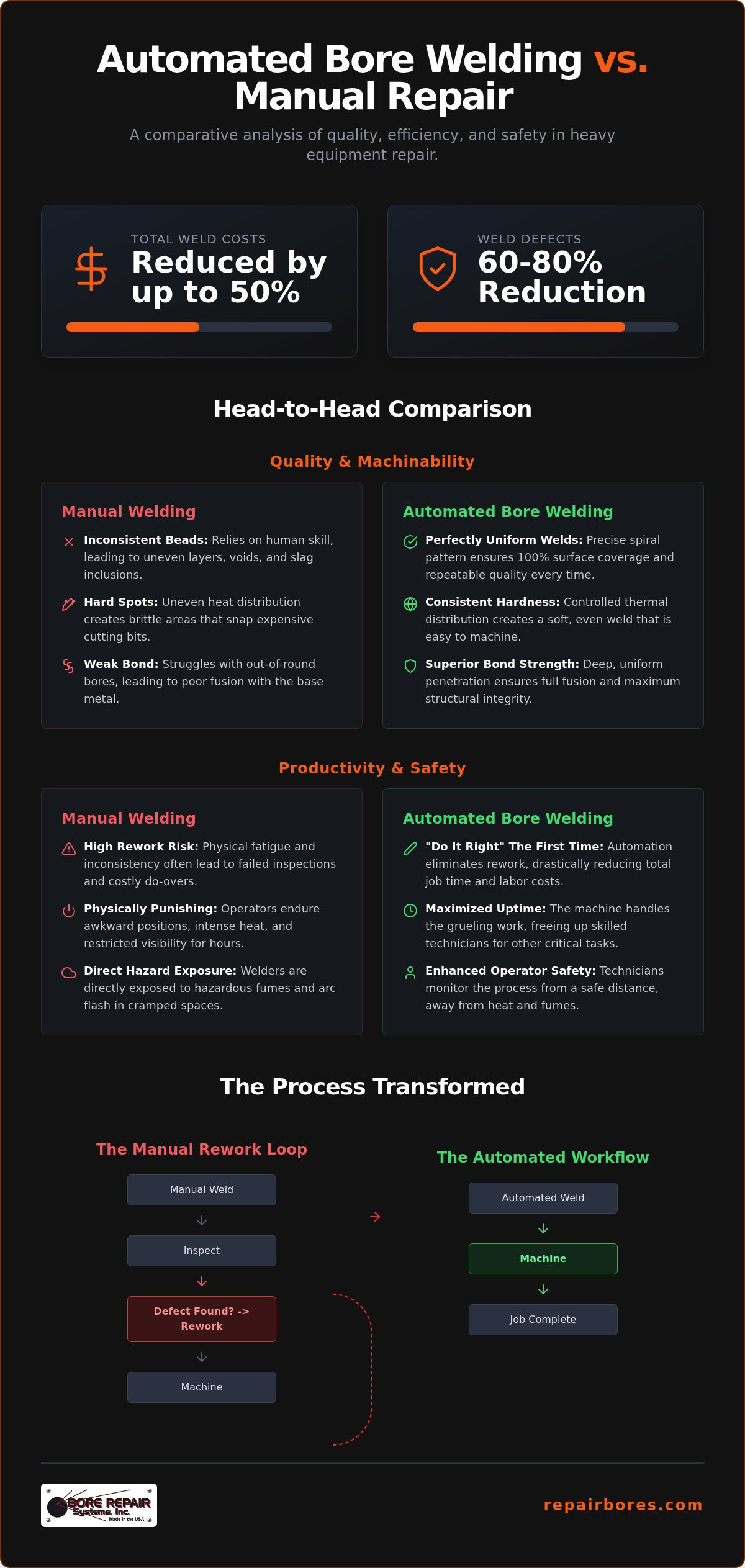
We understand that your goal is to get equipment back into the dirt as fast as possible. This guide will show you how automated bore welding delivers uniform beads that are significantly easier to machine while reducing total weld costs by up to 50 percent. You'll discover how to achieve a 60 to 80 percent reduction in weld defects and why moving away from manual methods is the smartest way to protect your personnel from repetitive strain and hazardous fumes. We'll compare the two methods across speed, quality, and long-term ROI to help you choose the right path for your fleet.
Table of Contents
The Evolution of Bore Repair: Manual vs. Automated Methods
For decades, the process of welding bores relied entirely on the steady hand of a master craftsman. This manual approach required incredible skill to lay uniform beads inside dark, cramped cylinders. Even the best welder faces physical limits that eventually impact the final product. When evaluating bore welding vs manual repair, it's clear that the industry is shifting toward automation to eliminate the variables of human fatigue and error. Modern repair shops can't afford the downtime associated with manual rework, especially as equipment sizes and project complexities increase.
Heavy equipment repair covers a vast range of scales. Whether you're fixing excavator pin holes or massive industrial pump housings, the requirement for precision remains the same. Portable automated systems have become the standard for shops that prioritize uptime and repeatable quality. These tools allow a technician to set the parameters and let the machine handle the grueling work of laying down metal, ensuring the repair is done correctly the first time.
The Challenges of Manual Bore Welding
Manual bore welding is physically punishing. A technician often has to maintain an awkward posture for hours while battling intense heat and restricted visibility inside a bore. These physical constraints lead to inconsistent bead overlap, which often creates voids or slag inclusions. When a manual weld fails a post-machining inspection, the cost of rework is staggering. You don't just lose the time spent welding; you lose the labor hours required to strip the setup, clean the bore, and start the entire process over again.
The Automated Alternative
Automated bore welders solve these issues by utilizing a precise spiral welding pattern. This mechanical consistency ensures 100 percent surface coverage without the "hot spots" common in manual work. Because the machine maintains a constant travel speed and arc length, weld penetration is deep and uniform across the entire surface. This results in a metallurgical consistency that makes the subsequent machining process much smoother and faster. Most modern systems are designed to integrate directly with your existing line boring mounts, allowing for a seamless transition from boring to welding and back again without losing your center.
Technical Comparison: Weld Quality and Machinability
The quality of your repair depends on the metallurgical bond between the new weld and the base metal. When comparing bore welding vs manual repair, the technical differences become obvious once the line boring tool touches the metal. Manual hand welding relies on the operator's ability to maintain a consistent arc gap and travel speed. This rarely happens perfectly. The result is a series of "hot spots" where excessive heat alters the grain structure of the steel, making it brittle and difficult to cut.
Automated systems utilize controlled thermal distribution. By maintaining a constant travel speed and wire feed rate, the machine prevents localized overheating. This creates a uniform weld bead with predictable hardness levels. Because the machine doesn't get tired or lose focus, it eliminates the air pockets and slag inclusions that plague hand-welded bores. Industry data shows that automated systems can lead to a 60 to 80 percent reduction in weld defects compared to manual processes. This precision also means you lay down less excess material, which significantly reduces the time spent on the subsequent machining phase.
The Machinability Factor
Machinability in bore restoration is the measure of how easily the deposited weld metal can be machined back to factory specifications without causing tool chatter or premature bit wear. Manual welds often cool unevenly, creating tool-shattering hard spots. These chilled areas act like rocks in a soft field; when your line boring bit hits one, it can chip or shatter instantly. Automated welding provides a soft, consistent foundation that allows for high-tolerance line boring without the risk of tool failure. If you want to see how this precision impacts your shop's bottom line, you can explore professional bore welding equipment designed for these exact tolerances.
Structural Integrity and Bond
Achieving full fusion to the base metal is critical for the structural integrity of the repair. When choosing between bore welding vs manual repair for structural components, the bond strength is non-negotiable. Manual welding often struggles with out-of-round bores where the distance between the gun and the wall changes constantly. An automated system compensates for these irregularities, ensuring deep penetration and a solid bond across the entire circumference. This is further enhanced by consistent shielding gas coverage. While a manual welder might struggle with gas drift in open environments, an automated torch maintains a steady envelope of protection. This prevents porosity and ensures the repair can withstand the extreme stresses of heavy industrial use.
Productivity and Safety in the Shop and Field
Productivity in heavy equipment repair isn't just about how fast the wire moves. It's about how long an operator can sustain peak performance without a drop in quality. When analyzing bore welding vs manual repair, the physical toll on the welder is often the most overlooked cost. Manual hand welding requires a technician to maintain a steady arc inside a dark, cramped housing for hours. This leads to physical exhaustion, which inevitably results in inconsistent beads and increased rework. Automation changes this dynamic by shifting the burden of precision from the human to the machine.
Safety is a critical driver in this shift. As of 2026, OSHA regulations (29 CFR 1910.252) continue to mandate strict controls for welding fumes and worker exposure. Automated systems allow the operator to stand back from the arc, significantly reducing their exposure to hazardous fumes, intense heat, and arc flash. Instead of being hunched over a smoking bore, the technician can monitor the process from a safe distance. This improved environment doesn't just meet compliance standards; it keeps your best people on the job longer and reduces the risk of repetitive stress injuries.
Reducing Human Error and Fatigue
Maintaining a steady arc in a 4-inch bore is a mechanical nightmare for a human. The tighter the space, the harder it is to maintain the correct torch angle and travel speed. Automation prevents the "Friday afternoon" drop in quality that occurs when fatigue sets in. Because the machine handles the repetitive motion, the technician is free to multi-task. While the bore welder is laying down a perfect spiral, the operator can prep the next bore or organize the line boring tools. This workflow turns a one-man job into a high-efficiency production line.
Field Repair Efficiency
In the field, downtime is measured in thousands of dollars per hour. Bringing shop-quality welds to a job site is the primary advantage of portable automated systems. Traditional manual field repairs are often compromised by harsh environments, wind, and awkward positioning. Modern automated mounting systems allow for rapid setup even in difficult terrain. You can achieve a 60 to 75 percent saving by performing on-site repairs rather than disassembling the machine for transport to a workshop. The reliability of an automated weld in the field ensures that once the equipment is back in service, the repair will hold up under the most demanding industrial conditions.
The ROI of Equipment Ownership: Cost-Benefit Analysis
Investing in automated equipment is a strategic move for any shop tired of the high costs and low predictability of manual labor. When you analyze bore welding vs manual repair from a strictly financial perspective, the numbers favor automation for almost any operation with a steady workload. According to industry data, automated welding can reduce total weld costs by 30 to 50 percent compared to manual processes. This is because you're paying for machine-driven consistency rather than the high-tier specialized labor required for out-of-position hand welding.
The return on investment for this equipment is surprisingly fast. Most shops see a full ROI within 6 to 24 months, depending on their specific part volume and local labor rates. Beyond the machine itself, you save money on consumables. Manual welding is inherently wasteful; operators often over-weld to ensure coverage, which burns through wire and gas unnecessarily. Automated precision ensures you use exactly what the job requires, no more and no less. This uniformity also extends the life of your line boring bits. By eliminating the hard spots discussed earlier, you reduce the frequency of bit replacements and avoid the cost of ruined cutters.
Calculating Labor Savings
A standard 4-inch bore repair that takes four hours of manual labor can often be completed in half that time using automation, including the setup. A 50 percent reduction in welding time effectively doubles your shop's throughput at that specific station, allowing you to clear backlogs and take on more profitable work. This efficiency eliminates the "waiting game" associated with third-party repair services. When you own the tools, you control the schedule. You can see the full range of bore welding systems that make this transition possible for your shop.
Equipment Longevity and Resale Value
Professional-grade bore welders are designed for the rigors of heavy industrial use. Unlike general shop supplies, these are high-value assets that maintain their resale price and provide decades of service. Owning this equipment allows you to implement proactive maintenance programs instead of waiting for a catastrophic failure. You can catch wear early and perform a quick build-up before a pin hole becomes a major structural issue. This capability gives you a massive competitive edge, as you can offer customers faster turnaround times and a higher standard of repair quality than shops still relying on hand-held torches.
Mastering the Transition: Training and Implementation
Transitioning to automated systems shouldn't be viewed as a daunting technical hurdle. While some industry forums label it a "dark art" that takes years to master, the reality is much simpler. Comparing bore welding vs manual repair shows that the real challenge isn't the machine; it's breaking the habit of relying on human instinct for precision. Logic and repeatable settings must replace the "feel" of a hand-held torch to ensure every repair meets factory specifications.
Expert welders already understand the arc, but they need a bridge to translate that knowledge into system parameters. Bore Repair Systems, Inc. provides the education required to turn a manual craftsman into a precision operator. Standardizing your workflow ensures that every repair is identical, regardless of which technician is on the clock. This standardized approach includes a rigorous cleaning phase, precise wear measurement, and a final machining pass that returns the bore to factory tolerances.
Ongoing support is the final piece of the puzzle. Technical education shouldn't end after the first week of equipment ownership. As your fleet evolves and your repair challenges change, you need a partner who understands the mechanical realities of the field. This long-term partnership ensures your team remains proficient and your equipment stays in peak operating condition for decades.
The Importance of Specialized Training
Specialized training covers the variables that a manual welder usually handles by instinct. You'll learn to master travel speeds, wire feed rates, and step-over distances. These settings determine the overlap and thickness of the weld bead. Professional training significantly reduces the initial learning curve, preventing common mistakes like poor penetration or bit chatter. Proper education also covers safety protocols for automated field machining, keeping your personnel away from direct heat and fumes while the machine is live.
Choosing Your System
Selecting the right system depends on your specific equipment fleet and typical bore sizes. A shop fixing small loader pins has different needs than a facility repairing large mining housings or industrial pump components. Look for American-made quality and direct manufacturer support to ensure your investment stays operational. If you're ready to modernize your workflow and eliminate the bottlenecks of hand welding, Contact Bore Repair Systems, Inc. to find the right equipment for your shop. Our team provides the specialized tools and training needed to ensure your transition to automation is a success.
Modernizing Your Bore Repair Workflow
Choosing between bore welding vs manual repair is a decision that impacts your shop's reputation and its bottom line. Automated systems remove the physical burden of out-of-position welding while delivering the metallurgical consistency required for high-tolerance machining. You've seen how these tools reduce rework and keep your operators safe from hazardous fumes and repetitive strain. By shifting to automation, you turn a grueling manual task into a repeatable, high-efficiency process.
Success in this field requires more than just a machine. It requires a partner who understands the mechanical realities of heavy equipment. Upgrade your shop with professional bore repair equipment and training to start seeing these results. We offer American-made precision equipment and specialized accessories for heavy-duty maintenance. Our expert-led training programs ensure your team can operate at peak performance from day one. It's time to stop fighting with inconsistent welds and start delivering factory-quality repairs every time.
Frequently Asked Questions
Is automated bore welding significantly faster than manual welding?
Yes, automated systems are much faster because they operate continuously without the frequent stops required for manual repositioning. While a technician must pause to rest or change angles, a machine maintains a constant arc for the entire duration of the repair. This eliminates the "stop-start" marks common in hand welding and can cut total arc time by up to 50 percent on deep or large-diameter bores.
Do I still need a line boring machine if I use an automated bore welder?
Yes, you still need a line boring machine to complete the repair. The bore welder's job is to deposit new metal to build up the worn surface, but it cannot achieve the precise tolerances required for pin fits. After the welding is finished, you use the line boring machine to cut the new material back to the exact factory diameter and finish.
Can an automated bore welder repair egg-shaped or badly worn holes?
Automated systems handle egg-shaped bores effectively by using a specific two-step process. You first perform a "cleanup" pass with your line boring bar to make the hole round again, even if it's oversized. The automated welder then applies a uniform layer of metal to that circular foundation, ensuring the final repair is structurally sound and perfectly centered.
What is the learning curve for operating an automated bore welding system?
Most experienced welders can master the system in just a few days of hands-on training. The challenge isn't learning how to weld, but rather learning how to set the machine's step-over and travel speed parameters. Professional training programs simplify this transition, allowing your team to move from bore welding vs manual repair workflows with minimal downtime or frustration.
Does automated welding work on all types of heavy equipment metals?
Automated bore welders work on most common industrial metals, including carbon steel and various high-strength alloys. Since the process is essentially an automated MIG system, it's compatible with any material you can weld with a standard wire feeder. Using the correct wire and shielding gas ensures the new weld metal matches the metallurgical properties of the base equipment.
Is it better to hire a mobile service or buy my own bore repair equipment?
Buying your own equipment is almost always the better long-term investment for shops that perform more than a few repairs per year. Owning the tools allows you to keep the profit in-house and eliminates the high travel fees and scheduling delays associated with third-party services. It also gives you total control over the quality and speed of your maintenance program.
How does automated welding improve the life of my machining tools?
Automated welding creates a bead with uniform hardness, which is much easier on carbide cutting bits. Manual welds often have localized "chilled" spots or slag inclusions that can chip or dull a line boring tool instantly. By providing a consistent, soft foundation for the boring bar, automation extends the life of your consumables and prevents expensive tool failure.
Can I use my existing wire feeder with a new bore welding system?
Most professional bore welders are designed to interface directly with standard Constant Voltage (CV) power sources and wire feeders already found in most shops. This makes the transition to automation more affordable since you don't always need to purchase a new power supply. You simply connect the bore welder to your existing setup to start producing high-quality, repeatable repairs.

Comments