

The Core Benefits of Automated Bore Welding for Heavy Equipment Repair
- slinger6
- 20 hours ago
- 12 min read
How much revenue did your operation lose the last time a machine sat idle for three days because of a botched manual weld? You already know that manual welding is physically punishing work. Even the most skilled technician eventually hits a wall of fatigue that leads to inconsistent beads and out-of-round bores. When you're dealing with critical heavy equipment, these small errors lead to expensive rework and extended downtime. Mastering the automated bore welding benefits is the most direct way to reclaim your schedule and ensure every repair meets exact factory tolerances.
We understand that your priority is getting machines back into the dirt as fast as possible without sacrificing mechanical integrity. This article explores how automated systems eliminate human error and slash repair times by providing a steady, tireless arc. You'll learn how these tools provide a professional-grade finish, reduce your long-term maintenance costs, and keep your crew safe from the physical strain of manual bore repair. It is time to stop fighting your equipment and start using tools designed for precision.
Table of Contents
What is Automated Bore Welding and How Does it Work?
Automated bore welding is a specialized repair method where a machine-controlled torch applies a continuous spiral weld bead inside a worn cylindrical opening. This process represents a major evolution from traditional manual Welding techniques. By automating the torch movement, you achieve a level of consistency that a hand-held torch simply cannot match. It’s about precision. The machine doesn't get distracted, and it doesn't lose its steady hand halfway through a pass.
To get the job done, you generally need three core components: the bore welder itself, a compatible power supply, and specialized mounting hardware. In the past, technicians relied on "pad welding." This involved applying manual beads in a longitudinal or haphazard pattern. It often resulted in uneven buildup and excessive machining time later. Modern automated systems shift the focus to a spiral overlay. This technology is now essential for restoring pin holes, pivot points, and articulating housings to their original dimensions. One of the primary automated bore welding benefits is this shift from guesswork to repeatable, mechanical accuracy.
The Mechanics of the Spiral Weld
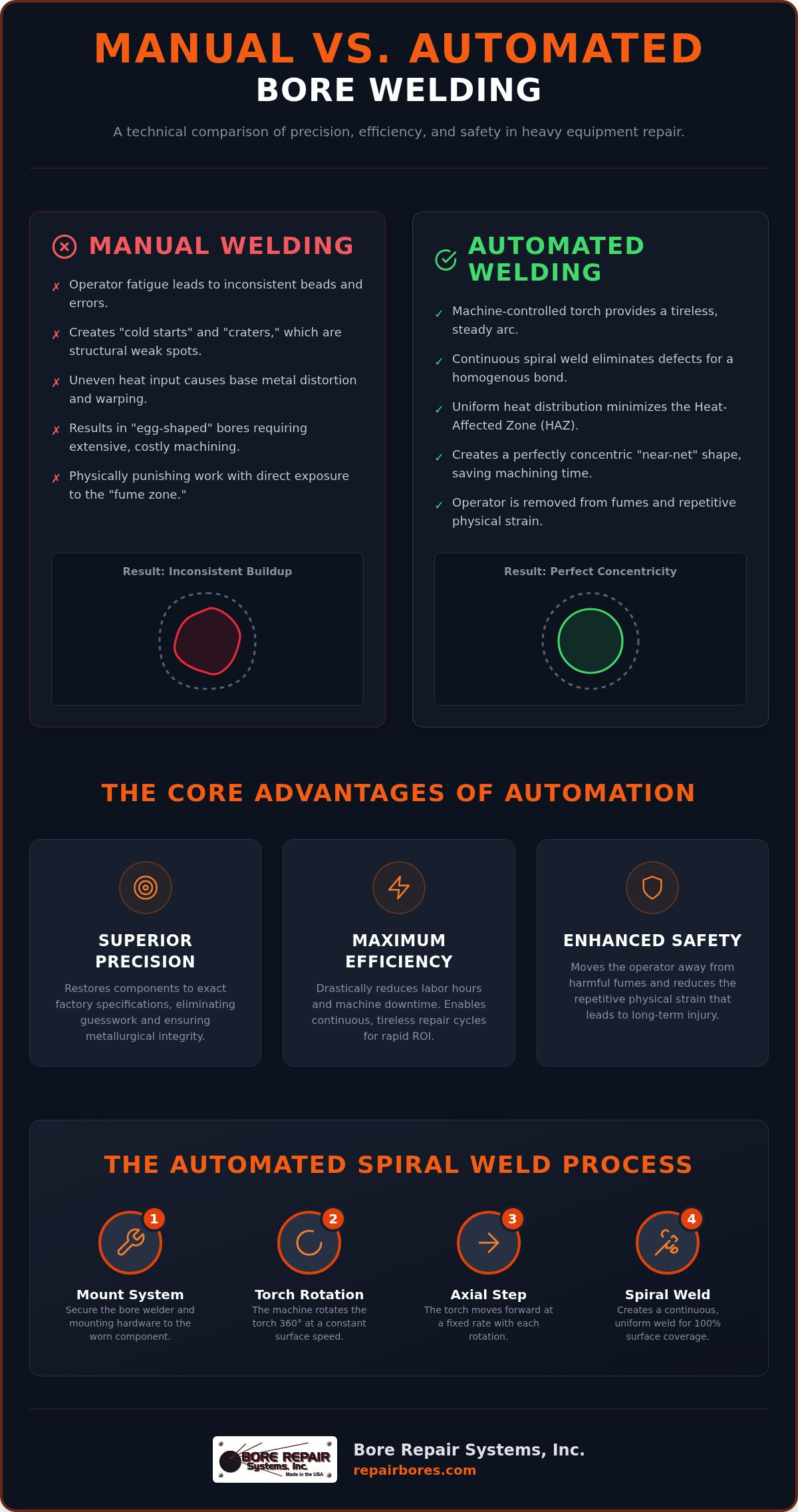
The brilliance of this technology lies in its "step" function. As the torch rotates, the machine moves it forward at a fixed axial rate. This ensures 100% surface coverage without gaps or overlaps. The welder maintains a constant surface speed, which is nearly impossible to do manually inside a small, dark bore. Mechanical consistency beats the human hand every time in these tight industrial spaces. You get a uniform layer of metal that requires far less machining to reach factory specs. This reliability is another one of the automated bore welding benefits that keeps your shop profitable.
Portable vs. Stationary Systems
Modern advancements have moved this technology out of the factory and into the field. Portable units allow you to bring the repair capability directly to the machine. You don't have to strip down a massive excavator and transport the mainframe to a central facility. These systems are designed for high compatibility; they integrate easily with standard MIG power sources. This makes them a practical addition to any service truck or maintenance shop. By repairing the component in place, you slash transportation costs and get the equipment back into the dirt faster. It’s a straightforward solution for a complex mechanical problem.
Superior Precision and Metallurgical Integrity
Manual welding relies on the operator's ability to maintain a steady hand for hours. It’s an impossible standard to meet consistently. Stop-start welding creates "cold starts" where the weld fails to fuse properly to the base metal. It also leaves "craters" at every termination point. These are structural weak spots that can lead to premature failure. One of the key automated bore welding benefits is the elimination of these defects through a continuous, uninterrupted arc. You get a single, homogenous layer of metal that bonds perfectly to the parent material.
Distortion is the enemy of any machinist. When heat input fluctuates, the base metal expands and contracts unevenly. Automated systems maintain a precise travel speed and voltage. This creates a predictable Heat-Affected Zone (HAZ). By distributing heat uniformly around the circumference of the bore, you minimize the risk of warping the entire housing. This level of control ensures the component retains its structural integrity. You don't have to worry about the metallurgical surprises that often hide beneath a manual weld bead.
Maintaining Geometric Concentricity
Manual "pad welding" often results in an "egg-shaped" bore. The buildup is thicker in some areas and thinner in others. This makes the subsequent machining process a nightmare. An automated system applies a perfectly centered weld overlay. This creates a "near-net" shape that closely follows the original bore geometry. Because the overlay is concentric, you remove less material during the final cut. This saves your cutting tools and significantly reduces your overall shop time. It turns a complex machining task into a straightforward cleanup operation. If you want to see the equipment that makes this possible, you can browse our professional bore welders and accessories.
Metallurgical Benefits of Continuous Arc Time
The quality of the metal itself improves with automation. In a manual setup, gas coverage can be inconsistent as the welder adjusts their position. Automated torches provide steady shielding gas and wire feed for the entire 360-degree rotation. This stable environment drastically reduces porosity and slag inclusions. You aren't just filling a hole; you're restoring the component with high-quality, dense weld metal. The bond between the overlay and the parent material is stronger because the arc remains stable. The result is a repair that often exceeds the durability of the original factory part. This consistency is why automation has become the industry standard for high-stakes heavy equipment repair.
Maximizing Operational Efficiency and ROI
Efficiency in heavy equipment repair isn't a luxury. It's a survival tactic. When a machine is down, you're losing money every hour it sits idle. Manual welding is inherently slow and prone to constant interruptions. A technician needs to stop, reposition, clean slag, and rest. These breaks kill your productivity. One of the most significant automated bore welding benefits is the dramatic reduction in total labor hours. By removing the human factor from the actual welding motion, you can achieve a 60% to 80% reduction in direct labor costs per part.
The machine doesn't suffer from physical fatigue. It can run continuous repair cycles through multiple shifts if necessary. This reliability allows you to predict your turnaround times with pinpoint accuracy. You're also saving money on consumables. Manual welders often over-weld or create waste through excessive grinding and wire clipping. Automated systems optimize wire and gas usage, ensuring you only use what the job requires. Every inch of wire ends up in the bore, not on the shop floor. This lean approach to materials adds up to substantial savings over a year of heavy maintenance.
The 'One-Pass' Advantage
In many cases, an automated system completes a repair in a single setup. You don't have to stop to chip slag or grind out inclusions between every bead. This continuity maximizes your productivity. Arc-on time is the primary driver of repair speed. By keeping the torch lit and moving, you move through the project without the traditional stop-start delays of hand-welding. It turns a multi-day repair into a single-shift task. You eliminate the need for multiple cleaning and grinding sessions that usually plague manual repairs. The machine simply stays in the cut until the job is done.
Lowering Total Cost of Ownership
Investing in your own equipment changes the financial math of your maintenance department. Relying on outside service contractors is expensive and leaves you at the mercy of their schedule. Most well-integrated automated systems offer a payback period between 12 and 24 months. You're also extending the life of expensive castings and frames. A repeatable, high-quality repair prevents the need for total component replacement. You aren't just fixing a hole; you're protecting a six-figure asset from catastrophic failure. This long-term value is a core component of the automated bore welding benefits that fleet managers prioritize. It's about keeping your iron in the dirt and your costs under control.
Enhanced Safety and Ergonomics in the Field
Manual bore repair is one of the most physically demanding tasks in any industrial maintenance shop. It requires technicians to work in cramped, poorly ventilated areas for hours at a time. The physical toll on a welder's body is significant and often leads to long-term health issues. By transitioning to machine-controlled systems, you address these risks head-on. One of the primary automated bore welding benefits is the immediate improvement in workplace safety and operator ergonomics. The machine takes the brunt of the heat and the physical strain, allowing your skilled labor to focus on precision setup rather than physical endurance.
The safety advantages extend beyond just physical comfort. When a technician is forced into a confined space to hand-weld a bore, they are exposed to high heat and potential burns from spatter in tight quarters. Automation removes the human element from the immediate hazard zone. The operator can monitor the arc from a safe distance, making adjustments to the control box rather than wrestling with a torch in a dangerous position. This creates a more controlled environment where the risk of acute accidents is drastically lowered.
Fume Management and Respiratory Health
Welding inside a deep bore creates a concentrated plume of smoke and metallic dust that lingers in the air. In manual operations, the welder's head is often positioned directly above or inside the opening to maintain visibility. This puts them right in the "fume zone." Automation completely changes this hazardous dynamic. Because the machine handles the torch rotation and axial movement, the operator can monitor the process from a safe distance. This distance allows for:
Natural dispersion of welding gases away from the operator's breathing zone.
Better positioning of localized ventilation and fume extraction units.
Significant reduction in the inhalation of hazardous particulates.
Protecting your team from chronic respiratory issues isn't just a compliance requirement. It is a smart business move that preserves your most valuable assets. When your crew stays healthy, your operation stays on schedule.
Ergonomics in Challenging Orientations
Imagine the difficulty of hand-welding a 12-inch bore while lying on your back under a 50-ton excavator. Maintaining a steady arc in a vertical or overhead orientation is physically exhausting. Gravity constantly pulls at the weld puddle and the technician's arm. Human fatigue eventually leads to the "shaky hand" factor, which results in poor fusion and expensive rework. An automated bore welder removes this variable. The machine maintains a consistent travel speed and wire position regardless of the orientation. It eliminates the risk of repetitive motion injuries and the acute strain associated with holding awkward positions for extended periods.
Safety shouldn't be an afterthought in your repair process. You can protect your crew and improve your shop's efficiency by choosing tools designed for the reality of the field. If you are ready to upgrade your safety standards and reduce operator fatigue, you can buy professional bore welders and training packages to modernize your workflow. Realizing these automated bore welding benefits means fewer injury claims and a more reliable workforce. It turns a dangerous, grueling task into a controlled, professional procedure.
Implementing Automated Bore Welding in Your Shop
Selecting the right equipment starts with an honest look at your most common repair diameters. You don't need a massive system if you're primarily fixing small pivot points on compact loaders. Conversely, undersized equipment will struggle with the heavy housing repairs found in mining or large scale construction. Understanding the full range of automated bore welding benefits requires more than just buying a machine; it requires a strategy for implementation. Your bore welder should work seamlessly with your existing line boring machines to ensure the entire repair process is streamlined. At Bore Repair Systems, Inc., we help you navigate these choices by providing American-made tools designed for the heavy-duty maintenance world.
The Importance of Professional Training
Automation is a tool, not a replacement for skill. Even a veteran welder with thirty years of experience needs a curriculum-based approach when moving to automated systems. It isn't just about pulling a trigger and watching the machine work. You must master the setup, centering, and parameter adjustments for different base materials. Our training programs focus on the technical nuances that ensure a professional result every time. We cover everything from the initial mount to the final safety protocols. This knowledge is what truly unlocks the automated bore welding benefits you're looking for. Without proper instruction, you're just guessing with expensive equipment.
Selecting Accessories for Versatility
A versatile shop needs the right bore repair accessories to handle a wide range of work. Small-diameter work requires different torch extensions and mounting hardware than a large-diameter project. Investing in high-performance, American-made bore welders ensures you have the durability needed for grueling field repairs. These systems are built to withstand the grit of a job site while maintaining the precision of a machine shop. By choosing the right setup and accessories, you ensure your team can handle any repair that comes through the door. Don't let a lack of the right hardware slow down your turnaround times. Explore our professional bore welding systems and training programs to see how we can modernize your maintenance workflow.
Modernize Your Maintenance Workflow
Transitioning to machine-controlled repairs is a strategic shift in how you maintain your fleet. You've seen how precise spiral overlays eliminate the metallurgical defects of manual welding while keeping your technicians out of the hazard zone. These automated bore welding benefits translate directly to your bottom line through a proven reduction in equipment downtime and lower long-term labor costs. It's about working smarter, not harder.
By prioritizing American-engineered durability and industry-leading training services, you ensure that every repair meets factory specs without the physical toll of hand-welding. Our systems are built for the reality of the field; they provide the reliability you need to stay on schedule. Don't let outdated manual methods bottleneck your productivity. It's time to equip your shop with the tools that match the scale of your work. View Our Professional Bore Welding Systems and Equipment to start your transition today. Your crew and your balance sheet will thank you.
Frequently Asked Questions
What is the difference between manual and automated bore welding?
Automated welding uses a machine to drive the torch in a precise, continuous spiral. Manual welding relies on a technician applying individual beads, often called pad welding. The machine eliminates stop-start defects like cold starts and craters that plague hand-welding. By using a machine, you get a uniform layer of metal that requires far less machining to reach factory specifications. It’s about mechanical consistency versus human variability.
Can automated bore welders be used in the field?
Yes, portable bore welders are designed specifically for field use. You don't have to transport heavy frames or castings to a repair facility; you bring the tool to the equipment. These units are compact and integrate with standard MIG power sources found on most service trucks. This capability is a core part of the automated bore welding benefits that keep large fleets operational in remote locations.
How much time can I save by using an automated bore welder?
You can reduce direct labor costs per part by 60% to 80% compared to manual methods. Because the machine doesn't suffer from fatigue, it maintains a continuous arc without the need for frequent breaks. You also save time on cleanup because the near-net shape of the weld requires fewer machining passes. Realizing these automated bore welding benefits turns a multi-day repair into a single-shift task.
Do I need special training to operate an automated bore welder?
Professional training is essential for maximizing your equipment ROI. Even experienced welders need to learn the specific nuances of machine setup, centering, and parameter adjustment. A curriculum-based approach ensures your team follows correct safety protocols and achieves a professional-grade finish on every repair. We provide specialized training programs to help operators transition from manual techniques to precise automated workflows without the guesswork.
Is automated bore welding stronger than hand welding?
The strength comes from the superior metallurgical integrity of a continuous bead. Manual welding often introduces structural weak spots like porosity or slag inclusions during stop-start cycles. Automated systems provide consistent gas shielding and wire feed for the entire 360-degree rotation. This results in a dense, homogenous weld that often exceeds the durability of the original factory component. It creates a more reliable bond to the parent metal.
What types of heavy equipment can be repaired with these systems?
These systems repair a wide range of machinery, including excavators, wheel loaders, dozers, and mining trucks. Any component with a worn pin hole, pivot point, or articulating housing is a candidate for this process. From small construction equipment to massive industrial frames, automated welding restores critical bores to their original dimensions. It is the standard solution for maintaining structural integrity in high-stress mechanical joints.
Can an automated bore welder work in vertical or overhead positions?
Yes, automated bore welders handle vertical and overhead orientations with mechanical precision. Gravity makes manual welding in these positions extremely difficult, often leading to an uneven weld puddle. The machine maintains a constant axial movement and travel speed, ensuring the bead remains uniform regardless of the bore’s position. This capability allows you to perform complex repairs in place without flipping or repositioning heavy machine components.
Does automated welding work on all types of metal bores?
Automated welding works on most weldable metals used in heavy equipment fabrication. While carbon steel is the most common, the process is adaptable to various alloys by adjusting the wire type, gas mixture, and machine parameters. It’s important to match the weld material to the parent metal to ensure a proper bond. Using the right accessories and training allows your shop to handle diverse repair requirements with a single system.