

American-Made Line Boring Machine: How to Evaluate Your Options

An American-made claim is useful only when you can verify what it means and confirm that the machine can handle your repair work. The FTC’s standard for an unqualified “Made in USA” claim is “all or virtually all” made in the United States, so final assembly alone may not tell the whole story. And even a well-supported origin claim won’t confirm that a machine suits the bores you need to repair.
Choosing an American made line boring machine means weighing both questions: where the equipment and key components are made, and whether its capabilities match your jobs. Before investing, ask for clear answers about the machine, training, and technical information available after purchase.
This guide explains how to assess manufacturing claims, compare machine capability with your typical repair work, and evaluate training and support. It also outlines practical questions to prepare before contacting a manufacturer, including what to ask about component origin, machine specifications, accessories, and operator training. That preparation helps you compare options consistently and make a more informed choice.
Table of Contents
Why an American-Made Line Boring Machine Needs More Than an Origin Claim
A manufacturer’s American identity and a machine’s country of origin are related, but they aren’t the same thing. A company may manufacture equipment in the United States while sourcing some components elsewhere. Manufacturing steps and component origins can also vary by machine or configuration. Before treating an American-made claim as a buying criterion, identify the specific machine it covers and what the claim describes.
Origin can matter for practical reasons. Buyers may want clear communication with the manufacturer, access to equipment training, or better visibility into parts information. Those are reasonable priorities, but don’t assume they’re guaranteed by a domestic origin claim. Ask the supplier to explain its processes, training options, and available parts information for the equipment you’re considering.
What does American-made mean when buying industrial equipment?
Ask which manufacturing steps take place in the United States, where the machine is finally assembled, and whether key components come from other countries. Request the answer in writing for the exact model and configuration rather than relying on a broad company description. If you need to assess whether a particular origin label meets applicable requirements, verify those requirements with an appropriate authoritative source.
A company’s stated identity can be a useful starting point, but it isn’t product-specific proof. Bore Repair Systems, Inc. is an American manufacturer that sells line boring machines and related training. Buyers should still confirm the origin and manufacturing details of the specific machine they’re evaluating. The company also maintains a line boring and bore welding Instagram page.
Why origin is only one part of a sound equipment decision
Start with the repair work. Consider the types of bores you need to machine, how often the jobs arise, the workpiece and setup conditions, and the experience of the operators who will run the equipment. A machine’s purpose is to perform a machining operation: the Boring (manufacturing) overview explains the basic process of enlarging or refining an existing hole. Your specific application determines the capabilities and setup you need.
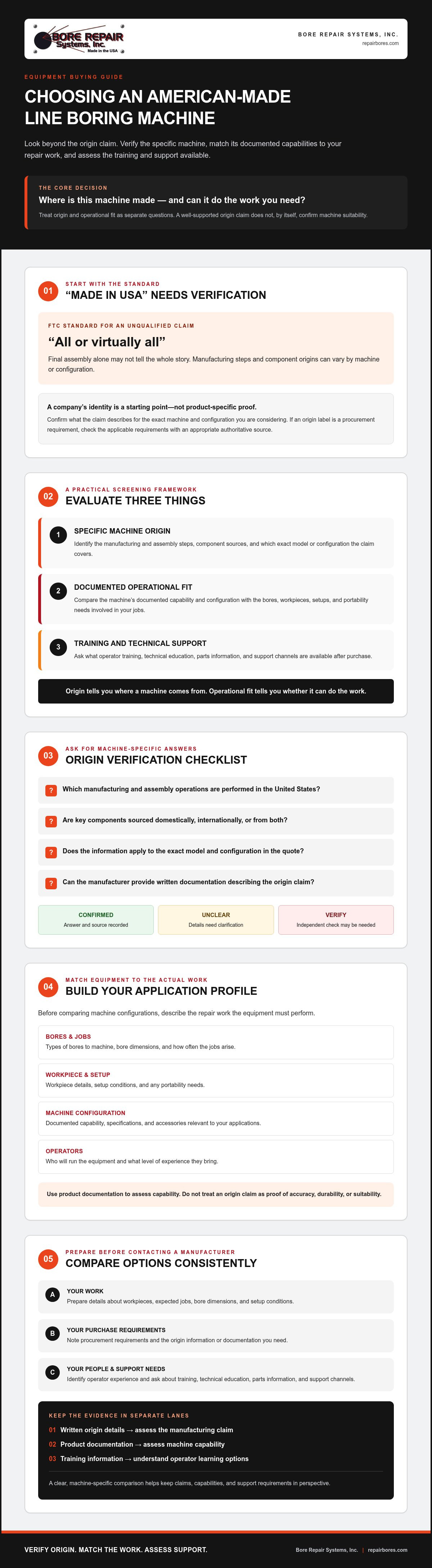
Keep evidence separate from assumptions. Written origin details help you assess manufacturing claims. Product documentation helps you assess machine capability. Training information helps you understand how operators can learn to use the equipment. None of these alone proves accuracy, durability, or suitability. Evaluate each against your requirements and the manufacturer’s documentation.
Origin tells you where a machine comes from; operational fit tells you whether it can do the work. Use a three-part screen before comparing options: verify the specific machine’s origin, match its documented capability to your applications, and assess the training and technical support available. This keeps a country-of-origin claim in perspective and gives your supplier conversation a practical starting point.
How to Verify an American-Made Line Boring Machine Claim
Use a repeatable check, not a slogan. A company may be American-owned or based in the United States without every machine it sells having the same manufacturing origin. Verify the claim against the exact machine and configuration you’re considering.
Questions to ask about the machine’s manufacturing origin
Ask the manufacturer to explain which steps happen in the United States and which components or processes may come from elsewhere. Make sure the response applies to the specific model and configuration, not just the company’s product line. If domestic origin is a procurement requirement, request a written, product-specific statement and any supporting documentation the manufacturer can share.
Which manufacturing and assembly operations are performed in the United States?
Are key components sourced domestically, internationally, or from both?
Does this information apply to the exact model and configuration in the quote?
Can you provide written documentation describing the origin claim?
Record each answer and its source. Mark details as confirmed, unclear, or requiring independent verification. If your purchasing decision depends on a particular origin label, review the Federal Trade Commission’s Complying with the Made in USA Standard guidance, and seek appropriate advice if you need to determine how requirements apply to your purchase.
How to evaluate origin statements without overreading them
Keep four details separate: where the company is headquartered, where manufacturing operations occur, where final assembly takes place, and where components are sourced. These facts describe different parts of the supply chain. A U.S. address or an “American manufacturer” description doesn’t, by itself, establish the origin of every machine or component.
Patents don’t prove where a product is made, either. They relate to intellectual property, not the manufacturing location of a specific machine. Treat brand identity, marketing language, and general company descriptions as prompts for questions, not as product-level evidence. Don’t repeat an origin statement as confirmed until you’ve verified what it covers.
Bore Repair Systems, Inc. describes itself as an American manufacturer and offers line boring machines. That company-level information is a starting point, not confirmation that every machine or component has the same origin. Review the line boring machine product catalog, then ask for origin details about the specific equipment that fits your application.
Bring your model questions and any procurement requirements to the manufacturer. A focused product-origin inquiry can help clarify what’s documented and what still needs checking before you compare options.
Compare Line Boring Machine Capability Against Your Repair Work
An American made line boring machine still has to suit the job in front of you. Start with the components you repair and the conditions technicians face, then compare those requirements with the manufacturer’s documentation. Don’t assume a machine fits because its origin or brand is appealing.
Match the machine to the bores and components you repair
Before contacting manufacturers, record the dimensions and repair conditions you encounter. Include bore dimensions, workpiece geometry, access limitations, alignment needs, and whether the job takes place in a shop or another work setting. Use this list to ask which machine configurations support your intended applications. For tooling and setup questions, review the manufacturer’s line boring machines and accessories.
Verify required capacity against the intended workpiece rather than inferring it from a machine’s general description. Confirm operating limits and compatibility in the documentation for the exact machine and configuration. If a requirement isn’t clear, ask the manufacturer to explain it before comparing options.
Assess portability, setup, and operator requirements
Shop-based work and field use can place different demands on equipment. Consider available workspace, how the machine and accessories will be transported, and the steps required to prepare each job. Ask the manufacturer to describe setup requirements for the configuration you’re evaluating rather than assuming all portable machines work the same way.
Include operator capability in the comparison. A technically suitable machine still needs to be set up and operated correctly, so ask what training or technical education is available and what operators should know beforehand. Also consider routine care: review the manufacturer’s instructions for cleaning, inspection, storage, and maintenance, and clarify what documentation comes with the equipment.
Domestic sourcing and industry context may help explain a manufacturer’s broader operations. The National Association of Manufacturers provides information about U.S. manufacturing, but that context doesn’t establish an individual machine’s capabilities. Keep the decision grounded in your workpiece measurements, documented operating limits, setup conditions, and operator requirements.
Compare Domestic Sourcing, Training, and Technical Support Before Buying
An American made line boring machine is only part of the purchase decision. Your operators also need clear instruction, useful equipment documentation, and a defined way to raise technical questions. Compare these details alongside origin and machine capability. Ask each manufacturer what’s included with the equipment and what requires a separate arrangement, then record the answers so you can compare suppliers on the same basis.
What to ask about operator training and technical help
Training should relate to the equipment your team will operate and the repair processes you plan to perform. Ask what topics are covered, who the instruction is designed for, what formats are available, and whether separate costs or scheduling requirements apply. Bore Repair Systems, Inc. offers line boring and bore repair training. Confirm current formats and terms directly before making plans.
Clarify what happens after initial instruction. Ask how operators can access technical guidance, what information they should have ready when requesting help, and whether support is included or arranged separately. Also request relevant operating and maintenance documentation, along with information about parts identification and ordering. Clear answers help your team plan for ownership without assuming a particular level of ongoing support.
How domestic sourcing may fit a company’s procurement priorities
Domestic sourcing may matter to your procurement process, but evaluate it against your organization’s actual requirements. Check product-specific origin information, the format and detail of available documentation, communication expectations, and any purchasing procedures your organization must follow. Don’t assume a U.S. manufacturer means faster delivery, local service, or easier access to parts. Confirm those details for the machine and parts you’re considering.
Use a consistent comparison sheet for each supplier. Include training scope, access to technical education, parts information, communication channels, and what is included in the purchase. Mark unconfirmed answers for follow-up. If you review customer feedback, check that it describes a relevant machine or training experience and provides enough context to be useful. A general positive review isn’t proof that a particular configuration or support arrangement will suit your team.
Prepare your machine model or configuration, repair applications, operator experience, and questions about training and parts before reaching out. Bore Repair Systems, Inc. sells line boring machines and related training, so you can ask about machine fit and training directly. Confirm the details that matter to your purchase rather than relying on assumptions.
Choose an American-Made Line Boring Machine with a Clear Next Step
Make the decision with a short list of evidence, not assumptions. An American made line boring machine should meet your repair requirements, and its origin claim should be clear for the specific equipment you’re considering. Before comparing quotes or configurations, gather the details a manufacturer needs to give useful answers.
Prepare for a productive manufacturer conversation
Bring measurements and examples from representative jobs. Note bore dimensions, component details, access constraints, alignment requirements, and the repair processes your team expects to perform. Include how often this work comes up and where the equipment will be used. Be ready to describe operator experience and any procurement requirements, such as product-specific manufacturing documentation.
Identify what you’re evaluating: line boring equipment, bore welding equipment, accessories, training, or a combination. Then ask which configuration addresses your applications and request documentation for its operating limits. Keep a checklist as you compare options:
Origin: What product-specific information documents the machine’s manufacturing and component origins?
Job fit: Does the documented capability match your workpiece dimensions and repair requirements?
Configuration: Which machine setup and accessories are needed for your intended jobs?
Training: What instruction is available for the equipment and repair processes your operators will perform?
Support: How can you access technical guidance, parts information, and relevant operating documentation?
Ask the manufacturer to distinguish confirmed details from anything that still needs verification. This makes it easier to compare answers consistently and flag unanswered questions before making a purchase decision.
When to request product guidance
Contact a manufacturer if your application falls near a stated operating limit, the suitable configuration isn’t clear, or origin documentation doesn’t answer your procurement questions. Equipment videos can help you understand machine setups and processes, but they aren’t proof of origin or a substitute for confirming performance against product documentation. Use videos as a visual reference, then verify details directly.
Bore Repair Systems sells line boring machines, bore welders, accessories, and related training. Share your workpiece details, expected jobs, operator experience, and questions about origin, configuration, training, and support. For product-specific guidance, contact Bore Repair Systems about your equipment requirements.
Make Your Next Machine Decision with Confidence
The right American made line boring machine is more than a country-of-origin claim. Verify manufacturing details for the specific equipment, confirm its documented capabilities against your repair work, and compare the training and technical support available. Bring your workpiece measurements, expected applications, operator experience, and procurement requirements to the manufacturer so you can get answers that fit your needs.
Bore Repair Systems sells line boring machines, bore welders, and bore repair accessories, and offers line boring and bore welding training. Confirm current training formats and terms, along with product-specific origin and configuration details, before making a decision.
Have questions about machine fit or origin documentation? Discuss your line boring machine requirements with Bore Repair Systems. A clear set of questions is a practical first step toward equipment that suits your work.
Frequently Asked Questions
What is an American-made line boring machine?
An American-made line boring machine is equipment whose manufacturing origin is represented as being in the United States. The phrase alone doesn’t explain where each manufacturing step occurs or where components are sourced. A manufacturer’s American identity also doesn’t establish the origin of every machine it sells. Ask about the specific model and configuration, and get product-specific details before relying on an origin claim for purchasing decisions.
How can I verify whether a line boring machine is made in the USA?
Ask the manufacturer for a written explanation of where the specific machine is manufactured and assembled, which operations occur in the United States, and whether components are sourced domestically or internationally. Check that the information applies to the exact model and configuration you’re considering. A U.S. business address, brand identity, or patent isn’t proof of product origin. If the wording matters for procurement, consult the FTC’s Made in USA guidance.
Does buying an American-made line boring machine guarantee better quality?
No. Country of origin alone doesn’t establish a machine’s accuracy, durability, or suitability for your repair work. Evaluate product documentation, operating limits, configuration options, and the manufacturer’s information about training and technical support. Ask how the equipment matches your intended applications, and confirm claims against written materials. A well-documented origin may matter to your sourcing priorities, but it shouldn’t replace a technical assessment of the machine.
What should I compare when choosing a line boring machine?
Compare the machine’s documented capabilities with your typical work. Consider bore and component dimensions, access and alignment requirements, setup conditions, portability needs, and operator experience. Check what configuration and accessories are needed for your applications. Ask about training, technical guidance, parts information, and what is included in the purchase. Confirm all operating limits in the manufacturer’s documentation for the exact machine and configuration, rather than relying on general descriptions.
Can one line boring machine handle different repair applications?
Possibly, but it depends on the machine’s documented capacity, configuration, tooling, and the requirements of each job. Don’t assume one setup will suit every component or bore. List the dimensions, access constraints, alignment needs, and repair types you expect, then ask the manufacturer which configurations support those scenarios. Verify compatibility and operating limits against the documentation for the exact setup before deciding that a machine can cover multiple applications.
Does Bore Repair Systems provide line boring machine training?
Yes. Bore Repair Systems offers line boring and bore welding training, along with training for equipment bore repair. Ask the company to confirm current training formats, terms, and the topics covered for the equipment you’re considering. Check that the instruction matches your operators’ experience and intended repair work. Training details can vary, so confirm them directly rather than assuming a particular format or arrangement is included with a machine purchase.
What information should I have before contacting a line boring machine manufacturer?
Prepare representative bore measurements, component details, access and alignment constraints, and examples of the repair work you expect to perform. Note whether you’re evaluating line boring equipment, bore welding equipment, accessories, or training. Include operator experience and any procurement requirements, such as written origin information. With those details ready, you can ask focused questions about machine configuration, documented operating limits, training options, parts information, and technical guidance.


Comments